


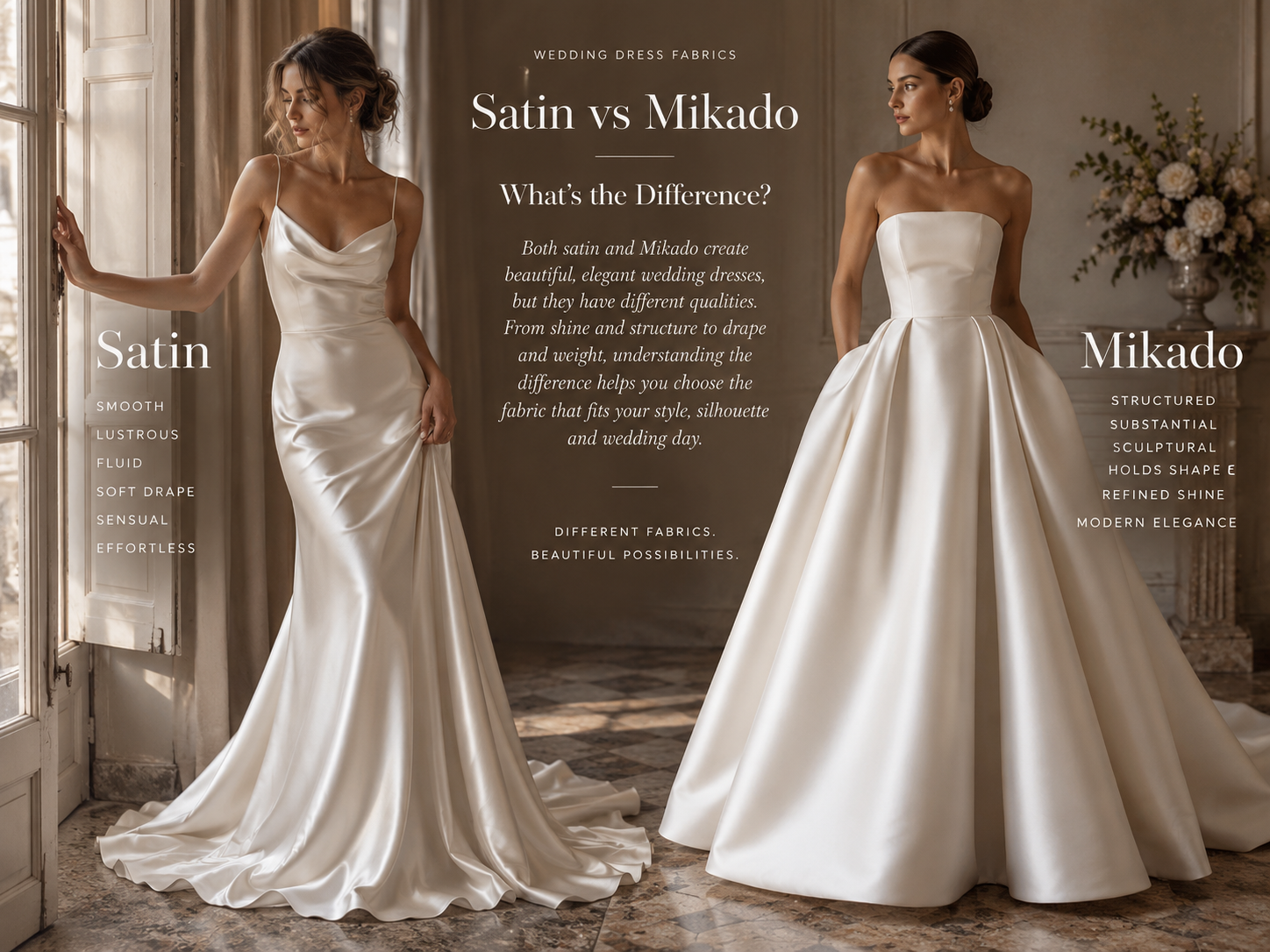
Satin and Mikado are two of the most popular fabrics for sleek, structured wedding dresses. Both can create beautifully clean silhouettes, both have a smooth surface, and both are frequently used for gowns with little or no lace or embellishment.
But satin and Mikado are not the same fabric — and they do not behave the same way on a wedding dress.
Satin is defined primarily by its weave and is known for its smooth surface and characteristic sheen. Mikado is a substantial fabric traditionally associated with silk and prized in bridalwear for its structure, body and sculptural quality.
If you are deciding between a satin vs Mikado wedding dress, the biggest differences are usually structure, weight, shine, drape and the type of silhouette each fabric can create.
Satin vs Mikado Wedding Dresses: The Quick Difference
In simple terms:
- Satin: smooth, lustrous and available in many different weights and levels of drape.
- Mikado: generally heavier, more structured and particularly good at holding architectural shapes.
That is the useful shorthand. The reality is slightly more complicated because neither name tells you everything about the exact fabric in front of you.
What Is Satin?
Satin is technically a type of weave rather than one specific fibre.
Its construction creates a characteristically smooth face that reflects light, producing the sheen associated with satin.
Satin can be made from silk as well as manufactured fibres such as polyester and other fibre blends.
This is why two dresses described as “satin” can look, feel and cost very different amounts.
Is Satin Always Shiny?
Satin normally has some degree of lustre, but that does not mean every satin wedding dress is dramatically glossy.
Some satins have a rich, luminous finish. Others are comparatively matte and produce only a soft glow when they move through light.
The fibre, weave, weight and finishing all influence the result.
What Does Satin Feel Like?
One of satin’s defining characteristics is its smooth surface.
Depending on the particular satin, it may feel fluid and silky or relatively substantial.
This variation is important when wedding dress shopping because the word “satin” alone does not tell you whether a gown will drape softly or hold a stronger shape.
What Is Mikado?
Mikado is a substantial, tightly woven fabric traditionally made from silk, although modern bridal Mikados are also available in synthetic fibres and blends.
It has a smooth surface with considerably more body than many softer bridal fabrics.
This structure allows Mikado to hold clean lines, pleats, folds and dramatic skirt shapes exceptionally well.
Is Mikado a Type of Silk?
Traditional silk Mikado is made from silk, but not every wedding dress described as Mikado is necessarily pure silk.
Polyester and blended Mikados are widely used in contemporary bridalwear.
If fibre content matters to you, check the designer’s fabric specifications rather than assuming based on the word “Mikado.”
Does Mikado Have a Shine?
Usually, yes — but the finish tends to look different from the fluid shine people often associate with classic satin.
Mikado frequently has a more controlled, refined lustre.
Because the fabric is substantial and holds its shape, light tends to emphasize the architecture of the dress: a curved bodice, a sharp pleat or the sweep of a full skirt.
Which Is Shinier: Satin or Mikado?
Satin often appears more obviously lustrous, but there is no universal answer.
A highly polished Mikado can reflect considerable light, while a matte satin can appear comparatively restrained.
Always judge the actual gown rather than choosing based on the fabric name alone.
Which Is More Structured: Satin or Mikado?
Mikado is generally the more structured choice.
Its body makes it particularly suited to silhouettes that need the fabric to hold a defined shape rather than collapse softly toward the body.
This is why Mikado appears so frequently in modern ball gowns, architectural A-lines and sculptural minimalist dresses.
Which Fabric Drapes Better?
Many satins drape more fluidly than Mikado.
However, satin exists in different weights, so a heavy satin can still create considerable structure.
If you want fabric that falls and moves around the body rather than standing away from it, a softer satin is usually more appropriate than a substantial Mikado.
Which Is Heavier: Satin or Mikado?
Mikado generally feels more substantial than lightweight or medium-weight satin.
But again, satin is a broad category.
A heavy satin gown with multiple lining layers can weigh more than a relatively simple Mikado dress.
The construction of the entire gown matters more than the fabric name alone.
What Does a Satin Wedding Dress Look Like?
Satin creates a smooth, uninterrupted surface that works particularly well when the cut of the dress is the main feature.
Depending on its weight, satin can create:
- Fluid slip dresses
- Bias-cut gowns
- Soft A-lines
- Fit-and-flare dresses
- Structured ball gowns
- Draped bodices
- Clean column silhouettes
The lack of obvious surface texture makes seams, draping and construction especially visible.
What Does a Mikado Wedding Dress Look Like?
Mikado is particularly effective when a designer wants the gown to have presence without relying on lace, beading or heavy embellishment.
It works beautifully for:
- Ball gowns
- Structured A-lines
- Princess silhouettes
- Architectural bodices
- Box pleats
- Overskirts
- Statement bows
- Sculptural trains
The fabric itself provides much of the drama.
Which Is Better for a Ball Gown?
Both can work, but Mikado is particularly good at creating a full, defined skirt.
Its structure allows a ball gown to maintain a strong silhouette without necessarily requiring enormous quantities of soft fabric.
A satin ball gown can be equally beautiful, but its appearance depends greatly on the weight and type of satin used.
Which Is Better for an A-Line Wedding Dress?
Again, both.
Choose Mikado if you want the A-line to feel crisp, architectural and clearly defined.
Choose a softer satin if you want the skirt to fall closer to the body and move more fluidly.
Which Is Better for a Mermaid Wedding Dress?
Satin is commonly used for fitted and mermaid silhouettes because it can follow the body while retaining a polished surface.
Mikado can also create spectacular fitted gowns, but its greater structure tends to produce a more sculpted result.
The distinction is essentially fluid curve versus architectural curve.
Which Is Better for a Slip Wedding Dress?
Satin.
A traditional slip silhouette relies on softness and drape, often using a lighter satin cut on the bias.
Mikado’s structure generally works against the deliberately effortless movement associated with a slip dress.
Which Is Better for a Minimalist Wedding Dress?
Both satin and Mikado are excellent minimalist bridal fabrics.
The difference is the kind of minimalism you want.
Satin minimalism can feel fluid, sensual and understated.
Mikado minimalism tends to feel crisp, sculptural and architectural.
Neither needs embellishment to look complete.
Which Fabric Creates Better Pleats?
Mikado is particularly effective for prominent pleating because it holds folds so clearly.
Box pleats and structured skirt folds can become major design features.
Satin can also be pleated, but a softer satin produces a less architectural result.
Which Fabric Is Better for Draping?
Softer satin generally wins here.
Draped necklines, cowls and fluid gathered details benefit from fabric that can fall naturally into folds.
Mikado can certainly be folded and manipulated, but those folds tend to appear more sculptural than liquid.
Which Is Better for a Corset Wedding Dress?
Either fabric can cover a structured corset beautifully.
Mikado reinforces a sharp, constructed appearance, while satin can soften the visual effect depending on its weight.
The actual support comes primarily from the internal construction of the bodice rather than the outer fabric.
Does Satin Show Every Line?
Some satin does.
Because satin has a smooth surface and reflects light, anything underneath it can become more noticeable.
This may include:
- Underwear edges
- Seams
- Boning
- Lining transitions
- Pockets
- Alteration marks
Good construction and appropriate undergarments make a significant difference.
Does Mikado Hide More?
Its greater thickness and structure can make Mikado less revealing of tiny details underneath than thinner, more fluid fabrics.
That does not mean it automatically “hides” the body, nor should that be the goal.
It simply creates a firmer surface between the body and the outside of the dress.
Does Satin Wrinkle Easily?
Wrinkling depends on fibre content, fabric weight and construction.
Some satins crease noticeably while others recover relatively well.
Silk fabrics in particular may develop natural creasing during wear.
If wrinkles concern you, sit down in the sample dress and see what actually happens rather than trying to predict it from the label.
Does Mikado Wrinkle?
Yes, Mikado can crease too.
Its structure can sometimes make folds more defined when they do occur.
However, different Mikados behave differently, particularly when comparing silk and synthetic versions.
Which Fabric Is Better for a Summer Wedding?
Neither fabric is automatically ideal or unsuitable for summer.
Consider the entire construction.
A lightweight satin slip dress may be significantly cooler than a heavily lined Mikado ball gown.
But a simple sleeveless Mikado dress may still be perfectly comfortable in an air-conditioned city venue.
Season should inform the decision, not dictate it.
Which Fabric Is Better for a Winter Wedding?
Mikado’s visual weight and structure make it particularly attractive for autumn and winter weddings.
Heavy satin can also feel rich and appropriate for colder seasons.
Neither should be treated as actual insulation, however. A wedding dress remains a wedding dress, not a coat.
Which Fabric Is Better for a Beach Wedding?
A lightweight satin is generally easier to reconcile with a relaxed beach setting than substantial Mikado.
Wind, heat, sand and movement all matter.
That said, if your beach wedding takes place at a formal resort and you want an architectural gown, there is no law requiring you to arrive in chiffon simply because the sea is nearby.
Which Fabric Works Better for a City Wedding?
Both can be excellent.
A satin column dress can look exceptionally sophisticated in a modern city setting.
A sharply constructed Mikado midi, A-line or ball gown can create a much more fashion-forward architectural effect.
Think about the venue and the silhouette rather than matching fabric to postcode.
Which Fabric Works Better for a Castle Wedding?
Mikado is particularly effective in grand spaces because its structure holds visual presence in large rooms.
A substantial satin ball gown can achieve the same effect.
But the scale of the dress matters more than whether the fabric belongs to one particular category.
Does Satin Photograph Well?
Yes, but its reflective surface reacts strongly to light.
Highlights and shadows can become part of the visual character of the gown.
Good satin can look extraordinarily rich in photographs because light reveals every fold and curve.
Does Mikado Photograph Well?
Very well.
Its clean surface and structural qualities make silhouettes extremely clear in photographs.
Large folds, pleats, bows and trains maintain their shape, creating strong graphic lines.
Which Looks More Expensive: Satin or Mikado?
Neither.
Fabric quality, fibre content, cut, construction and finishing determine whether a gown looks beautifully made.
Cheap-looking satin exists. Cheap-looking Mikado exists. Exceptional versions of both exist.
A fabric name is not a luxury certificate.
Is Silk Satin Better Than Polyester Satin?
“Better” depends on what you value.
Silk satin is prized for its natural fibre, hand, drape and distinctive lustre, but it is generally more expensive and can require careful handling.
High-quality synthetic satin can offer durability, consistency and a beautiful finish at a different price point.
Judge the fabric in the context of the actual dress.
Is Silk Mikado Better Than Polyester Mikado?
The same principle applies.
Silk Mikado has qualities associated with natural silk that may justify its price for some brides.
Modern synthetic and blended Mikados can also produce excellent structure and appearance.
If fibre composition is important to you, ask the boutique rather than relying on assumptions.
Can Satin Wedding Dresses Be Altered Easily?
They can certainly be altered, but satin is unforgiving of poor workmanship.
Its smooth surface makes uneven seams, puckering and needle marks easier to notice.
Use a seamstress experienced with bridal fabrics.
Can Mikado Wedding Dresses Be Altered?
Yes.
Its structure can make some alterations relatively straightforward, but architectural seams, pleats and complex bodices require precision.
Changes to a sculptural gown must preserve the proportions that made the design work in the first place.
Can Needle Marks Show on Satin or Mikado?
Potentially.
Previous stitching can sometimes leave visible marks, particularly on smooth fabrics.
This is important when seams are moved significantly during alterations.
A bridal specialist can assess how forgiving the specific fabric is before making major changes.
Are Satin and Mikado Wedding Dresses Easy to Steam?
Both may require professional or careful steaming depending on their fibre content.
Always follow the designer or boutique’s instructions.
Do not assume that maximum heat is the solution to every crease simply because the fabric looks substantial.
Do Satin and Mikado Need Embellishment?
Absolutely not.
One of the reasons both fabrics work so beautifully in bridalwear is that their surfaces allow construction to become decoration.
A beautifully cut neckline, precise waist seam, dramatic pleat or sculptural bow may provide all the visual interest the gown needs.
Can Satin or Mikado Be Combined With Lace?
Yes.
Lace bodices with satin or Mikado skirts are extremely common.
Appliqués can also extend from a lace bodice onto a smooth skirt, creating a gradual transition between textures.
Can Satin or Mikado Be Beaded?
Yes, although embellishment changes the character of the fabric.
Pearls, crystals, embroidery and appliqués can all be added selectively.
On a smooth surface, even a small amount of decoration becomes highly visible.
Satin vs Mikado: Which Is More Comfortable?
Comfort depends on the entire gown.
A soft satin may move more easily with the body, while Mikado can feel more substantial and structured.
But lining, corsetry, skirt volume, boning, sleeves and fit may affect comfort far more than the outer fabric.
Do not evaluate comfort by touching a swatch. Wear the dress.
Satin vs Mikado: Which Should You Choose?
Choose satin if you are drawn to:
- A smooth, luminous finish
- Softer movement
- Fluid draping
- Slip and bias-cut silhouettes
- Clean gowns with a sensual quality
Consider Mikado if you prefer:
- More structure
- Architectural silhouettes
- Crisp pleats
- Full skirts that hold their shape
- Sculptural bows and overskirts
- Clean gowns with strong definition
Do Not Choose the Fabric Before You Choose the Dress
Understanding bridal fabrics is useful because it helps you describe what you like.
But it should not become another wedding dress rule.
You may walk into a boutique convinced that you want satin and discover that the gown you cannot stop looking at is Mikado.
Or you may think you want the structure of Mikado until you see yourself moving in a beautifully fluid satin.
The difference between satin and Mikado matters. But the way the actual dress looks, moves and feels on you matters considerably more.
Tips & Tricks
View All Tips & Tricks


