


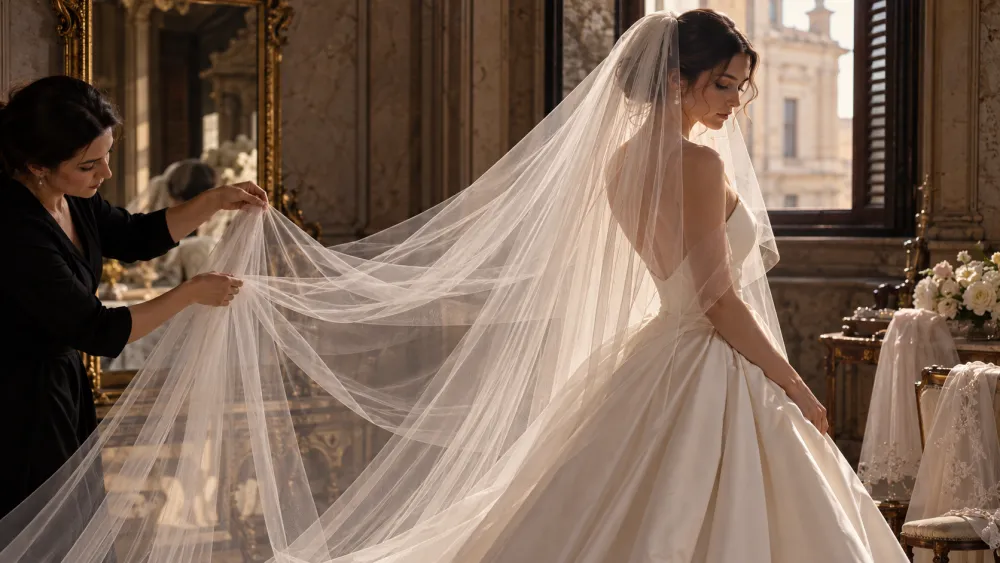
A wedding veil can appear to be the simplest object in the entire bridal wardrobe.
A piece of tulle. Perhaps a comb. Occasionally some lace around the edge.
Surely, after constructing a wedding dress with boning, internal waist stays, twelve layers of fabric and a cathedral train, making the veil must be the easy part.
Not quite.
The shape of the fabric, its stiffness, the amount of gathering, the placement of the comb and even the finish of the edge can completely change how a veil sits around the head and falls over the gown.
Two veils made from seemingly identical ivory tulle can behave like entirely different accessories.
A wedding veil is constructed by selecting and cutting the fabric, shaping its edges, deciding whether and how to gather it, and attaching it to a comb, pins or another fastening. The fabric, cut, width and gathering determine the silhouette; the attachment determines how securely and naturally it sits.
It Starts With the Tulle
Most traditional wedding veils are made from some form of tulle or fine net, but these fabrics are not interchangeable.
Soft bridal tulle falls close to the body, producing delicate movement and a relatively fluid silhouette.
Stiffer tulle holds itself farther away from the head and shoulders, creating more volume even without additional decoration.
The distinction becomes particularly noticeable in long veils.
A cathedral veil made from exceptionally soft tulle may trail behind the bride almost like a transparent liquid. The same dimensions in a firmer material can create a much fuller, more structured shape.
The fabric decides whether the veil whispers behind you or arrives with its own architectural ambitions.
What Is the Difference Between Soft Tulle and Illusion Tulle?
Bridal terminology can be rather inconsistent, and terms such as illusion tulle, soft tulle and English net are not always used identically by every supplier.
Generally, fine illusion tulle is chosen for its transparency and delicate appearance. Softer nets may have a more fluid drape, while firmer varieties provide greater volume.
Some premium veils use silk tulle, which has its own characteristic texture and movement, although it may be more delicate and expensive than synthetic alternatives.
The important thing is to feel the fabric and see how it falls rather than relying entirely on the name.
Hold two veils of similar length side by side. Look at how the fabric falls from the comb, how transparent it appears against the gown and whether it stands away from the shoulders. These differences matter more than the fabric description on the label.
How Is a Veil Cut?
Veils are not necessarily simple rectangles of fabric.
Depending on the intended design, they may be cut into oval, circular, rounded-rectangle or other shaped configurations.
The cut affects the outline of the veil and how its edges fall around the bride.
A narrower shape may create a relatively straight fall behind the body. A wider, more rounded shape can spread across the shoulders and train.
With a veil that includes a blusher, the relationship between the front and back sections also needs careful consideration.
The fabric has to fall comfortably over the face while leaving sufficient length behind the head.
Why Veil Width Matters
Length gets most of the attention when brides shop for veils, but width can be just as important.
A narrow cathedral veil can look surprisingly sleek, even when it extends several metres behind the bride.
A wider veil of the same length creates a fuller outline and may spread dramatically around the skirt.
- Falls closer to the body
- Creates a cleaner silhouette
- Can leave more of the dress visible
- Works beautifully with fitted gowns
- Generally produces less fullness around the shoulders
- Creates greater visual volume
- Can frame a full skirt
- Offers more fabric for dramatic photographs
- May cover more of the gown’s detailing
- Can create a fuller appearance around the head when gathered
Neither is automatically better. The choice depends on the gown, hairstyle and desired effect.
Gathering Changes Everything
One of the most important decisions in veil construction is how much fabric is gathered into the attachment.
Gathering means drawing a wider section of fabric into a smaller area, usually with stitching, before securing it to the comb.
More gathering creates fullness around the attachment point and often adds volume behind the head.
Less gathering allows the fabric to fall flatter.
This is one of the principal differences between a traditional gathered veil and the clean, flowing appearance associated with a drop veil.
A veil does not become more luxurious simply because somebody has managed to fit an alarming quantity of tulle onto one small comb.
How Is a Gathered Veil Made?
In a conventional gathered veil, the upper section of fabric is stitched and drawn together until it reaches the desired width.
That gathered section is then secured to a comb or another attachment.
The distribution of gathering matters. If the fabric is concentrated unevenly, the veil may appear lopsided or create unexpected bunching.
When done well, the folds should spread naturally from the attachment and create the intended amount of volume.
How Is a Drop Veil Different?
A drop veil is generally constructed with little or no gathering, allowing the fabric to lie smoothly over the head.
It may be secured with a discreet comb or pins, depending on the design.
Because the fabric is not compressed into a substantial gathered section, the silhouette remains flatter and more transparent around the crown.
This is particularly effective with minimalist gowns, sculptural dresses and veils intended to fall softly over the face.
They describe different approaches to construction. Either can be long or short. The defining difference is how the fabric is arranged and attached around the head.
What Is a Blusher?
A blusher is the section of veil designed to fall over the bride’s face.
Some veils are constructed with a separate blusher layer, while others use a continuous piece of fabric that can be positioned over the face and later lifted back.
The length of the blusher matters.
Too short, and it may sit awkwardly around the face. Too long, and it may extend farther down the bodice than intended.
The fabric also needs to be soft enough to fall naturally without creating an uncomfortable or excessively stiff shape.
The Edge Is a Design Decision
Veil edges can be left raw, finished with narrow stitching, bound with ribbon or decorated with lace, embroidery, beads or other trims.
Each finish changes the visual weight of the veil.
A raw edge can almost disappear against the dress. A satin ribbon edge creates a clear outline. A lace border turns the perimeter into a decorative feature.
Even a very narrow finish can change how the fabric hangs.
Raw-Edge Veils
Many types of synthetic bridal tulle can be cut without immediately fraying like a woven fabric, allowing the edge to remain visually unfinished.
This produces one of the lightest, cleanest veil styles.
The quality of the cut becomes especially important because there is no decorative trim to conceal irregularities.
Raw edges work beautifully when the bride wants the veil to add movement without competing with the gown.
Ribbon and Rolled Edges
A narrow ribbon or stitched rolled edge creates a more defined border.
Depending on the finish, it can add a subtle decorative line or become an obvious design element.
A rolled edge may also introduce a little structure, affecting how the veil curves and falls.
On very soft tulle, even a small amount of additional weight around the perimeter can influence the drape.
Lace-Edged Veils Require More Work Than They Appear To
A lace border needs to follow the veil’s perimeter without distorting its shape.
This becomes particularly complicated around curved edges and on very long veils.
Some designs use lace with a decorative scalloped edge. Others attach individual motifs onto the tulle or position a continuous trim around the perimeter.
The lace must be applied carefully so that the fabric remains smooth and the border appears balanced.
The lace should look as though it naturally belongs there, not as though it has been persuaded around the corner against its will.
Beading and Embroidery Add Weight
Pearls, crystals, sequins and embroidery can transform a simple veil, but they also change how it behaves.
Dense decoration adds weight, which may cause the fabric to fall differently and place more strain on the attachment.
Scattered pearls generally create a different effect from a heavily embellished border.
On delicate tulle, decoration also needs to be secured without damaging the mesh or creating excessive puckering.
- Whether the decoration feels securely attached
- Whether the tulle puckers around embroidered areas
- How much additional weight the embellishment creates
- Whether the border hangs evenly
- Whether the decoration complements or competes with the gown
How Does the Comb Work?
The comb is one of the least glamorous and most important components of many wedding veils.
It anchors the fabric into the hairstyle and helps distribute the veil’s weight.
Combs may be made from metal or plastic, with different widths, shapes and tooth configurations.
The appropriate comb depends on the veil’s construction, weight and intended placement.
A short, lightweight veil and a heavily embroidered cathedral veil do not necessarily require the same attachment system.
Where Should the Comb Sit?
Placement can change the entire silhouette.
A comb positioned high on the crown may create more visible volume around the head.
A lower placement, often beneath an updo, can produce a sleeker effect and leave more of the hairstyle visible.
The same veil may therefore look substantially different depending on where it is attached.
This is why trying on a veil without considering the wedding hairstyle can be misleading.
Can a Veil Be Attached Without a Comb?
Yes.
Some veils are secured using hairpins, discreet loops, clips or other fastening arrangements.
The correct solution depends on the hairstyle and the design of the veil.
A very flat drop veil may benefit from discreet pinning, while a heavier veil may require more substantial support.
Whatever the method, it needs to remain secure when the bride walks, turns and moves.
At your hair trial, turn your head, walk around and gently move the veil. Check whether the attachment shifts or pulls uncomfortably. A veil that stays perfectly positioned only while you remain motionless is not quite finished doing its job.
Why Some Veils Pull Backward
Long veils can create noticeable tension behind the head, particularly when the fabric drags across the floor.
Weight, fabric texture, embellishment and the attachment method all contribute.
A heavy cathedral veil secured into a hairstyle without sufficient support may feel uncomfortable or begin slipping.
Additional pins or a different attachment arrangement may help, but the solution should be tested by the hairstylist rather than improvised immediately before the ceremony.
Your veil should follow you down the aisle. It should not attempt to take your hairstyle with it.
Why Does One Veil Look More Transparent Than Another?
Transparency depends on the fineness of the mesh, the number of layers, the colour of the fabric and how densely it gathers.
Even very fine tulle becomes less transparent when multiple folds overlap.
This is one reason heavily gathered veils may look cloudier around the head than an ungathered drop veil made from similar fabric.
Ivory, white, champagne and other tones can also behave differently against the dress and skin.
Check the colour in natural light where possible.
Can a Veil Be Altered?
Often, yes.
Plain veils can sometimes be shortened or adjusted relatively easily, particularly when they have a raw edge.
A veil with lace around the perimeter may require the border to be removed and reapplied, which can be much more involved.
Changing the width, gathering or comb placement may also be possible depending on the original construction.
But a veil cannot always be transformed into an entirely different style without essentially remaking it.
What About the Veil and the Train?
The veil and dress train need to be considered together.
A cathedral veil may extend beyond the train, end at a similar point or fall shorter to reveal the gown’s detailing.
None of these arrangements is inherently incorrect.
What matters is how the two shapes interact.
A heavily decorated train may benefit from a simple veil that does not obscure its embroidery. A clean gown may look spectacular with an elaborate lace-edged veil.
The relationship is visual, not administrative.
Do You Need an Expensive Veil?
Not necessarily.
A beautifully cut veil made from appropriate tulle can look exceptional without elaborate embellishment.
Conversely, a more expensive veil may justify its price through finer materials, hand-applied lace, detailed embroidery or complex construction.
Judge the fabric, finish, attachment and overall appearance rather than assuming price alone determines quality.
There is no requirement for a veil to cost a significant percentage of the dress simply because it has been granted bridal status.
The edge falls cleanly. The fabric moves naturally. The comb stays secure. The veil frames the gown rather than fighting it. Nobody notices the engineering because nothing is going wrong.
What to Check Before Buying a Wedding Veil
- Does the tulle have the softness or structure you want?
- Is the width appropriate for your gown?
- Do you prefer gathering or a flatter drop construction?
- Does the colour work with the dress?
- Is the edge cleanly finished?
- Are lace and embellishments securely attached?
- Does the comb feel comfortable and stable?
- Will the veil work with your intended hairstyle?
- Can you remove it without destroying the hairstyle?
- Does the veil complement the dress from the front, side and back?
The Simplest Accessory Still Needs Good Construction
A veil may contain far fewer components than a wedding dress, but those components still need to work together.
Fabric softness, width, shape, gathering, edging and attachment determine whether the finished veil feels light, dramatic, architectural, romantic or almost invisible.
The best result is rarely about adding the most decoration or choosing the longest possible length.
It is about understanding what the veil is supposed to contribute to the complete bridal silhouette.
A wedding veil may be only a piece of tulle. Making that piece of tulle behave beautifully is the entire art.
“`
Tips & Tricks
View All Tips & Tricks


