


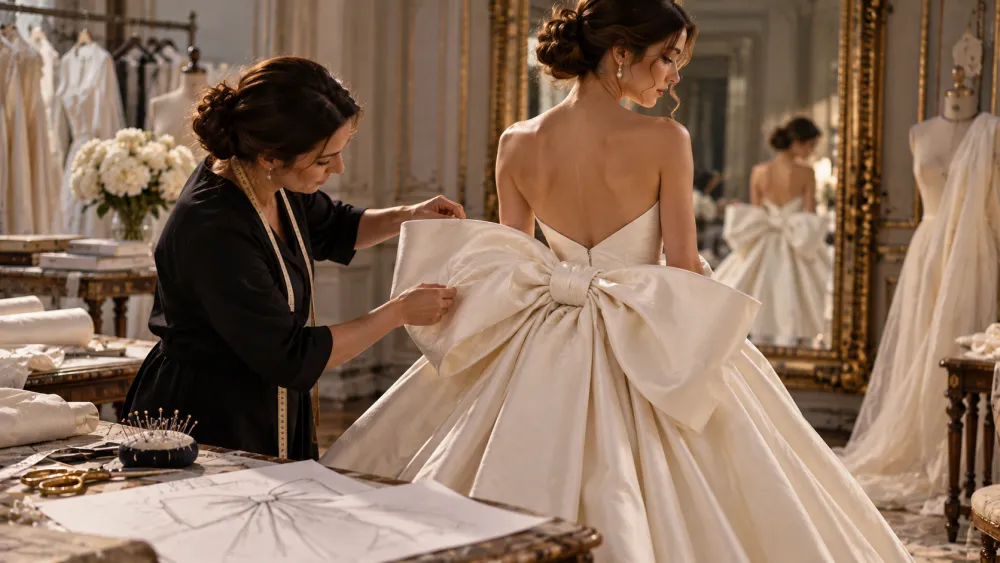
A bridal bow looks wonderfully effortless when it is done well.
Two beautifully curved loops, a neat centre knot, perhaps a pair of long satin tails falling down the back of the gown.
It all appears rather simple.
Until you ask several metres of Mikado to form an enormous bow, remain perfectly symmetrical, survive an entire wedding ceremony and somehow avoid collapsing into a very expensive fabric pancake.
Suddenly, the little decorative bow becomes a surprisingly serious exercise in dressmaking.
THE QUICK ANSWER
Bridal bows are constructed using carefully cut fabric, controlled folds, internal support and secure attachment points. Their shape depends on the material, the way the loops are formed, the structure inside them and how their weight is distributed across the gown. Large sculptural bows are often built rather than simply tied.
Not Every Bridal Bow Is Actually Tied
One of the first things to understand is that many dramatic bridal bows are not conventional ribbons tied into a knot.
They are constructed components.
The loops may be individually shaped, folded and stitched into position. The centre knot may be a separate piece of fabric wrapped around the join. The tails may be cut and attached independently.
This allows the designer to control the proportions much more precisely than would be possible with a bow tied by hand.
It also prevents the shape from changing every time somebody adjusts it.
The enormous perfect bow at the back of a couture gown has probably never experienced the indignity of being tied like a shoelace.
The Fabric Determines the Possibilities
Different bridal fabrics behave very differently when shaped into bows.
Structured Mikado can create strong, architectural loops. Satin provides smooth surfaces and elegant reflections. Taffeta can hold crisp folds with relatively little weight. Organza introduces transparency and volume, while tulle creates a much softer, airier effect.
Crepe and other fluid materials tend to produce relaxed bows with less defined structure unless they are supported internally.
Choosing the fabric is therefore part of choosing the shape.
FOR SCULPTURAL BOWS
- Mikado
- Taffeta
- Structured satin
- Crisp organza
- Supported fabric layers
FOR SOFTER BOWS
- Soft tulle
- Chiffon
- Fluid satin
- Soft organza
- Lightweight crepe
These are not absolute restrictions. Internal construction can make a naturally soft fabric behave more firmly, although the finished effect will still depend on the material.
How Are Oversized Bow Loops Made?
For a structured bow, each loop may begin as a shaped piece of fabric rather than a simple straight strip.
The fabric is cut, folded and stitched to produce the intended curve and volume.
Seam placement matters because visible seams can interrupt the smooth surface of satin or Mikado.
Designers may position seams underneath the loops or conceal them within folds.
Some loops are softly stuffed or supported with additional layers. Others rely on the stiffness of the fabric and carefully positioned folds.
The objective is to create volume without making the bow look heavy or rigid in the wrong places.
What Keeps a Large Bow From Collapsing?
The answer is often hidden inside.
Interfacing, organza underlining, net, internal padding or other structural materials may be used to support the fabric.
Interfacing adds firmness. Underlining can help the outer fabric hold its shape. Net or padding can create additional volume.
In particularly elaborate constructions, designers may use more specialised internal supports to maintain an exaggerated silhouette.
But adding structure is not simply a matter of making everything stiffer.
Too much support can create an awkward, artificial shape. Too little can allow the loops to collapse.
A sculptural bow requires just enough engineering to defy gravity without looking as though it has been assembled from office stationery.
Interfacing Is Not the Same as Boning
These construction terms are sometimes confused.
Interfacing is a supporting material applied to fabric to give it additional body or stability.
Boning provides more directional support and is usually associated with bodices, corsetry and other structured garment components.
Most bridal bows do not need conventional corset boning.
However, certain highly architectural designs may incorporate specialised supports where the shape requires them.
The important distinction is that the support should be appropriate to the fabric and intended form.
The Centre Knot Is Often a Separate Component
The centre of a bow does more than conceal the point where the loops meet.
It controls the proportions of the entire design.
A narrow centre creates a sharply gathered appearance. A wider centre can make the bow look more sculptural and substantial.
Many constructed bows use a separate strip of fabric wrapped around the middle, hiding the stitching and securing the loops together.
Its width, tension and placement can change the character of the bow considerably.
Symmetry Is More Complicated Than It Looks
Perfectly symmetrical bows require careful cutting and assembly.
The loops need to have balanced dimensions, but the fabric must also behave similarly on both sides.
Differences in grain direction, internal support or seam tension can make one loop sit higher or collapse differently.
For very large bows, even small construction differences become visible.
LOOK AT THE BOW FROM BEHIND
If the design is intended to be symmetrical, check that both loops have comparable volume and that the centre sits where it should. A deliberately asymmetric bow is a design decision. An accidentally lopsided one is an alterations conversation.
Fabric Grain Can Change the Shape
Fabric grain describes the direction of the threads within a woven material.
Cutting a piece along the straight grain, cross grain or bias can affect how it stretches, folds and drapes.
For a structured bow, controlling the grain helps maintain the intended shape.
For softer bows, a bias cut may create more fluid movement, depending on the fabric.
This becomes particularly important when the bow includes long tails that need to hang evenly.
How Are Bow Tails Constructed?
Bow tails can be simple fabric strips, carefully shaped panels or elaborate extensions that function almost like a train.
They may be made from a single layer of fabric or constructed with a lining for a more finished appearance.
The ends can be straight, pointed, angled or curved.
Long tails may need careful weighting and hemming to ensure they fall smoothly rather than twisting.
Some designs integrate the tails directly into the skirt, while others attach them to the bow as separate components.
Once the bow tails reach cathedral-train proportions, the distinction between accessory and additional garment becomes rather philosophical.
How Is a Bow Attached to the Wedding Dress?
Smaller bows may be sewn directly onto the gown.
Larger bows need more considered attachment because their weight can pull on the fabric underneath.
A substantial bow attached to a lightweight outer layer may distort the dress or cause the fabric to sag.
For this reason, the attachment may need to connect to a more stable part of the garment, such as a structured waistband, reinforced seam or internal support.
The goal is to distribute the weight rather than concentrating it at one fragile point.
THE ATTACHMENT SHOULD SUPPORT THE BOW.
A beautifully constructed bow is not much use if its weight pulls the waistline out of shape. The fastening system must work with the structure of the gown, not simply the visible outer fabric.
Permanent Versus Detachable Bows
A permanently attached bow can be integrated directly into the gown’s construction.
This may allow a particularly clean finish because the attachment does not need to be removed.
A detachable bow introduces additional requirements.
It must remain secure while worn, come off without damaging the dress and leave the underlying gown looking complete.
Hooks, snaps, concealed buttons or other fastening systems may be used depending on the design and weight.
Some bows are attached to a separate waistband or structured panel that helps distribute the load.
Why Some Detachable Bows Look Awkward
The problem is often not the bow itself.
It is the transition between the bow and the gown.
A visible attachment, bulky waistband or poorly positioned fastening can make the piece look added rather than integrated.
The bow may also sit at an unflattering angle or create an unexpected ridge across the back.
Removing it can reveal another problem: visible loops, snaps or creased fabric left behind.
A WELL-DESIGNED DETACHABLE BOW SHOULD:
- Remain secure while walking and sitting
- Keep its intended shape
- Attach without distorting the gown
- Conceal its fastenings
- Be reasonably easy to remove
- Leave the dress looking finished afterwards
Can You Add a Bow During Alterations?
Often, yes.
A skilled bridal alterations specialist may be able to add a bow to an existing gown, particularly when the design has a suitable attachment point.
However, the result depends on the fabric, construction and proportions of the original dress.
A lightweight gown may not support an enormous structured bow without reinforcement.
Matching the original fabric can also be difficult, particularly if the gown uses a distinctive ivory tone or textured material.
Sometimes a deliberately contrasting fabric works better than an imperfect match.
Can an Existing Bow Be Removed?
That depends on how it was constructed.
A separately attached decorative bow may be relatively straightforward to remove.
A bow integrated into the bodice, waistband or skirt may be much more complicated.
Removing it could expose seams, fastening points or unfinished areas that were never intended to be visible.
Before purchasing a gown with the intention of removing a large decorative element, ask an alterations specialist whether the result will actually look clean.
Do not assume every bow is simply waiting for someone with a pair of scissors.
What About Bows on the Shoulders?
Shoulder bows introduce a different set of construction challenges.
They may attach to straps, sleeves or the upper bodice.
Because they sit near the arms and neckline, their weight and placement can affect comfort and movement.
A large shoulder bow must remain stable without pulling the strap out of position or distorting the neckline.
If the bow is detachable, its fastening should not create an uncomfortable lump against the shoulder.
How Do You Keep a Bow Looking Beautiful All Day?
Some bows are naturally resilient. Others crease, flatten or lose their shape when compressed.
Structured satin and Mikado can retain impressive volume, but they may also show pressure marks depending on the fabric and internal construction.
Soft bows can become crushed when the bride sits against a chair.
Ask whether the bow can be reshaped by hand and whether it should be removed before dinner or dancing.
For detachable bows, safe storage matters as well.
AT THE FINAL FITTING
- Walk with the bow attached.
- Turn to check whether it shifts.
- Sit down and stand up again.
- Inspect the attachment points.
- Check the silhouette from the side.
- Practise removing detachable pieces.
- Ask how to store and transport the bow.
Why Do Some Bows Look Expensive?
Usually because their construction is controlled.
The fabric has the right body. The loops hold their intended shape. The centre is proportionate. The tails hang cleanly. The attachment appears seamless.
There may be no embroidery, pearls or crystals whatsoever.
The quality comes from the cut and execution rather than the amount of decoration.
A perfectly constructed bow in beautiful fabric can look more luxurious than several hundred embellishments desperately trying to justify their existence.
When Is a Bow Too Big?
There is no universal maximum size.
An enormous bow can look extraordinary when it belongs to the design.
The real questions concern proportion, balance and practicality.
Does the bow obscure the most interesting part of the gown? Does it distort the waistline? Does it overwhelm the wearer? Can the bride move comfortably?
A bow that is dramatic but beautifully integrated can be successful at almost any scale.
A smaller bow that sits awkwardly can be far less convincing.
The Engineering Behind the Romance
Bridal bows may be associated with romance, softness and decorative femininity, but their construction can be remarkably technical.
Fabric selection, grain direction, internal support, seam placement, symmetry and attachment all contribute to the final result.
The most successful designs conceal that work.
The bride sees a beautiful bow. The dressmaker sees an arrangement of carefully controlled forces, folds and fastenings.
Both are correct.
The best bridal bow looks effortless precisely because somebody made quite sure it wasn’t.
“`
Tips & Tricks
View All Tips & Tricks


