


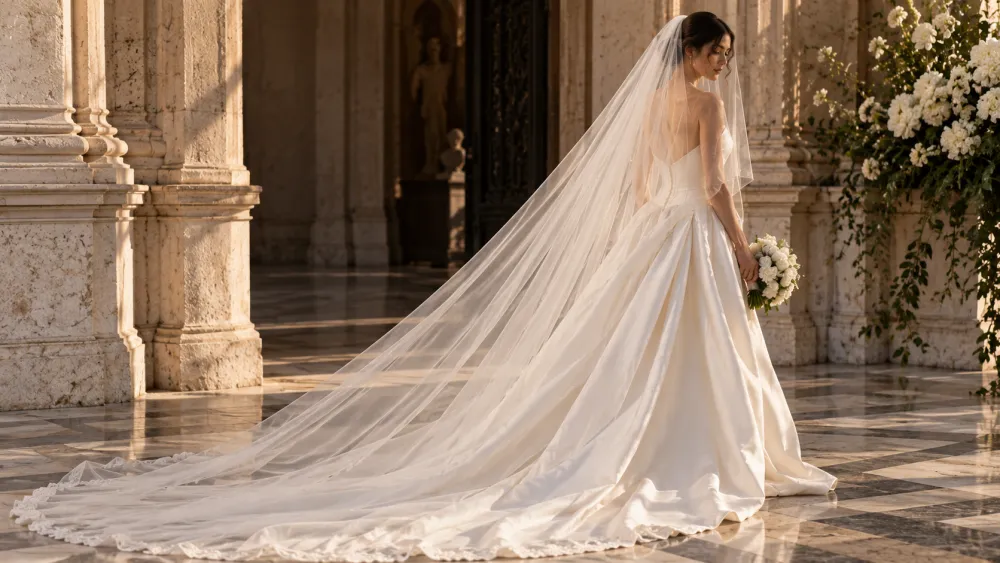
For several seasons, bridal veils have been asked to do rather a lot.
They have carried embroidered flowers, pearls, crystals, lace borders, personalised messages, enormous appliqués and enough decorative ambition to qualify as a second wedding dress.
Now something quieter is appearing again.
The drop veil — soft, ungathered and remarkably simple — is returning as part of a broader movement toward cleaner bridal styling.
And perhaps unsurprisingly, removing most of the decoration has made the veil considerably more noticeable.
A drop veil is a soft veil with little or no gathering at the comb, allowing the tulle to fall smoothly around the head and body. Its return fits perfectly with sculptural, minimalist and highly detailed modern gowns because it adds movement and ceremony without introducing another competing design.
What Is a Drop Veil?
A traditional drop veil is essentially a piece of tulle arranged so that it falls softly over the head rather than being heavily gathered into a comb.
Depending on its construction, it may be secured with a comb, pins or another discreet fastening.
The lack of gathering is what gives it its characteristic appearance.
Instead of creating volume immediately behind the head, the fabric lies much flatter and falls in a continuous, almost weightless line around the bride.
The drop veil does not arrive as a cloud attached to the back of your head. It simply falls.
Why Does It Feel Modern Again?
Because bridal dresses have become more interesting structurally.
Sculptural necklines, Basque waists, visible corsetry, architectural draping and dramatic trains already provide strong visual information.
Adding an equally elaborate veil can sometimes create competition rather than completion.
A simple veil gives those gowns room to exist while still providing the movement and ceremony associated with traditional bridal dressing.
It is minimalism functioning as contrast rather than absence.


It Works Particularly Well With Sculptural Gowns
A gown with dramatic folds, an asymmetric neckline or architectural volume rarely needs another complicated object fighting for attention around the shoulders.
Fine unembellished tulle creates a transparent layer over the silhouette without hiding it.
The contrast can be especially effective with substantial fabrics such as Mikado and satin: solid architectural gown underneath, almost invisible movement above it.
A veil that looks almost empty when held separately can be exactly what a complicated gown needs. Judge the complete silhouette rather than deciding that a simple veil is “not enough” while looking at it on a hanger.
Simple Does Not Necessarily Mean Short
Some of the most dramatic drop veils are cathedral length.
The absence of decoration means length itself becomes the statement.
Several metres of extremely fine tulle can extend beyond the train while remaining visually light enough not to overwhelm the dress.
This is one of the reasons the style works so well with contemporary minimalism.
There is nothing particularly understated about four metres of fabric. It can simply be understated fabric.
The Blusher Is Part of the Appeal
Drop veils are particularly beautiful when they include a blusher — the section of veil worn over the face.
Because there is little gathering, the tulle can fall softly across the face rather than creating substantial volume around the crown.
Once lifted, the blusher becomes another layer behind the bride.
The result feels traditional without necessarily making the entire bridal look traditional.
For brides who like the ritual of a veil over the face but not the appearance of a heavily constructed veil, this can be a very elegant compromise.
Raw-Edge Veils Are Becoming Important
One of the cleanest versions of the trend uses an unfinished-looking raw edge.
Fine bridal tulle does not necessarily require a visible decorative border, so the edge can almost disappear against the gown and surrounding space.
This makes the veil feel exceptionally light.
It is particularly effective when the dress already contains strong detailing — lace, embroidery, beading or complicated construction — because there is no additional border cutting across the silhouette.
- Very clean appearance
- Almost invisible edge
- Lets the gown remain dominant
- Works beautifully with modern minimalism
- Feels particularly light at long lengths
- Creates a stronger frame
- Can repeat lace or embellishment from the gown
- Becomes a focal point itself
- Can add detail to a simple dress
- Usually has greater visual weight
Simple Veils Are Also Returning to Detailed Dresses
Minimalist gowns are not the only reason for the trend.
A simple veil can be even more useful with a highly decorated wedding dress.
If the gown already contains elaborate lace, dimensional flowers, pearls or embroidery, repeating all of that on the veil can blur the silhouette.
Plain tulle creates breathing room.
The bride still gets the scale and movement of a veil without adding another layer of competing motifs.
> Matching the dress does not require copying everything the dress has ever done.
But Matching Lace Can Still Be Beautiful
The return of simplicity does not mean lace-edged veils have suddenly become wrong.
A narrow border made from the same lace as the gown can create an extraordinarily coherent look. Scattered appliqués can visually connect the veil to the dress without covering its entire surface.
The difference is restraint.
Rather than treating every square metre of tulle as an available location for another embellishment, the decoration can be concentrated where it actually contributes something.
The Width of the Veil Matters
Two veils of exactly the same length can create completely different silhouettes depending on their width.
A narrower veil falls relatively close behind the body and can feel sleek and modern.
A very wide veil spreads around the bride, creating greater volume and a much more dramatic frame.
This becomes particularly noticeable at cathedral length.
If you want simplicity without losing grandeur, increasing the width can provide drama without adding a single pearl or appliqué.
Fine Tulle Makes an Enormous Difference
When a veil contains very little decoration, the quality and behaviour of the tulle become particularly important.
Soft tulle falls close to the body and moves easily. Stiffer tulle creates more volume and holds itself farther away from the dress.
Neither is inherently superior. They simply produce different effects.
For the soft, fluid drop-veil look, however, a fine material generally creates the most convincing result.
When a veil has no lace, pearls or embroidery to distract the eye, its softness, transparency and movement become the entire point.
How Should a Drop Veil Be Attached?
Some drop veils have a discreet comb positioned so that the fabric remains relatively flat. Others can be pinned directly into the hairstyle.
The correct method depends on the veil’s weight, length, hairstyle and construction.
A cathedral veil creates considerably more pull than a fingertip-length version, particularly when it begins moving behind the bride.
Whatever fastening is used needs to survive walking, turning and the occasional enthusiastic relative.
Placement Changes the Entire Look
A veil positioned high on the crown creates a different silhouette from one attached low beneath a bun.
Higher placement can make the veil more visible from the front and create additional volume around the head.
Lower placement tends to feel sleeker and allows more of the hairstyle to remain visible.
With a drop veil, even relatively small changes in placement can alter how the tulle frames the face and shoulders.
- Bring the actual veil if possible.
- Test more than one placement.
- Photograph it from the front, side and back.
- Walk while wearing it.
- Check how securely the comb or pins hold.
- Practise removing it without dismantling the hairstyle.
Do You Keep the Veil on All Day?
You can, but you certainly do not have to.
Long veils are often removed after the ceremony or photographs, particularly if they would interfere with dinner and dancing.
This creates a natural styling transformation without requiring any alteration to the dress itself.
A bride can therefore have the full cathedral-scale silhouette for the ceremony and reveal the gown completely afterwards.
Which is rather efficient for a piece of tulle.
Simple Veils Photograph Beautifully
Fine tulle interacts with light and movement particularly well in photographs.
It can catch air, soften the outline of the gown and create transparent layers without obscuring the dress underneath.
Long versions also provide photographers with considerable material for those dramatic veil photographs everyone pretends happened spontaneously.
The veil floating perfectly three metres behind the bride has frequently received assistance from someone who has just thrown it into the air.
This is not a criticism. It is teamwork.
Do You Need a Veil at All?
No.
A veil is not the final administrative requirement that converts a woman in a white dress into a bride.
Capes, scarves, headpieces, flowers and nothing whatsoever are all legitimate alternatives.
But there is a reason the veil continues to survive every prediction of its disappearance.
Very few other accessories can change the scale and movement of a bridal silhouette so dramatically while remaining almost transparent.
- The softness and transparency of the tulle
- The amount of gathering at the attachment
- The overall width
- The length relative to the train
- Whether you want a blusher
- Raw edge versus lace or another finish
- Where it will sit in your hairstyle
- When you intend to remove it
The Veil Is Becoming Quiet Again
The return of the drop veil does not mean elaborate veils are finished.
Bridal fashion is simply rediscovering the impact of restraint.
A nearly invisible layer of tulle can soften an architectural gown, give scale to a minimalist dress or provide breathing room around elaborate lace.
It does not need to compete with the wedding dress to matter.
Sometimes the most modern thing a veil can do is stop trying to be another dress.
Tips & Tricks
View All Tips & Tricks


