


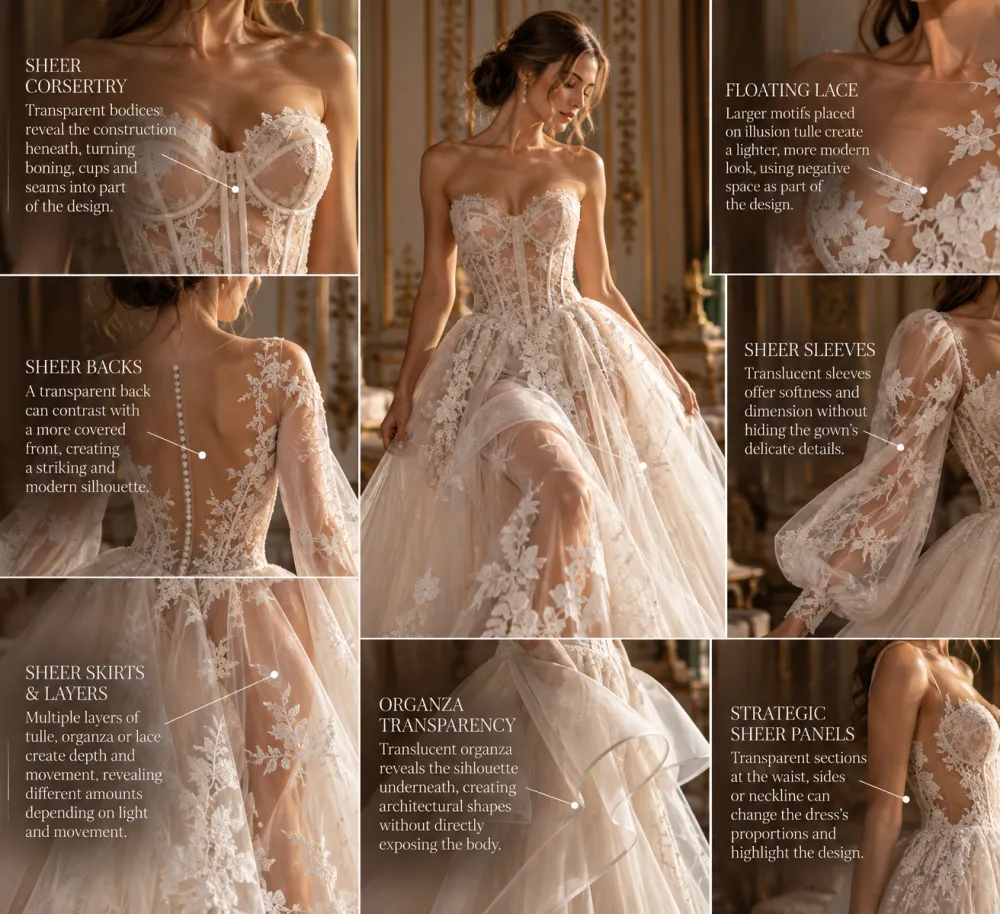
Sheer wedding dresses are not exactly new.
For years, bridal designers have experimented with illusion tulle, transparent corsets, barely-there skirts and strategically placed lace. At certain points, the objective appeared to be determining precisely how little fabric could technically still qualify as a wedding dress.
For 2027, transparency is taking a more interesting direction.
Rather than simply revealing more skin, designers are using sheer fabric to expose construction, create layers, separate embellishment from the body and play with the space between covered and uncovered.
Sheer bridal fashion is becoming less about maximum exposure and more about contrast: transparent against opaque, corsetry beneath tulle, lace floating over skin and translucent layers creating depth.
The Naked Dress Is No Longer the Only Reference
For a while, the most visible version of sheer bridal fashion was the so-called naked dress: transparent tulle covered with carefully positioned lace, crystals or embroidery.
That look has not disappeared.
But transparency is becoming much broader than that single aesthetic.
A gown can now have an opaque skirt and completely sheer corset. A transparent layer can sit over a minimalist slip. Lace can appear to float across otherwise invisible tulle. Organza can reveal another silhouette underneath without exposing the body itself.
The interesting question is no longer simply how much the dress reveals. It is what the transparency allows you to see.
Sheer Corsetry Is Becoming More Refined
One of the strongest versions of the trend remains the exposed corset bodice.
But the newer versions often feel more architectural than overtly lingerie-inspired.
Boning channels become clean vertical lines. Cups are deliberately shaped. Seams are allowed to remain visible. The transparency reveals how the bodice has been constructed rather than merely creating the impression that the bride is almost naked.
This works particularly well with basque and elongated waists, where the internal structure becomes a significant part of the overall silhouette.
If designers are going to spend that much time constructing a beautiful corset, apparently they have decided we may as well see it.
Transparency Is Being Used in Sections
The modern sheer gown does not necessarily need to be transparent from neckline to hem.
In fact, some of the most effective designs use transparency selectively.
A sheer waist can visually separate the bodice from the skirt. Transparent side panels can interrupt an otherwise opaque silhouette. A sheer back can contrast with a completely covered front.
These placements allow designers to change the proportions of a dress without relying on additional decoration.
Lace Is Starting to Float
Illusion tulle allows lace and appliqué to appear almost suspended on the body.
The technique itself is familiar, but contemporary gowns are increasingly leaving more negative space between motifs.
Instead of covering the entire surface with dense lace, designers may place large florals individually across sheer fabric, allowing the skin or lining underneath to become part of the composition.
The result can make traditional bridal lace feel considerably lighter and more modern.
Sometimes the most effective part of the lace is the space the designer deliberately leaves around it.
Sheer Skirts Are Becoming Layered Rather Than Simply Transparent
Transparency below the waist is changing too.
A single transparent skirt over briefs remains one interpretation, but designers are increasingly using multiple translucent layers to create depth.
Tulle, organza and lace can overlap so that the gown reveals different amounts depending on movement and light.
An opaque mini or fitted underskirt may sit beneath a transparent full-length layer. Alternatively, several sheer layers can soften the outline of the legs without completely concealing them.
A skirt that appears softly translucent under boutique lighting may become considerably more informative in strong daylight. Before ordering, understand exactly what is lined, what is sheer and whether the lining can be changed.
Organza Offers a Different Kind of Transparency
Not all sheer fabric creates a naked effect.
Organza is translucent but structured, which means it can create architectural shapes while still allowing light and underlying layers to show through.
This makes it particularly interesting for sculptural skirts, overskirts, sleeves and dramatic trains.
Instead of revealing the body directly, organza can reveal the construction of the silhouette underneath.
Transparency becomes atmospheric rather than explicitly revealing.
Sheer Sleeves Are Getting Cleaner
Illusion sleeves have long been used as a base for lace and embellishment.
The newer direction often involves less camouflage.
Rather than attempting to make the tulle completely disappear, designers may use clearly visible transparent fabric as a deliberate element of the gown.
Wide sheer sleeves, translucent gloves and unembellished tulle can create softness without reproducing the traditional lace-sleeve effect.
It is a subtle distinction, but an important one: the sheer fabric no longer always needs to pretend it isn’t there.
Illusion Tulle Still Needs to Match the Wearer
When sheer mesh is intended to disappear against the skin, colour matters enormously.
“Nude” is not one colour, despite several decades of fashion behaving as though humanity had reached a surprising agreement on beige.
Illusion tulle that is too pale, too pink, too yellow or too dark can become much more visible than intended.
This is particularly noticeable at necklines, backs and sleeves where the edge of the mesh meets bare skin.
Some designers offer illusion tulle in several skin-tone shades. If the mesh is intended to disappear, ask whether the gown can be ordered with a shade closer to your skin rather than assuming the sample colour is your only option.
Lining Can Completely Change the Same Dress
One of the most useful things to understand about sheer wedding dresses is how dramatically lining changes them.
A lace gown over nude lining may emphasise every motif and create strong contrast against the body. The same gown over ivory lining can appear softer, more traditional and considerably less revealing.
Blush, sand, mocha and other lining colours create still more variations.
In some designs, the bodice and skirt can even be ordered with different lining options.
You may not dislike the dress. You may simply dislike what is happening behind the dress.
Sheer Does Not Automatically Mean Sexy
Transparency is a technique, not a personality.
A sheer gown can be overtly sensual, but it can also be romantic, architectural, ethereal, minimalist or surprisingly restrained.
A translucent organza cape does not communicate the same thing as a crystal-covered naked dress. Neither does a sheer corset underneath a monumental satin skirt.
Grouping every transparent wedding dress into one category misses much of what designers are currently doing with the idea.
And Opaque Does Not Automatically Mean Conservative
The reverse is equally true.
A completely opaque dress can have a dramatic neckline, an extreme silhouette or a very close fit.
The amount of visible skin is only one part of how a gown feels.
This matters because brides are sometimes encouraged to think about transparency through a strange moral vocabulary: tasteful versus too much, elegant versus revealing.
Those categories are considerably less useful than asking whether the design works and whether you feel comfortable wearing it.
The Back Deserves Particular Attention
A sheer bodice may look relatively covered from the front because of cups, appliqué or draping while revealing considerably more from behind.
This is not necessarily a problem.
It is simply something worth discovering before the wedding photographs arrive.
Look at the dress from every direction and pay particular attention to where lining begins and ends.
A beautiful front does not grant diplomatic immunity to the back of the dress.
Photography Can Change Transparency
Lighting matters enormously.
Flash photography can emphasise differences between sheer panels, lining and skin. Strong backlighting may make translucent skirts substantially more transparent. Dark reception lighting can have the opposite effect.
If transparency is an important part of your gown, take photographs during the fitting in several lighting conditions if the boutique permits it.
The camera occasionally discovers information the mirror had politely withheld.
Think About Underwear Before the Wedding Morning
A sheer dress can dramatically reduce your underwear options.
Visible corsetry may already provide enough support that a bra is unnecessary. Transparent side panels can make conventional shapewear visible. A sheer skirt may reveal underwear that appeared completely discreet under ordinary clothing.
Bring suitable options to alterations appointments rather than experimenting for the first time several hours before the ceremony.
Stand in daylight. Sit down. Walk. Turn around. Take a photograph with flash. Then decide whether everything you intended to reveal — and nothing you did not — remains exactly where expected.
Can a Sheer Wedding Dress Be Lined?
Often, yes.
Depending on the construction, a seamstress may be able to add lining to a bodice, skirt or individual transparent section.
But it is better to discuss this before ordering whenever possible.
Adding lining can change the colour, contrast, flexibility and visual depth of the gown. It may also cover visible boning or construction that was deliberately intended to be part of the design.
The question is therefore not merely whether lining can physically be inserted.
It is whether the dress will still look the way you want once it is.
The New Sheer Wedding Dress Is About Choice
The most interesting development in transparent bridal fashion is not that gowns are becoming more or less revealing.
It is that designers are using transparency with considerably more precision.
A bride can choose a completely sheer corset with an opaque skirt, floating lace over nude mesh, translucent organza over another silhouette or only the smallest transparent panel at the waist.
There is no single correct amount.
The modern sheer wedding dress is not really about showing more. It is about deciding exactly what should be seen.
“`
Tips & Tricks
View All Tips & Tricks


