
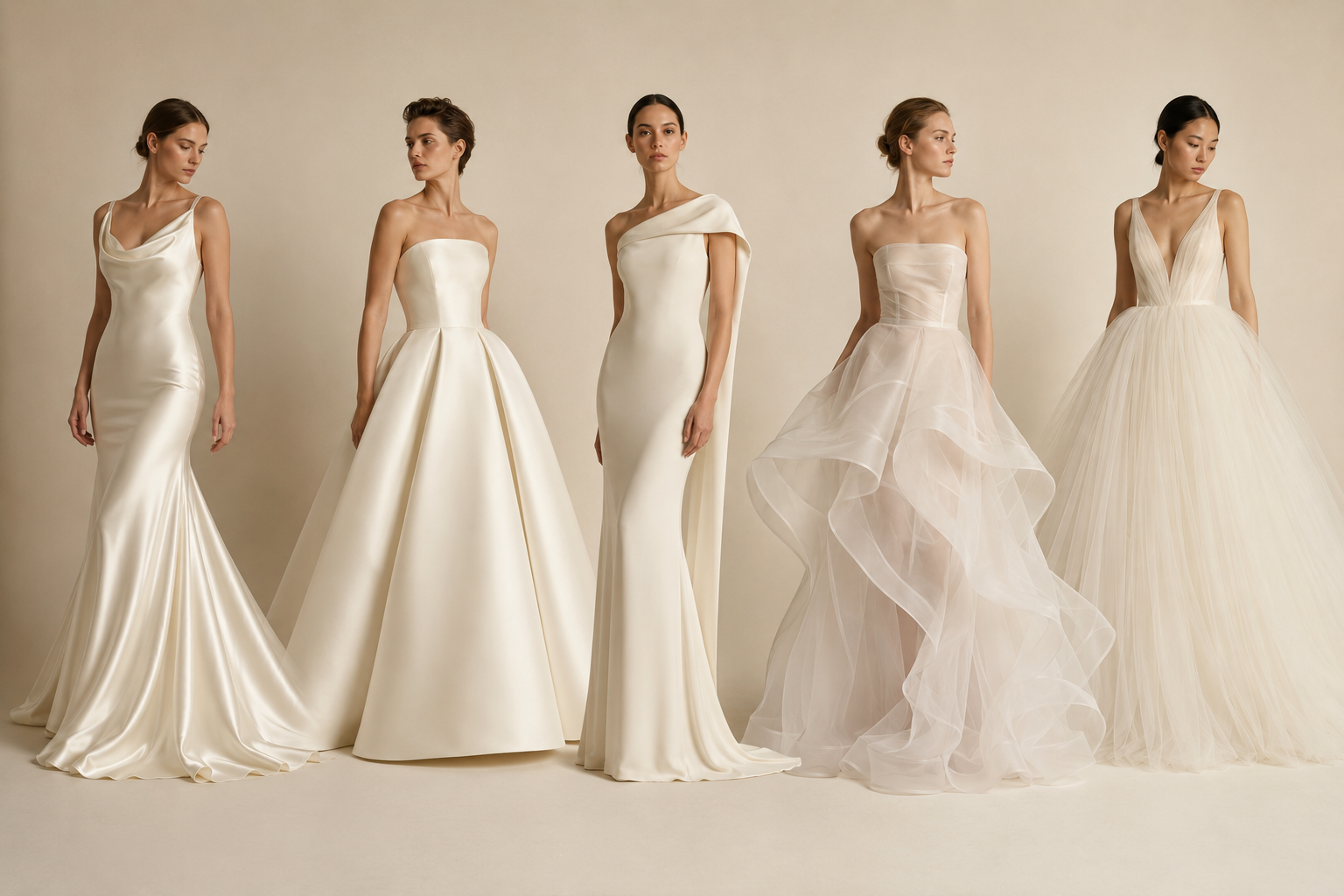
Fabric determines far more than the surface appearance of a wedding dress. It influences whether the gown feels fluid or structured, matte or luminous, lightweight or substantial. It also affects how the dress moves, photographs, creases and holds its silhouette.
Terms such as satin, Mikado, crepe, organza and tulle describe fabrics with very different constructions. Some are commonly made from silk, while others may be woven from polyester, nylon, rayon or blended fibres. “Silk” and “satin” are not interchangeable: silk is a fibre, while satin refers to a type of weave.
This complete guide explains the most important wedding dress fabrics, including satin, Mikado, crepe, organza, tulle, chiffon, charmeuse, taffeta, lace and more.
Wedding Dress Fabrics at a Glance
| Fabric | Appearance | Structure | Common Bridal Uses |
|---|---|---|---|
| Satin | Smooth with a luminous surface | Varies from fluid to substantial | Ball gowns, A-line and fitted dresses |
| Mikado | Smooth with a restrained sheen | Structured and sculptural | Ball gowns, A-line and architectural designs |
| Crepe | Matte or softly textured | Fluid to moderately structured | Sheath, column and fit-and-flare gowns |
| Organza | Sheer with a crisp finish | Lightweight but holds shape | Full skirts, overlays and sleeves |
| Tulle | Sheer, net-like and airy | Soft to stiff | Layered skirts, veils and illusion details |
| Chiffon | Sheer, matte and fluid | Soft with little body | Empire, A-line and destination dresses |
| Charmeuse | Glossy face and matte reverse | Fluid and body-skimming | Slip and bias-cut dresses |
| Taffeta | Crisp with a subtle shine | Structured and lightweight | Ball gowns, pleats and gathered skirts |
| Duchess satin | Smooth with a rich lustre | Heavy and substantial | Formal gowns and sculpted silhouettes |
| Georgette | Matte with a fine grain | Fluid with slightly more body than chiffon | Soft skirts, sleeves and draping |
| Faille | Subtly ribbed and softly lustrous | Structured but flexible | Tailored and architectural gowns |
| Lace | Open decorative pattern | Varies by type and backing | Bodices, sleeves, overlays and complete gowns |
Fibre, Weave and Fabric: What Is the Difference?
Bridal fabric terminology can be confusing because the names do not all describe the same thing.
- Fibre is the raw material used to create the yarn. Examples include silk, cotton, wool, polyester, nylon, rayon and acetate.
- Weave describes how the yarns are arranged to produce the fabric. Satin is one example of a weave.
- Fabric is the completed textile. Its behaviour depends on both its fibre content and construction.
This means satin can be made from silk, polyester, acetate or a blend. Organza may be woven from silk or synthetic fibres. Tulle can be made from silk, nylon, polyester or rayon.
Two fabrics sold under the same general name may therefore have very different weights, textures and prices.
Is Satin the Same as Silk?
No. Silk is a natural fibre, while satin is a weave that creates a smooth surface with a characteristic lustre.
Silk can be woven into satin, chiffon, organza, taffeta, Mikado and numerous other textiles. Satin can be woven from silk or from manufactured fibres such as polyester and acetate.
A label that says “satin wedding dress” does not automatically mean that the gown is made from silk. The exact fibre content should be listed separately.
Satin Wedding Dress Fabric
Satin is one of the most recognizable bridal fabrics. Its weave creates a smooth face that reflects light and a comparatively dull reverse.
The term covers a wide range of weights. Lightweight satin can drape closely around the body, while heavier satin can support pleats, corseted bodices and substantial skirts.
Satin is used for minimalist gowns, dramatic ball gowns, fit-and-flare dresses and bridal accessories. Its continuous surface makes construction, seams and fit particularly visible, so precise tailoring is important.
Advantages of Satin
- Creates a polished and formal appearance
- Photographs with a distinct, luminous finish
- Available in numerous weights and fibre compositions
- Can support both fluid and structured silhouettes
- Provides a clean surface for draping and architectural construction
Considerations for Satin
- May show pulling, puckering and seam tension
- Can reveal marks and water spots
- Some varieties crease noticeably
- Highly reflective satin can appear different under flash photography
- Heat and pressing must be handled according to its fibre content
Duchess Satin
Duchess satin, sometimes called bridal satin, is a substantial satin with a smooth surface and rich, restrained lustre. It is heavier and less fluid than charmeuse.
Its weight allows it to hold sculpted necklines, fitted bodices, pleats and full skirts. Duchess satin is often associated with formal and couture bridal gowns.
Silk duchess satin is particularly luxurious, but synthetic versions can provide a similar visual weight at a lower cost. The two may feel and behave differently despite sharing the same general name.
Charmeuse
Charmeuse is a lightweight satin-weave fabric with a glossy face and matte reverse. It is significantly more fluid than Duchess satin and follows the body closely.
Charmeuse is frequently used for slip dresses, bias-cut gowns, softly draped necklines and minimalist bridal looks. Its movement can be beautiful, but the fabric is less forgiving of unsuitable seam placement, tension or undergarment lines.
Satin Versus Charmeuse
Charmeuse belongs to the satin family, but it is specifically lightweight and fluid. The general term satin may refer to textiles ranging from similarly soft materials to heavy, structured bridal satin.
Mikado Wedding Dress Fabric
Mikado is a substantial fabric known for its smooth surface, restrained sheen and ability to hold sculptural shapes. Traditional Mikado is made from silk, although many contemporary wedding dresses use polyester or blended versions.
Mikado is firmer than fluid satin and is particularly effective for architectural seams, pleated skirts, oversized bows, clean ball gowns and structured A-line silhouettes.
Its surface is less glossy than many satins, allowing it to create visual richness without an extremely reflective finish.
Advantages of Mikado
- Holds volume and structural details exceptionally well
- Creates clean, architectural silhouettes
- Has a refined rather than highly glossy sheen
- Works well for minimalist gowns that rely on construction
- Supports pleats, folds, bows and sculpted necklines
Considerations for Mikado
- Can feel heavier than chiffon, tulle or organza
- May be warm in hot weather
- Its stiffness can affect sitting and movement
- Creases may be visible across large unembellished areas
- Not every Mikado gown contains silk
Mikado Versus Satin
Mikado is generally firmer, more matte and more sculptural than conventional satin. Satin is a broader category and may be either fluid or structured, depending on its weight.
Choose based on the individual textile rather than the name alone. A heavy Duchess satin may hold a shape almost as strongly as Mikado, while a lightweight satin will behave completely differently.
Crepe Wedding Dress Fabric
Crepe is characterized by a slightly grainy, crinkled or pebbled surface. The texture can be very subtle, producing an almost smooth matte finish, or more pronounced.
Crepe may be made from silk, wool, polyester, rayon or blended fibres. Bridal crepe is commonly used for sheath, column, trumpet, mermaid and fit-and-flare wedding dresses.
Its fluid weight creates clean vertical lines and allows it to follow the body without the shine of satin. Some bridal crepes contain stretch fibres, making them particularly suitable for fitted gowns.
Advantages of Crepe
- Creates a clean, modern and generally matte appearance
- Drapes well without excessive volume
- Works particularly well for fitted silhouettes
- Can feel softer and less formal than structured satin
- Stretch versions may offer improved movement
Considerations for Crepe
- Smooth crepe can reveal seams and undergarment edges
- Some varieties cling closely to the body
- Creasing varies significantly by fibre composition
- Thin crepe may require a carefully constructed lining
- Alterations must preserve the clean fall of the fabric
Crepe Versus Satin
Crepe usually has a matte or softly textured finish, while satin has a smoother, more reflective surface. Both can drape beautifully, but satin produces more visible lustre and crepe tends to create a quieter, modern effect.
Organza Wedding Dress Fabric
Organza is a sheer, crisp plain-weave fabric. Despite being lightweight, it has enough body to hold volume and maintain a defined shape.
Organza can be made from silk, polyester or nylon. It is frequently used for layered skirts, sleeves, overlays, ruffles, bows and translucent architectural details.
Because it is both sheer and structured, organza can create fullness without the visual density of heavy satin. Multiple layers produce volume while retaining lightness and transparency.
Advantages of Organza
- Creates volume without looking extremely heavy
- Holds ruffles, folds and sculptural shapes
- Has a light, luminous transparency
- Works well for warm-weather gowns requiring structure
- Can be layered over satin, crepe or lining fabric
Considerations for Organza
- Can feel crisp or slightly abrasive against the skin
- May snag on rough surfaces or jewellery
- Wrinkles and crushing can affect structured details
- Usually requires lining when used across the body
- Cut edges and seams may remain visible because of its transparency
Tulle Wedding Dress Fabric
Tulle is a lightweight net with an open, hexagonal construction. It ranges from extremely soft and fine to stiff and voluminous.
Tulle is one of the most widely used bridal materials. It appears in skirts, veils, sleeves, illusion necklines, corset panels, ruffles and appliqué-covered overlays.
Layers of tulle can create substantial volume without the solid visual weight of satin or Mikado. A single layer may appear almost invisible, while numerous gathered layers can produce a full ball-gown skirt.
Types of Bridal Tulle
- Silk tulle: exceptionally soft, fluid and delicate, traditionally made from silk.
- English tulle: soft with gentle drape and slightly more body than silk tulle.
- Italian tulle: fine and generally soft, often used for veils and delicate layers.
- Illusion tulle: very fine net used for sheer necklines, backs and sleeves.
- Bridal tulle: a general term often applied to nylon or polyester net used for skirts and veils.
- Stiff tulle: structured net used to support volume beneath skirts.
- Glitter tulle: tulle finished with fine glitter or reflective particles.
Advantages of Tulle
- Creates airy volume
- Can appear almost invisible against the skin
- Supports lace appliqués, embroidery and beading
- Works for skirts, veils and sheer bodice details
- Ranges from soft and fluid to highly structured
Considerations for Tulle
- Can catch on jewellery, shoes and rough ground
- Fine varieties may tear
- Stiff tulle can feel scratchy
- Some synthetic tulles generate static
- Illusion tulle must be selected carefully for colour and transparency
Organza Versus Tulle
Organza is a sheer woven fabric with a continuous surface, while tulle is an open net. Both can create lightweight volume, but they behave differently.
Organza holds crisp folds and produces a smooth, translucent layer. Tulle creates softer or more cloud-like fullness and can be gathered into numerous layers. Organza generally looks more polished and architectural; tulle often appears more airy and romantic.
Chiffon Wedding Dress Fabric
Chiffon is a sheer, lightweight fabric with a soft, slightly textured surface. Unlike organza, it has little stiffness and falls in fluid folds.
Chiffon may be made from silk, polyester, nylon or rayon. It is frequently used for relaxed A-line gowns, empire silhouettes, sleeves, capes and soft overlays.
Its lightness makes it popular for destination and warm-weather weddings, although the gown’s lining and internal structure will also influence its actual weight and temperature.
Advantages of Chiffon
- Creates soft, fluid movement
- Feels visually light and relaxed
- Works well for draping and gathered details
- Can soften a structured lining beneath it
- Suitable for sleeves, capes and flowing skirts
Considerations for Chiffon
- Requires lining because it is sheer
- Can snag and pull
- May show water marks
- Does not hold architectural volume without support
- Hems can be technically demanding because the fabric shifts easily
Chiffon Versus Organza
Chiffon is soft, fluid and generally matte. Organza is crisp, translucent and capable of holding shape.
A chiffon skirt falls close to the body and moves in soft folds. An organza skirt stands farther away from the body and can support structured volume.
Chiffon Versus Tulle
Chiffon is a continuous woven fabric, while tulle is a net. Chiffon drapes downward in fluid layers; tulle can either fall softly or create volume depending on its stiffness and the number of layers.
Georgette
Georgette is a lightweight fabric with a matte, grainy surface. It resembles chiffon but generally has slightly more weight and body.
Georgette drapes fluidly while offering more substance than extremely light chiffon. It is used for sleeves, softly fitted dresses, gathered skirts and draped overlays.
Like chiffon, it may be made from silk or manufactured fibres and usually requires lining when used for the main body of a wedding dress.
Taffeta Wedding Dress Fabric
Taffeta is a crisp plain-weave fabric known for its subtle sheen and characteristic rustling sound. It can be made from silk, polyester, acetate or blended fibres.
Taffeta holds pleats, gathers and sculptural volume while remaining lighter than many heavy satins. It has been used extensively for formal gowns, ball-gown skirts, bows and dramatic draping.
The fabric’s crispness produces visible movement and texture rather than the smooth, heavy fall of Duchess satin.
Advantages of Taffeta
- Holds structured silhouettes and pleats
- Creates volume without extreme weight
- Has a distinctive luminous surface
- Works well for bows and gathered skirts
- Provides a formal look with visible texture and movement
Considerations for Taffeta
- Creases noticeably
- Produces an audible rustle
- Can reveal needle marks after alterations
- May feel crisp rather than soft against the skin
- Water and pressure marks may be difficult to remove
Faille
Faille is a woven fabric with a subtle horizontal rib. It has enough body to support tailored shapes while remaining more flexible than extremely stiff textiles.
Silk faille has a soft, refined lustre, while synthetic versions may appear crisper. Bridal designers use faille for structured A-line gowns, column dresses, ball gowns, bows and architectural draping.
Its ribbed surface distinguishes it from smooth satin and Mikado when viewed closely.
Dupioni and Shantung Silk
Dupioni and shantung are silk fabrics recognized for their visible texture and irregular slubs.
Dupioni is generally crisper and more textured, while shantung tends to be slightly finer and smoother. Both hold structure and provide an organic alternative to completely smooth satin.
The irregularities are characteristic of the textiles rather than defects. Brides who prefer a perfectly uniform surface may favour satin or Mikado instead.
Velvet
Velvet has a dense pile that creates a soft texture and rich, directional sheen. It may be made from silk, cotton, rayon, polyester or a blend.
Although less common for complete wedding gowns, velvet appears in winter bridal dresses, fitted bodices, bows, belts, capes and accessories. Its visual weight and warmth make it particularly associated with colder seasons.
The pile changes appearance depending on the direction of the light, which should be considered when matching separate panels or accessories.
Brocade and Jacquard
Jacquard describes fabric with a pattern woven directly into its structure rather than printed or embroidered onto the surface. Brocade is a richly patterned type of jacquard, often featuring raised motifs.
These fabrics create decorative depth without relying on lace or applied embellishment. They can be woven from silk, polyester, metallic yarns or blends.
Brocade and jacquard usually have enough body to support structured skirts, corseted bodices, coats and formal architectural silhouettes.
Lace Wedding Dress Fabric
Lace is an open decorative textile created through looping, twisting, braiding or embroidering threads into a pattern. It can be used as an overlay, appliqué, trim or structural part of the gown.
The appearance and behaviour of lace vary enormously. Fine Chantilly lace can be almost weightless, while heavily corded or beaded lace creates substantial texture.
Chantilly Lace
Chantilly lace is fine, lightweight and known for delicate floral motifs outlined by intricate threadwork. It is frequently used for sleeves, overlays, veils and soft fitted gowns.
Alençon Lace
Alençon lace features motifs outlined with heavier cord, creating more definition and dimension than Chantilly lace. It is often used for bodices, appliqués and formal gowns.
Guipure Lace
Guipure lace, also called Venetian lace, connects motifs with bars or braids rather than a fine net background. It has a heavier, more graphic appearance.
Corded Lace
Corded lace uses raised thread to outline portions of the pattern. The cord creates texture and makes the motifs more visible from a distance.
Embroidered Tulle
Embroidered tulle consists of decorative motifs stitched onto a tulle base. It can resemble lace, but its pattern is applied through embroidery rather than created as part of the lace structure itself.
3D Floral Lace and Appliqués
Three-dimensional floral textiles use layered petals, leaves, embroidery and appliqués to create motifs that rise from the surface of the gown. These details are commonly applied to tulle, organza or lace foundations.
Illusion Fabric
Illusion fabric is a fine, sheer tulle or mesh used to create apparently transparent necklines, backs, sleeves and cut-outs.
It can stabilize a plunging neckline, hold appliqués in place or provide coverage while remaining visually discreet. The best result depends on selecting an appropriate colour, degree of transparency and level of stretch.
Illusion mesh should be examined in natural light, indoor light and flash photography. A shade that appears invisible in the salon may become significantly lighter or darker in photographs.
Beaded and Sequined Fabrics
Beads, crystals, pearls and sequins may be applied to lace, tulle, chiffon, crepe or other foundations. The base fabric still influences the gown’s behaviour, but embellishment adds weight and can alter its drape.
A heavily beaded tulle gown may be far more substantial than an unembellished satin dress. Beading can also affect alteration costs because decorative elements often need to be removed and reapplied around seams and hems.
Which Wedding Dress Fabrics Hold Their Shape?
Fabrics that generally support structured silhouettes include:
- Mikado
- Duchess satin
- Taffeta
- Faille
- Brocade
- Jacquard
- Crisp organza
- Stiff tulle
The internal construction of the dress remains equally important. Boning, interlining, horsehair braid, petticoats and multiple layers may provide structure even when the visible outer fabric is relatively soft.
Which Wedding Dress Fabrics Are Most Fluid?
Fabrics commonly used for soft drape and movement include:
- Charmeuse
- Silk satin
- Chiffon
- Georgette
- Lightweight crepe
- Soft tulle
- Silk jersey
Fluid fabrics tend to follow the body and reveal the construction beneath them. Linings, undergarments and seam placement therefore have a strong influence on the finished appearance.
Which Wedding Dress Fabrics Wrinkle the Least?
Wrinkling depends on fibre composition, weave, weight and finishing. Synthetic fabrics often recover from creasing more easily than comparable natural-silk textiles, but this is not a universal rule.
Structured Mikado, heavier synthetic satins, lace and tulle may conceal minor creases relatively well. Silk charmeuse, lightweight satin, taffeta and some crepes can show folding or pressure marks more clearly.
Before ordering, scrunch a small, discreet area of the skirt gently in your hand and release it. This provides a practical indication of how the fabric responds to sitting and transportation.
Which Wedding Dress Fabrics Are Best for Warm Weather?
Chiffon, georgette, soft tulle, organza and lightweight crepe can create visually light gowns suitable for warm-weather weddings.
However, the outer fabric does not tell the complete story. A sheer chiffon gown may still contain multiple synthetic lining layers, cups, boning and shapewear. Conversely, a clean silk dress may feel more breathable despite looking substantial.
Consider the complete construction, not simply the material listed in the product name.
Which Wedding Dress Fabrics Are Best for Cold Weather?
Velvet, brocade, Mikado, Duchess satin, heavy crepe and substantial jacquard offer greater visual and physical weight. Long sleeves, linings, capes and coats can also provide warmth.
No conventional wedding dress fabric replaces appropriate outerwear in genuinely cold conditions. A gown with long lace sleeves may still provide almost no insulation.
How Fabric Changes a Wedding Dress Silhouette
The same pattern can create a very different result when made from another textile.
- An A-line chiffon gown will fall softly and remain relatively close to the body.
- An A-line Mikado gown will create a stronger, more architectural outline.
- A crepe mermaid dress may form a continuous, restrained curve.
- A tulle mermaid dress can produce a dramatic and voluminous lower skirt.
- A satin ball gown appears smooth and substantial.
- An organza ball gown creates lighter, more translucent volume.
Silhouette names describe the outline, but fabric determines how that outline is expressed.
How to Evaluate Wedding Dress Fabric
See It in Different Light
View the gown in natural daylight, indoor light and, if permitted, with camera flash. Sheen, transparency, colour and illusion mesh can change considerably under different lighting.
Move in the Dress
Walk, sit and turn. Some fabrics appear smooth while standing but crease, pull or collapse once the body moves.
Feel the Inner Layers
The outer textile may not touch the skin. Check the lining, boning channels, netting and seam finishes, particularly around the neckline and armholes.
Ask About Fibre Content
If fibre composition matters to you, request the actual material label. Words such as satin, Mikado and organza do not confirm that the dress contains silk.
Consider Alterations
Lace, beading, appliqués, pleats and multiple skirt layers can make alterations more complex. Smooth fabrics may be technically simpler but reveal imperfect seams and needle marks more easily.
Photograph the Fabric in Motion
A short video can show how the skirt moves, reflects light and returns to shape more accurately than a static showroom photograph.
Frequently Asked Questions About Wedding Dress Fabrics
What is the most popular wedding dress fabric?
Satin, tulle, lace, crepe, Mikado, organza and chiffon are among the most frequently used bridal fabrics. Their popularity changes according to trends, but each supports a different type of gown.
What is the difference between silk and satin?
Silk is a natural fibre. Satin is a weave that can be made from silk, polyester, acetate or other fibres.
Is Mikado always made from silk?
No. Traditional Mikado is a silk fabric, but many contemporary wedding gowns use polyester Mikado or blended versions. Check the fibre-content label for confirmation.
What is the difference between Mikado and satin?
Mikado is generally firmer, more structured and less glossy than conventional satin. Satin is a broader category available in both lightweight and heavy forms.
What is the difference between tulle and organza?
Tulle is an open net, while organza is a sheer woven fabric with a continuous surface. Tulle creates airy layers; organza creates crisp, translucent volume.
What is the difference between chiffon and organza?
Chiffon is soft and fluid, while organza is crisp and holds its shape. Both are sheer and lightweight but create very different silhouettes.
What is the difference between crepe and satin?
Crepe generally has a matte or finely textured surface. Satin is smoother and more reflective. Crepe usually produces a quieter look, while satin creates greater luminosity.
Which wedding dress fabric is most comfortable?
Comfort depends on the entire gown rather than the outer fabric alone. Weight, lining, boning, seam placement, stretch and skirt construction all matter. Lightweight crepe, chiffon and georgette can feel comfortable, but individual designs vary considerably.
Which wedding dress fabric is the most expensive?
High-quality silk fabrics, handmade lace and heavily embroidered or beaded textiles are typically among the most expensive. Price also reflects craftsmanship, fabric quantity, pattern development and construction rather than fibre content alone.
Does a polyester wedding dress look cheap?
Not necessarily. Polyester fabrics range widely in quality. A well-designed polyester Mikado or crepe gown can look refined and hold its shape beautifully, while silk alone does not guarantee good construction or design.
Choosing the Right Wedding Dress Fabric
The right fabric is the one that creates the silhouette, surface and movement you want while remaining suitable for the way you intend to wear the gown.
Mikado and Duchess satin build architectural shapes. Crepe produces clean, body-skimming lines. Organza creates crisp transparency, while tulle provides airy volume. Chiffon and georgette move softly, and charmeuse creates fluid, luminous dresses with minimal structure.
Use fabric names to make your search more precise, but evaluate the actual textile in person whenever possible. Its fibre content, weight, backing, lining and construction will ultimately matter more than the single word used in the dress description.
Tips & Tricks
View All Tips & Tricks


