
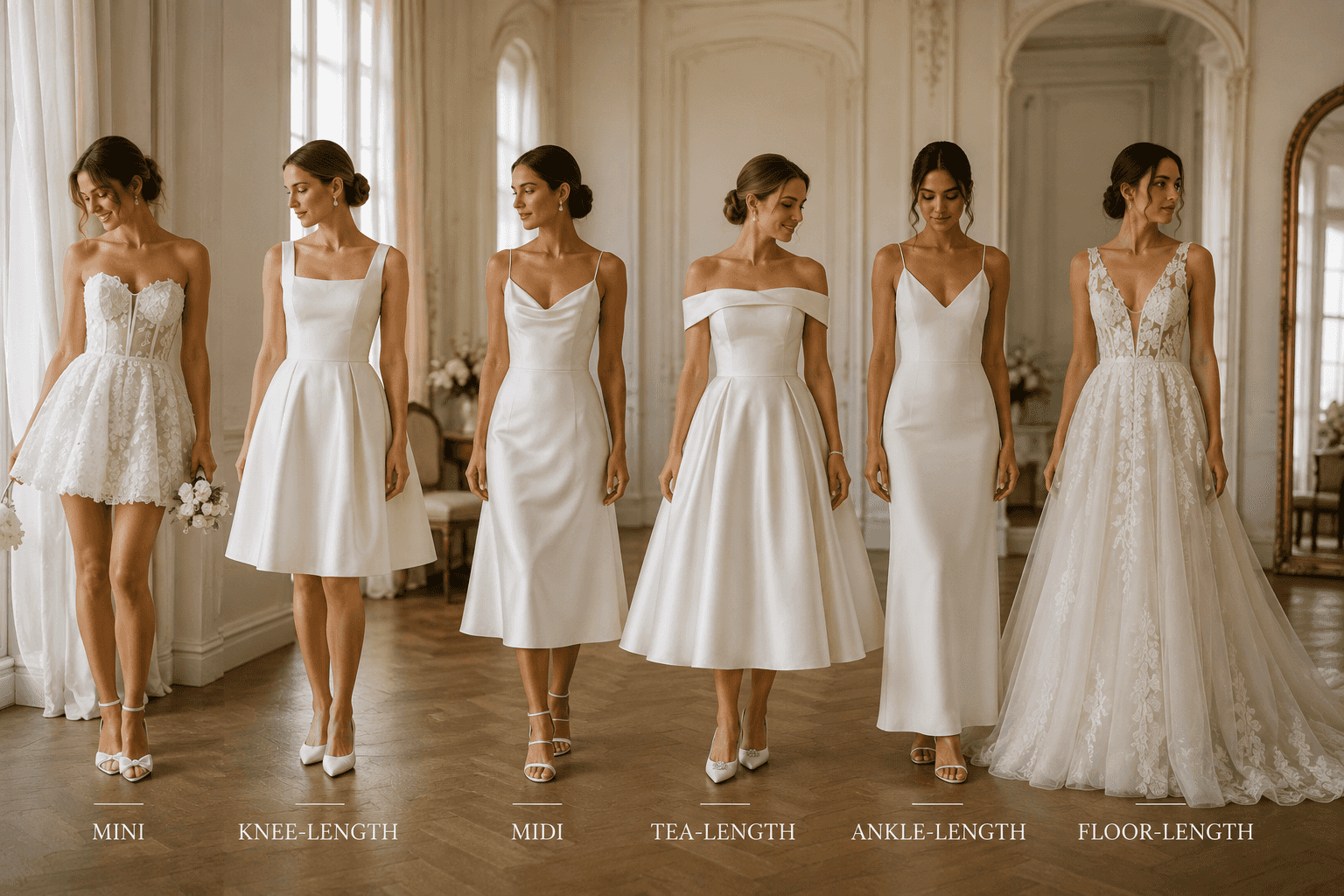
Wedding dresses are usually discussed in terms of silhouette — ball gown, A-line, mermaid, sheath — but length can change the entire feeling of a dress just as dramatically.
A mini wedding dress can feel sharp and modern. A tea-length gown can look playful and retro. A floor-length dress can be minimal, romantic or spectacular depending on the fabric and construction.
There is no single “correct” wedding dress length anymore.
The right length depends on your wedding, your style and what you actually want to wear.
What Are the Main Wedding Dress Lengths?
The most common wedding dress lengths include:
- Mini
- Knee-length
- Midi
- Tea-length
- High-low
- Ankle-length
- Floor-length
The names can overlap slightly between designers, especially around midi and tea-length styles, so always look at where the actual hem falls rather than relying exclusively on the label.
What Is a Mini Wedding Dress?
A mini wedding dress finishes above the knee.
Some are only slightly shorter than knee-length, while others sit much higher on the thigh.
Mini bridal dresses have become especially popular for:
- Civil ceremonies
- City hall weddings
- Welcome parties
- Rehearsal dinners
- Second wedding looks
- After-parties
- Small destination weddings
But there is no reason a mini cannot be the main wedding dress.
A structured ivory mini with beautiful tailoring can feel every bit as intentional as a traditional floor-length gown.
What Does a Mini Wedding Dress Look Best With?
Because the legs are visible, shoes become a much larger part of the overall look.
Pointed pumps, slingbacks, sculptural heels, embellished sandals and even elegant flats can all work beautifully.
A mini also creates an opportunity to play with proportion.
You might pair a very short dress with a long veil, dramatic sleeves or an oversized bow.
That contrast can make a simple mini feel unmistakably bridal.
Who Should Wear a Mini Wedding Dress?
Anyone who wants one.
Mini dresses are sometimes presented as something reserved for very young brides or second looks, but neither is true.
The important question is whether the length suits your personal style and the atmosphere you want to create.
If you feel more like yourself in a sharply tailored short dress than a large traditional gown, that is useful information.
What Is a Knee-Length Wedding Dress?
A knee-length wedding dress finishes approximately around the knee.
It offers more coverage than a mini while still showing the lower leg and shoes.
Knee-length styles can feel elegant, practical and slightly vintage depending on the cut.
They work particularly well for intimate ceremonies, city weddings and brides who want something formal without a full-length skirt.
What Is a Midi Wedding Dress?
A midi dress falls below the knee and above the ankle.
This is a broad category, so one midi may finish just below the knee while another falls close to the ankle.
Midi wedding dresses have become a strong option for modern brides because they balance formality with ease.
They can be sleek and minimalist, softly romantic or highly structured.
Why Choose a Midi Wedding Dress?
Midi dresses are particularly useful when you want a polished look without managing a long train or full-length skirt.
They also allow beautiful shoes to remain visible.
A midi can work well for:
- City ceremonies
- Restaurant weddings
- Civil weddings
- Destination celebrations
- Smaller formal weddings
- Second bridal looks
The length also makes walking, sitting and dancing relatively easy.
What Is a Tea-Length Wedding Dress?
A tea-length wedding dress typically falls between the knee and ankle, often somewhere around mid-calf.
It overlaps with the midi category, but tea-length usually describes a specific bridal proportion rather than simply any mid-length hem.
Traditional tea-length gowns often have a fitted bodice and fuller skirt, creating a silhouette associated with 1950s fashion.
Modern versions can be much sleeker.
Is Tea-Length the Same as Midi?
Not exactly, although the two terms are frequently used interchangeably.
“Midi” describes a general length category.
“Tea-length” often refers to a more specific hem placement and, historically, a particular formal style.
In bridal fashion, the distinction is not always rigid.
If you are shopping online, check the model photos and listed measurements rather than assuming that every designer uses the terms identically.
What Style of Wedding Suits a Tea-Length Dress?
Tea-length wedding dresses are often associated with vintage-inspired weddings, but they are much more versatile than that.
They can work beautifully for garden weddings, town hall ceremonies, intimate celebrations and elegant daytime receptions.
A clean satin tea-length dress can feel extremely contemporary.
A lace version with a full skirt may feel romantic and nostalgic.
What Shoes Work With Tea-Length Wedding Dresses?
Because the shoes are visible, they become part of the design rather than a hidden practical choice.
Classic pumps, slingbacks, Mary Janes, sandals and embellished heels can all work depending on the dress.
If you love bridal shoes, tea-length is one of the best ways to actually let people see them.
What Is an Ankle-Length Wedding Dress?
An ankle-length wedding dress finishes around the ankle rather than touching the floor.
This creates a long, elegant line while still keeping the hem completely off the ground.
Ankle-length gowns can be particularly sophisticated in clean fabrics such as crepe, satin or mikado.
They also make movement easier and allow a small glimpse of the shoes.
What Is a High-Low Wedding Dress?
A high-low wedding dress has a shorter hem in the front and a longer hem in the back.
The difference may be subtle or dramatic.
Some gowns finish around the knee at the front and extend into a train behind. Others create only a slight variation in length.
High-low dresses can be useful if you want the drama of a longer bridal skirt while keeping the front lighter and easier to move in.
Are High-Low Wedding Dresses Still Modern?
They can be, but the exact cut matters.
Very dramatic high-low hems can immediately create a particular fashion-era reference.
More subtle asymmetric lengths tend to feel cleaner and more contemporary.
If you love the idea, focus on the overall shape rather than worrying about whether the category itself is “in” or “out.”
What Is a Floor-Length Wedding Dress?
A floor-length wedding dress extends all the way to the ground.
This is still the most traditional bridal length and the one most frequently associated with formal wedding gowns.
However, “floor-length” covers an enormous range of styles.
A narrow silk column dress and an enormous layered ball gown may both technically have the same length while creating completely different effects.
How Should a Floor-Length Wedding Dress Fall?
The front hem should generally sit close enough to the floor to create a long continuous line without making normal walking unnecessarily difficult.
The exact position depends on:
- Your shoes
- The fabric
- The skirt shape
- Your movement
- The designer’s intended proportion
This is why your wedding shoes — or at least the correct heel height — are essential during alterations.
Should a Wedding Dress Touch the Floor?
Usually, a traditional full-length wedding dress will appear to skim the floor.
That does not necessarily mean the entire hem is dragging directly underneath your feet.
A properly altered gown needs to balance appearance with movement.
If the front is excessively long, you may kick the skirt while walking or repeatedly step on it.
What Is the Difference Between Dress Length and Train Length?
These are two separate things.
The dress length describes where the main hem falls.
The train describes fabric extending beyond the back of the gown.
A wedding dress can therefore be floor-length at the front while having:
- No train
- A sweep train
- A chapel train
- A cathedral train
- A much longer dramatic train
The longer the train, the more fabric you will need to manage during the wedding.
Does a Floor-Length Wedding Dress Need a Train?
No.
A gown can fall beautifully to the floor all the way around without extending behind you.
This can be a particularly good choice for city weddings, restaurant receptions and brides who want a formal gown without the logistics of a train.
Which Wedding Dress Length Is Most Formal?
Floor-length gowns are traditionally the most formal.
But formality also depends on fabric, construction and styling.
A beautifully structured midi in silk mikado may look far more sophisticated than a casual floor-length dress.
Length is one element of formality, not the entire equation.
Can You Wear a Short Wedding Dress to a Formal Wedding?
Yes.
If the dress itself has enough presence.
Sharp tailoring, luxurious fabric, sculptural construction or couture-level detailing can make a shorter gown feel extremely formal.
A dramatic veil or sophisticated accessories can also shift the overall look.
You do not need metres of skirt to look like the bride.
Which Wedding Dress Length Is Best for a Civil Ceremony?
Mini, midi and tea-length dresses are particularly popular for civil ceremonies because they suit the relatively streamlined setting.
But a courthouse does not impose a bridal hemline.
If you want to walk into city hall in a floor-length gown, you absolutely can.
Choose according to the ceremony you are creating rather than an imaginary rule about what civil brides are supposed to wear.
Which Wedding Dress Length Works Best for a Beach Wedding?
Shorter and ankle-length dresses can reduce the amount of fabric dragging through sand.
Lightweight floor-length gowns can also work beautifully if the skirt is manageable.
Very large trains and heavily layered hems may require considerably more effort outdoors.
The practical issue is not simply length — it is how much fabric you have to move through the environment.
Which Length Works Best for a City Wedding?
City weddings can accommodate almost every length.
Mini and midi dresses naturally suit restaurants, town halls and urban streets.
Sleek floor-length gowns can create a particularly strong contrast with modern architecture.
If you expect to walk between locations, consider how easily you can manage the hem and train.
Which Length Works Best for a Castle or Grand Venue?
Large spaces can visually support more fabric.
A floor-length gown with a dramatic skirt or train may feel completely at home in a grand ballroom, historic villa or castle.
But that does not mean you are obligated to match the scale of the venue.
A minimalist column dress or sophisticated midi can create an equally striking contrast.
Does Your Height Determine Your Wedding Dress Length?
No.
Petite brides are not required to avoid full-length gowns, and tall brides are not automatically better suited to them.
Proportion matters more than height alone.
A properly altered floor-length gown can work beautifully on a petite bride, while a carefully chosen mini or midi can look exceptional on a tall bride.
Can Petite Brides Wear Tea-Length Wedding Dresses?
Absolutely.
The key is where the hem intersects the leg.
Moving the hem slightly higher or lower can change the visual proportions considerably.
This is something worth evaluating during alterations rather than rejecting the entire length category in advance.
Should Your Wedding Dress Show Your Shoes?
Only if you want it to.
Mini, midi, tea-length and ankle-length dresses naturally make shoes more visible.
With a floor-length gown, shoes may appear only while walking or sitting.
If you have invested in spectacular bridal shoes and want them to be part of the look, a shorter hem gives them a much more important role.
How Does Fabric Change the Look of a Wedding Dress Length?
Length never operates alone.
A stiff mikado midi can create a sculptural silhouette. The same hemline in chiffon may feel light and relaxed.
A mini in structured satin can look polished and architectural, while one in lace may feel softer or more romantic.
Floor-length crepe creates an entirely different effect from layers of tulle despite both reaching the ground.
Think About Movement
Before choosing a length, imagine the actual wedding day.
Will you walk through a city?
Climb old stone stairs?
Stand on grass?
Dance for hours?
Move between several venues?
A dress does not need to be aggressively practical, but understanding what you will physically do in it helps you choose the amount of fabric you are comfortable managing.
You Can Wear More Than One Length
If you love the drama of a full-length gown but also want the freedom of a mini, you do not necessarily have to choose.
Some brides wear a traditional gown for the ceremony and change into a shorter dress for the reception or after-party.
Convertible overskirts can create a similar effect, allowing a gown to move from full-length drama to a slimmer or shorter silhouette.
How to Choose Your Wedding Dress Length
Consider four things:
- Your personal style: What lengths do you naturally feel good wearing?
- Your venue: How much fabric feels comfortable in the space?
- Your movement: How much walking, dancing and travel will the day involve?
- Your overall bridal look: How will the shoes, veil and accessories work with the hem?
Then try different lengths before deciding.
You may discover that the gown you expected to feel “too short” actually feels modern and effortless — or that nothing gives you the same feeling as a skirt reaching all the way to the floor.
There Is No Correct Bridal Hemline
Mini, midi, tea-length and floor-length wedding dresses all belong in modern bridal fashion.
The length changes the mood, proportion and practicality of the gown, but it does not determine whether the dress is sufficiently bridal.
A bride in a beautifully cut mini is no less dressed for her wedding than a bride wearing a cathedral train.
Choose the length that creates the silhouette you want — not the one you think a wedding dress is required to have.
Tips & Tricks
View All Tips & Tricks


