
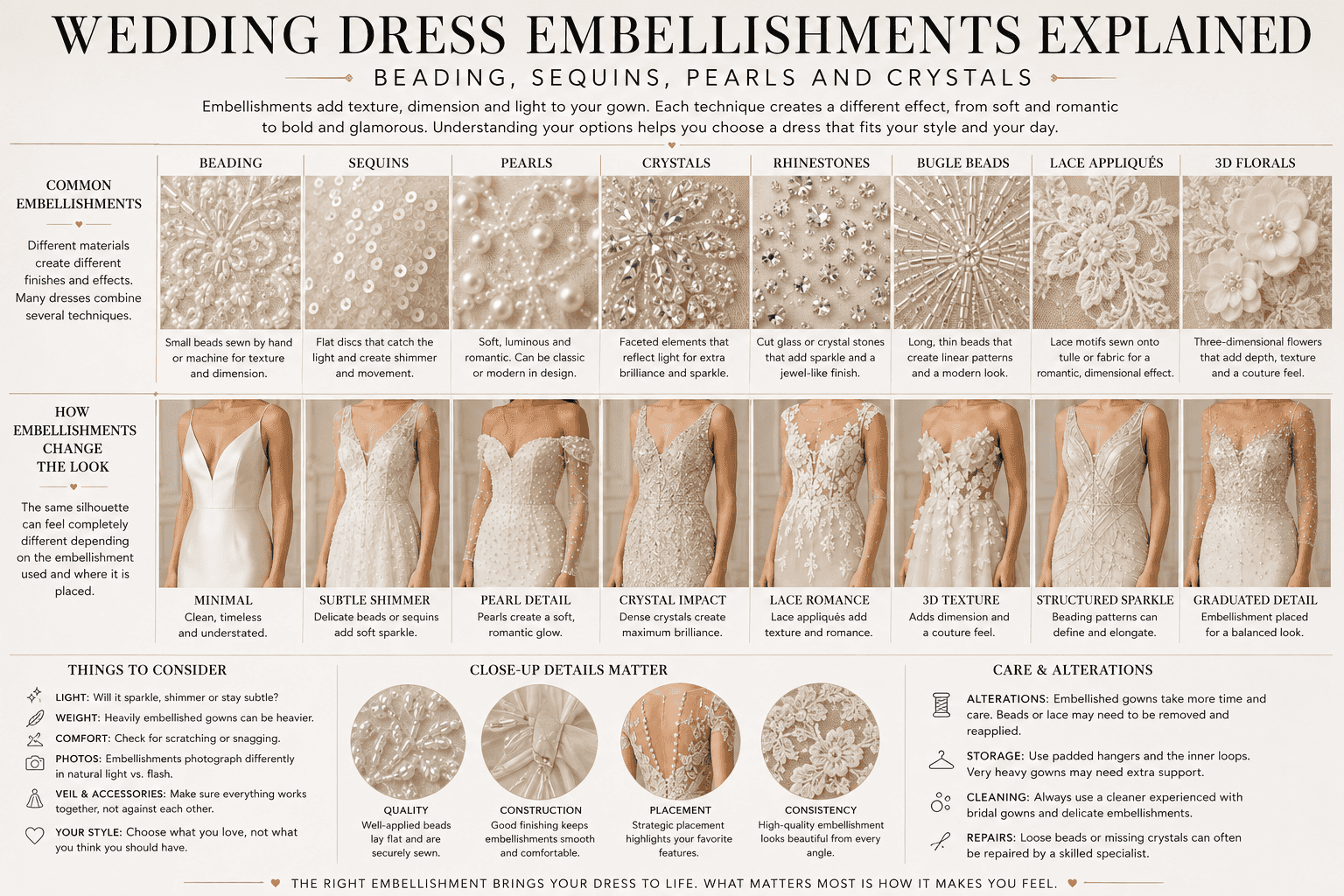
Wedding dress embellishments can completely change the character of a gown. Beading can add texture, sequins can create movement and light, pearls can feel soft and romantic, and crystals can introduce a sharper, more luminous finish.
But not all embellishment works in the same way.
The type, scale, density and placement of decoration affect how a wedding dress photographs, moves, weighs and ultimately feels to wear.
This guide explains the most common wedding dress embellishments, including beading, sequins, pearls, crystals, appliqués and embroidery, plus what to consider when choosing and altering an embellished gown.
What Are the Main Types of Wedding Dress Embellishments?
The most common bridal embellishments include:
- Beading
- Sequins
- Pearls
- Crystals
- Rhinestones
- Bugle beads
- Seed beads
- Embroidery
- Lace appliqués
- 3D floral appliqués
- Paillettes
- Feathers
Many wedding dresses combine several of these techniques, so a heavily embellished gown may contain beads, sequins, lace and crystals all in the same design.
What Is Beading on a Wedding Dress?
Beading refers to decorative beads sewn onto the fabric by hand or machine.
The beads may be tiny and subtle or large enough to become a visible design element.
Beading can cover an entire gown, concentrate around the bodice or appear only along specific lines and motifs.
What Are Seed Beads?
Seed beads are very small, rounded beads often used to create delicate texture.
Because they are tiny, they can be applied densely without looking bulky.
They are frequently used around lace motifs, embroidery and detailed bodices.
What Are Bugle Beads?
Bugle beads are long, narrow tubular beads.
They create linear sparkle and can be arranged in geometric patterns, Art Deco-inspired designs or radiating motifs.
Because of their shape, bugle beads reflect light differently from round beads and often create a sharper, more graphic effect.
What Are Sequins?
Sequins are flat decorative discs that reflect light.
They can be highly visible and glamorous or extremely subtle depending on their size, colour and finish.
Clear, matte or tone-on-tone sequins can add shimmer without making the dress look obviously sparkly.
Are All Sequins Shiny?
No.
Sequins can be:
- Highly reflective
- Matte
- Iridescent
- Transparent
- Pearlescent
- Tone-on-tone with the fabric
A heavily sequined gown does not necessarily look like eveningwear if the finish is soft and tonal.
What Are Paillettes?
Paillettes are larger, usually flat decorative discs similar to sequins.
Because they are bigger, they create a more visible and often more fashion-forward effect.
They may be scattered across tulle or used densely to create texture and movement.
What Are Pearls on a Wedding Dress?
Pearls can be sewn directly onto the fabric, incorporated into embroidery or scattered over illusion tulle.
They create a softer surface effect than crystals because they reflect light more gently.
Pearls can feel classic and traditional, but modern bridal designers often use them in very minimal or unexpected ways.
Are Pearl Wedding Dresses Always Traditional?
No.
A satin gown covered in small pearls can feel extremely contemporary.
Pearls can also be used to create sculptural straps, detachable sleeves or geometric patterns that have very little to do with traditional bridal styling.
As with every embellishment, placement matters more than the material alone.
What Are Crystals?
Crystals are faceted decorative elements designed to catch and reflect light.
They generally create more sparkle than pearls or matte beads.
Crystals may be sewn onto lace, attached individually to tulle or combined with beading in intricate patterns.
What Are Rhinestones?
Rhinestones are faceted decorative stones used to imitate the sparkle of gemstones.
In bridalwear, the terms crystal and rhinestone are sometimes used loosely, although the materials and quality can vary significantly.
What matters visually is the cut, clarity, placement and overall finish.
What Is Crystal Beading?
Crystal beading combines small faceted crystals with traditional beadwork.
This technique can create very dense, luminous surfaces.
It is commonly used on bodices, straps, belts and heavily embellished evening-inspired bridal gowns.
What Is Embroidery?
Embroidery creates decorative patterns using thread rather than applied beads or stones.
The design may be tonal and almost invisible or use contrasting thread for a much stronger effect.
Embroidery can also serve as a base for additional embellishment, with pearls, sequins or beads sewn over the embroidered motif.
What Are Lace Appliqués?
Lace appliqués are individual lace motifs attached to another fabric such as tulle, organza or crepe.
They allow designers to position lace strategically rather than constructing the entire gown from one continuous lace fabric.
Appliqués can create the impression of flowers or vines growing across the bodice, skirt or sleeves.
What Are 3D Floral Appliqués?
Three-dimensional appliqués stand away from the surface of the gown rather than lying completely flat.
Petals, leaves and flowers may be layered to create physical depth.
Some designs remain completely fabric-based, while others include pearls, crystals or beaded centres.
Are 3D Flowers Still Modern?
Yes, but scale and placement make an enormous difference.
Large sculptural flowers can feel highly editorial.
Small scattered florals can create a softer romantic effect.
Dense floral appliqué covering every surface of a gown creates a completely different visual language from a single oversized flower positioned at the shoulder or waist.
What Is a Fully Beaded Wedding Dress?
A fully beaded gown has decorative beadwork covering most or all of its visible surface.
These dresses can look extraordinarily luxurious because the fabric reacts constantly to light.
They can also be much heavier than they appear in photographs.
Are Beaded Wedding Dresses Heavy?
They can be.
Thousands of beads, crystals and sequins add real weight to a garment.
The gown may feel perfectly manageable during a ten-minute appointment but noticeably heavier after several hours.
If you are considering a densely embellished wedding dress, wear the sample for as long as the boutique allows and move around in it.
Do Embellished Wedding Dresses Scratch?
Sometimes.
Beads, sequins and crystals can have edges that catch against skin or other fabric.
Pay attention to areas where your arms repeatedly touch the bodice.
Also check the underarm area, neckline and inner sleeves.
A beautiful dress should not become increasingly irritating as the day continues.
Can Beading Catch on a Veil?
Yes.
Raised embellishment can catch on fine tulle, especially if the veil lies directly against heavily beaded shoulders or bodice areas.
Try your veil with the dress and walk around before committing to the combination.
This is especially important with cathedral-length veils and elaborate beaded backs.
Can Embellishment Damage Other Fabrics?
Potentially.
Sharp crystals, exposed bead edges or sequins may catch on delicate tulle, chiffon or silk.
This is one reason the internal finishing of an embellished gown matters.
High-quality construction should minimize rough edges wherever possible.
Why Do Some Embellished Dresses Sparkle More in Photos?
Different embellishments respond differently to light.
Crystals reflect sharply. Sequins create flashes as the dress moves. Pearls produce a softer sheen. Tonal beads may create texture without obvious sparkle.
Lighting matters too.
A gown that looks subtle in a softly lit boutique may appear far more luminous under flash photography or evening reception lighting.
Do Crystals Look Different in Daylight?
Yes.
Natural daylight tends to reveal the actual material and colour clearly, while artificial evening light can increase sparkle and contrast.
If possible, look at the dress under more than one lighting condition.
What Is Tone-on-Tone Embellishment?
Tone-on-tone embellishment uses beads, sequins or embroidery in a colour very close to the underlying fabric.
The result is texture without strong contrast.
An ivory gown with ivory beads may look almost plain from a distance and reveal extraordinary detail only up close.
This is a useful option if you like embellishment but do not want obvious sparkle.
What Is Silver or Metallic Embellishment?
Some wedding dresses use silver, gold or metallic thread, crystals and beads to create visible contrast against ivory fabric.
This can make the design feel more evening-focused or dramatic.
Metallic embellishment can also influence accessory choices because jewellery, shoes and hair pieces become part of the same visual story.
Does Embellishment Affect the Colour of a Wedding Dress?
Yes.
A nude lining under ivory beading creates a very different effect from ivory-on-ivory.
Silver crystals can cool the overall appearance of a gown, while champagne or gold beading can introduce warmth.
When evaluating colour, look at the entire finished surface rather than only the base fabric.
What Is Scattered Embellishment?
Scattered embellishment places decorative elements individually across the fabric rather than arranging them into a dense pattern.
This can create the impression of stars, droplets or flowers floating over tulle.
It is particularly effective when designers want visual interest without covering the gown completely.
What Is Graduated Embellishment?
Graduated embellishment changes density across the gown.
For example, a bodice may be densely beaded while the decoration gradually becomes lighter toward the hem.
This creates a natural transition and can visually direct attention toward particular areas of the dress.
What Is Placement Embellishment?
Placement embellishment uses decorative details only in specific areas.
Common examples include:
- Beaded straps
- Crystal waistlines
- Pearl necklines
- Embellished cuffs
- Beaded backs
- Decorated trains
This allows one part of the gown to become the focal point without embellishing everything.
How Does Embellishment Affect the Silhouette?
Decoration can visually emphasize shape.
Vertical beading can elongate the body.
Dense embellishment around the waist can draw attention to that area.
Radiating crystal patterns can highlight the bust or hips.
Large appliqués add visible texture and can alter the apparent scale of a gown.
Can Embellishment Make a Dress Look More Structured?
Yes.
Geometric beadwork and defined crystal patterns can reinforce architectural lines even when the underlying fabric is soft.
Conversely, scattered florals or loose embroidery can make a structured gown feel more romantic.
Can Embellishments Be Removed?
Sometimes.
Individual beads, appliqués or decorative elements may be removed during alterations.
However, the process can leave visible marks or expose stitching underneath.
If the embellishment forms part of the gown’s structural seams, removing it may become much more complicated.
Can You Add Beading to a Wedding Dress?
Yes.
A skilled dressmaker or bridal alterations specialist can often add beads, pearls, crystals or sequins to an existing gown.
Common additions include:
- Embellished straps
- Beaded waistlines
- Pearl-covered bodices
- Crystal appliqués
- Additional sparkle over lace
Matching the style and quality of the original gown is essential.
Can You Add Pearls to a Wedding Dress?
Absolutely.
Pearls can be scattered individually across tulle or sewn into existing lace motifs.
They can also be used on veils, detachable sleeves or straps to coordinate with the gown.
Can You Add Crystals to a Plain Wedding Dress?
Yes, although restraint often produces a more convincing result.
A few carefully placed crystal details can look intentional.
Randomly adding sparkle to every available surface can make a clean gown feel visually confused.
If you chose a minimalist wedding dress because you loved its simplicity, make sure you are not redesigning away the exact quality that attracted you to it.
Can Beading Be Repaired?
Usually.
Loose beads can often be resewn and missing pieces replaced.
This is especially relevant for sample sale, vintage and second-hand wedding dresses.
The biggest challenge is finding replacements that match the original colour, size and finish.
Check the Gown for Loose Embellishment
When buying an embellished sample or off-the-rack gown, inspect it carefully.
Look for:
- Loose threads
- Missing beads
- Broken sequins
- Missing crystals
- Damaged appliqués
- Areas where embellishment has pulled the fabric
A few missing beads may be easy to repair. Large damaged sections may require much more work.
Why Are Beaded Wedding Dresses More Expensive to Alter?
Because the decoration often needs to be removed before the seam itself can be accessed.
The seamstress may need to:
- Remove beads around the seam
- Open and alter the garment
- Reconstruct the seam
- Replace the original beadwork by hand
A simple side-seam adjustment can therefore involve far more labour than the same alteration on a plain crepe dress.
Does Embellishment Make Hemming More Difficult?
It can.
If beads, sequins, lace or appliqués extend to the hem, they may need to be removed and repositioned when the skirt is shortened.
Some heavily embellished gowns are designed so that the length is adjusted from another seam rather than directly at the bottom.
Your seamstress needs to examine the actual construction before deciding on the best approach.
Can a Heavily Beaded Dress Be Taken In?
Yes, but the alteration may be time-consuming.
Beadwork around the seams must usually be carefully removed first.
After the fit is changed, the decorative pattern needs to be restored so that the alteration does not become obvious.
Do Embellished Wedding Dresses Need Special Cleaning?
Often.
Beads, glued crystals, sequins and delicate embroidery can react differently to cleaning methods.
Always tell the cleaner exactly what materials are present and use someone experienced with bridal gowns.
How Should an Embellished Wedding Dress Be Stored?
Weight matters here too.
A very heavy beaded gown may stretch if left hanging from delicate shoulder straps for long periods.
Use the internal hanging loops provided by the designer and follow the boutique’s storage instructions.
Some particularly heavy gowns may be better stored flat or carefully supported.
Can You Wear a Heavily Embellished Dress With a Detailed Veil?
You can.
The question is whether the two pieces complement or compete with each other.
If the gown has dense crystal embroidery, a simple veil may allow the dress to remain the focus.
If the gown has subtle pearl embellishment, a pearl veil may create a beautifully coordinated effect.
There is no rule against detail on detail — it simply needs visual balance.
How Should Jewellery Work With an Embellished Wedding Dress?
Look at what is already happening around your face and neckline.
If the gown has a highly embellished neckline, large necklace and dramatic earrings may feel unnecessary.
If most of the embellishment is concentrated on the skirt, you may have far more freedom above the waist.
Think in terms of the complete composition rather than trying to match every bead individually.
Do Pearls Need Pearl Accessories?
No.
A pearl wedding dress does not obligate you to wear pearl earrings, a pearl veil, pearl shoes and a pearl handbag.
Repeating one detail can be elegant. Repeating it everywhere can become literal.
Do Crystals Need Silver Jewellery?
Again, not necessarily.
Look at the overall tone of the embellishment and your own jewellery preferences.
Mixed metals can work beautifully, particularly when the gown contains neutral crystal rather than strongly silver detailing.
Which Embellishment Works Best for a Minimalist Wedding Dress?
If you want to preserve a minimalist look, consider selective rather than all-over embellishment.
A pearl strap, crystal neckline, embellished back or single sculptural appliqué can provide detail without dominating the clean silhouette.
Which Embellishment Creates the Most Sparkle?
Faceted crystals and highly reflective sequins generally produce the strongest sparkle.
But density matters.
A gown covered in thousands of tiny crystal beads may sparkle more than one with a handful of larger stones.
Which Embellishment Is the Most Subtle?
Tonal embroidery, matte beads, tiny pearls and clear sequins can all create subtle texture.
From a distance, the dress may appear almost unembellished while revealing much more detail up close.
How to Choose Wedding Dress Embellishment
Consider:
- Light: Do you want sparkle, sheen or almost no reflection?
- Texture: Do you prefer a smooth surface or visible dimension?
- Weight: Is the gown comfortable enough to wear for hours?
- Placement: Where do you want the eye to go?
- Accessories: How will the veil and jewellery work with the detail?
- Alterations: Will extensive beadwork make resizing or hemming more complicated?
- Your style: Do you actually love sparkle, or do you simply feel that a bride is supposed to have some?
Embellishment Should Add to the Dress, Not Rescue It
A beautiful wedding dress does not need beading, pearls, crystals or sequins to qualify as bridal.
And an embellished dress does not automatically look more expensive or special than a clean one.
The decoration should strengthen the design that is already there.
If you love a gown because thousands of tiny beads turn it into light every time you move, wonderful.
If you prefer an uninterrupted sweep of silk with absolutely nothing sewn onto it, equally wonderful.
The best embellishment is the amount that makes the dress feel more like your dress — whether that means ten thousand crystals or none at all.
Tips & Tricks
View All Tips & Tricks


