
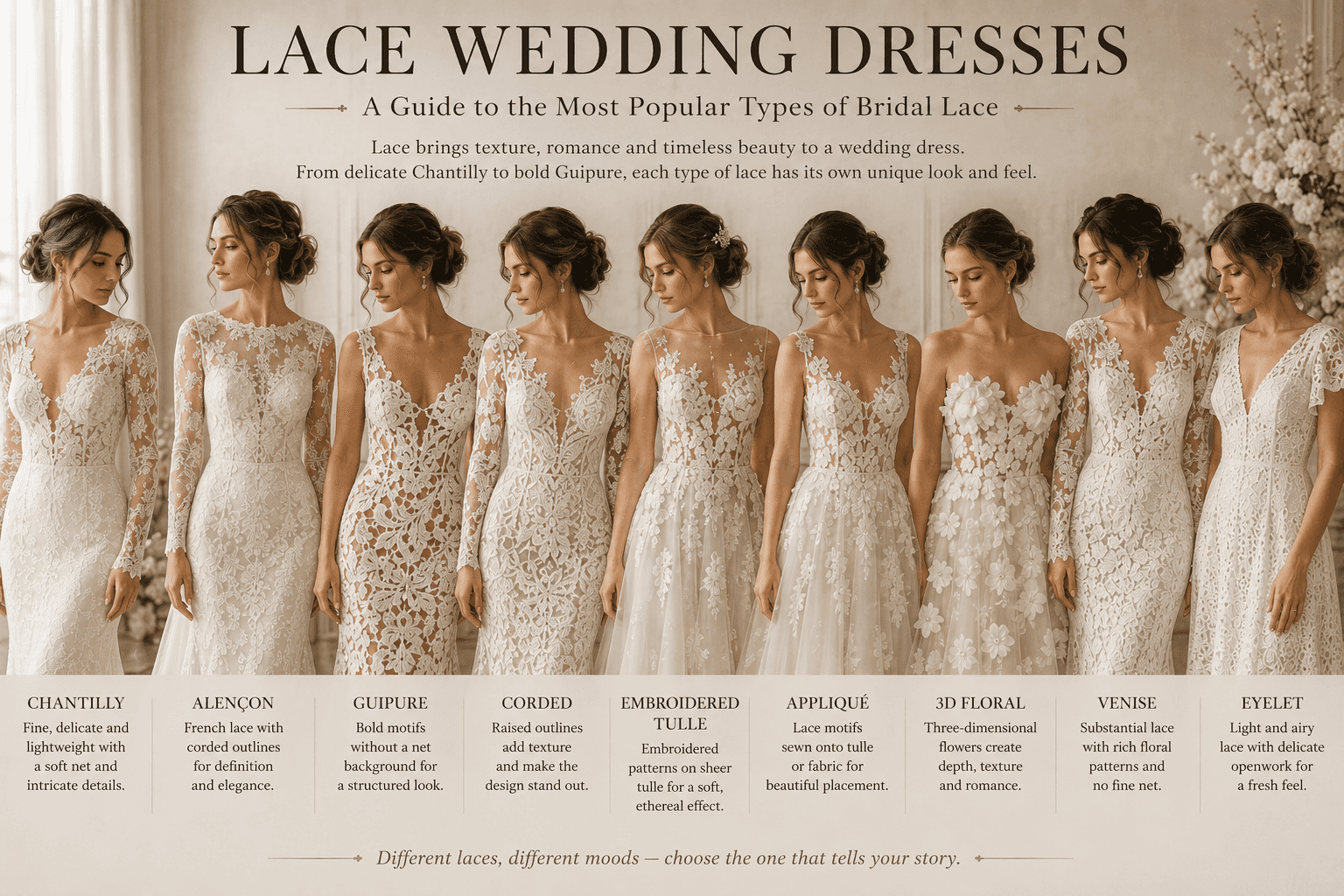
Lace is one of the most recognizable wedding dress fabrics, but “a lace wedding dress” can mean almost anything. Fine Chantilly lace can look delicate and almost weightless, while corded lace creates visible texture and Guipure can produce bold, graphic motifs with very little transparency.
The type of lace affects far more than decoration. It changes the texture, structure, weight, transparency and overall mood of a wedding dress.
This guide explains the most popular types of bridal lace, including Chantilly, Alençon, Guipure, embroidered tulle, corded lace and 3D floral lace, plus how different laces are used on modern wedding dresses.
What Are the Main Types of Lace Used for Wedding Dresses?
Bridal designers work with an enormous range of traditional and contemporary laces, but some of the most common include:
- Chantilly lace
- Alençon lace
- Guipure lace
- Corded lace
- Embroidered tulle
- Appliqué lace
- 3D floral lace
- Venise lace
- Eyelet lace
- Crochet-inspired lace
You may also encounter designer-specific fabrics that combine embroidery, lace, beading, sequins and appliqués, making them difficult to place neatly into one category.
What Is Chantilly Lace?
Chantilly lace is known for being fine, lightweight and delicate.
Traditional Chantilly lace features detailed floral or botanical motifs worked into a very fine net background.
Because the lace itself is relatively soft, it drapes beautifully and can follow the body without adding much bulk.
What Does Chantilly Lace Look Like on a Wedding Dress?
Chantilly lace often creates a soft, romantic effect.
It can be used across an entire gown or layered underneath other fabrics to create subtle texture.
Designers frequently use it for:
- Fitted bodices
- Long sleeves
- Illusion necklines
- Soft skirts
- Veils
- Underlayers beneath appliqués
Its delicacy makes it particularly beautiful when the designer wants detail without heaviness.
Is Chantilly Lace Fragile?
It can be more delicate than heavier lace constructions.
Fine netting can snag, particularly around jewellery, beading or rough surfaces.
That does not make Chantilly unsuitable for a wedding dress. It simply means the gown should be handled with appropriate care.
What Is Alençon Lace?
Alençon is a traditional French lace known for floral motifs outlined with a heavier cord or thread.
That raised outline gives the pattern more definition than very fine Chantilly lace.
It can therefore create a richer, slightly more structured appearance while still retaining the intricacy associated with traditional lace.
What Does Alençon Lace Look Like on a Wedding Dress?
Alençon works beautifully when the lace pattern itself is meant to be clearly visible.
It is often used on bodices, sleeves and overlays, and its defined motifs can also be cut into individual appliqués.
The result can feel classic and romantic, although contemporary designers can use the same lace in much cleaner silhouettes.
What Is Guipure Lace?
Guipure is a heavier lace constructed from motifs connected directly to one another rather than sitting on a fine net background.
It is sometimes called Venetian lace, although terminology can vary depending on the specific textile.
Because there is no delicate mesh filling the spaces between motifs, Guipure tends to look bolder and more graphic.
What Does Guipure Lace Look Like on a Wedding Dress?
Guipure can create striking patterns with significant visual texture.
It is often used for:
- Structured bodices
- Column dresses
- Modern A-lines
- Sleeves
- Statement overlays
Large-scale Guipure motifs can feel surprisingly contemporary, particularly when paired with simple construction.
Is Guipure Lace Heavy?
Generally, it has more physical substance than fine Chantilly lace.
Exactly how heavy it feels depends on the thickness of the threads, density of the motifs and amount used on the gown.
A full Guipure dress may therefore feel more structured than a gown covered in very fine lace.
What Is Corded Lace?
Corded lace has selected parts of the pattern outlined with a thicker thread or cord.
This creates a raised surface and makes the motif more visible.
The technique can be applied to different types of lace, so “corded lace” describes a construction detail rather than one single pattern.
Why Do Designers Use Corded Lace?
The additional outline gives lace more definition, especially from a distance.
Very fine patterns can disappear visually in photographs, while corded motifs maintain stronger shapes.
This makes corded lace useful for gowns where the designer wants intricate detail that remains visible across a room.
What Is Embroidered Tulle?
Embroidered tulle is technically not always lace in the traditional sense, although it is frequently grouped with bridal laces.
Decorative motifs are embroidered directly onto a tulle or mesh base.
This gives designers enormous freedom over pattern, scale and placement.
What Does Embroidered Tulle Look Like?
It can imitate traditional floral lace or look completely contemporary.
Designers can create:
- Botanical motifs
- Geometric patterns
- Oversized flowers
- Fine vines
- Abstract embroidery
- Metallic designs
Beads, sequins, pearls and crystals can also be incorporated into the embroidery.
What Is Lace Appliqué?
Lace appliqué refers to individual lace motifs that are cut out and attached to another fabric.
Rather than covering the entire gown in one continuous piece of lace, the designer can position each motif exactly where it is wanted.
This is one of the most common techniques in contemporary bridal design.
Why Is Lace Appliqué So Popular?
It allows the lace to follow the architecture of the dress.
Flowers can climb organically across a corset, fade gradually into a skirt or frame a neckline without requiring lace everywhere else.
Appliqués are also ideal for illusion designs because the motifs can appear to float over bare skin.
What Is 3D Floral Lace?
Three-dimensional floral lace uses layered or sculpted motifs that physically stand away from the surface of the gown.
Petals may be cut individually and attached in layers, sometimes with pearl, bead or crystal centres.
The result creates actual depth rather than simply the visual impression of texture.
Are 3D Floral Wedding Dresses Still Popular?
Three-dimensional flowers remain an important element of contemporary bridal design, but the way they are used continues to evolve.
Some gowns are covered in hundreds of tiny petals. Others use only a few oversized flowers as sculptural accents.
The second approach can feel almost architectural rather than traditionally romantic.
What Is Venise Lace?
Venise lace is a substantial lace with dense motifs and no obvious fine net background.
It is closely associated with Guipure-style construction and the names are sometimes used interchangeably in fashion descriptions.
Venise lace often features clearly defined floral, scroll or geometric patterns.
What Is Eyelet Lace?
Eyelet fabric features small decorative openings finished with embroidery.
It is lighter and more casual than many traditional bridal laces.
Eyelet wedding dresses can work particularly well for summer, destination and relaxed outdoor weddings.
What Is Crochet Lace?
Crochet lace has a more handmade, open-work appearance.
True crochet is constructed differently from machine-made lace, although bridal fabrics may sometimes imitate the effect.
It is commonly associated with relaxed, bohemian and destination bridal styles.
What Is Floral Lace?
Floral lace simply describes the motif rather than the construction.
A floral pattern can appear in Chantilly, Alençon, Guipure, embroidered tulle or appliqué.
This is why seeing “floral lace wedding dress” in a product description does not tell you exactly what kind of lace is being used.
What Is Botanical Lace?
Botanical lace expands beyond obvious flowers to include leaves, vines, branches and other plant-inspired forms.
Large botanical patterns have become especially popular on contemporary gowns because they can create strong graphic movement across the dress.
What Is Geometric Lace?
Geometric lace uses repeating lines, shapes or abstract patterns rather than traditional flowers.
It can be an excellent choice for brides who like texture but do not identify with very romantic floral lace.
Depending on the scale, geometric lace can feel Art Deco, minimalist, modern or slightly retro.
What Is All-Over Lace?
All-over lace means the lace pattern covers most or all of the visible gown.
The dress may be constructed directly from lace fabric or use a complete lace overlay over another material.
Because the pattern appears everywhere, the scale and density of the lace have a major effect on the finished look.
What Is a Lace Overlay?
A lace overlay is a layer of lace placed over another fabric.
The base may be ivory, nude, blush, champagne or another colour.
Changing the colour underneath can dramatically alter how strongly the lace pattern appears.
Why Do Some Lace Wedding Dresses Have Nude Lining?
Contrast.
Ivory lace placed over a skin-tone or nude lining becomes much more visible than ivory lace over ivory fabric.
The effect can emphasize corsetry, lace motifs and the architecture of the gown.
A matching ivory lining creates a softer, more tonal appearance.
What Is Illusion Lace?
Illusion lace usually refers to lace motifs applied over very fine transparent tulle.
The underlying mesh is designed to blend with the skin so that the lace appears to float across the body.
This technique is frequently used on:
- Necklines
- Backs
- Sleeves
- Side panels
- Plunging necklines
Does the Colour of Illusion Tulle Matter?
Very much.
If the mesh does not coordinate reasonably well with your skin tone, the illusion effect becomes much more obvious.
Ask whether the designer offers alternative mesh shades if the boutique sample is not a good match.
Can Lace Be Modern?
Absolutely.
Lace itself is not inherently traditional.
A large-scale Guipure pattern on a clean column gown can feel extremely modern. So can abstract embroidered tulle, geometric lace or a minimalist dress with one oversized lace appliqué.
The silhouette, scale and styling determine whether lace feels traditional or contemporary.
What Makes Lace Look Vintage?
Fine floral motifs, scalloped edges, high necklines and certain sleeve treatments can reference historical bridal fashion.
But “vintage” covers many different eras.
A 1920s-inspired geometric lace dress looks completely different from a 1950s tea-length lace gown or a 1970s crochet-style wedding dress.
What Makes Lace Look Expensive?
There is no single motif that automatically makes lace luxurious.
Look at:
- The clarity of the pattern
- The quality of the base mesh
- How motifs meet at seams
- Whether appliqués are carefully positioned
- How edges are finished
- The quality of any beadwork or embroidery
- How the lace behaves when the dress moves
Excellent placement and construction can make a relatively simple lace look extraordinary.
Why Does Lace Placement Matter?
Lace is not simply surface decoration.
The motifs can be positioned to emphasize the shape of the dress.
Designers may place lace vertically to create length, concentrate it around the waist, use motifs to frame a neckline or gradually fade the pattern from bodice to skirt.
The same lace can look completely different depending on how it is positioned.
What Is Lace Matching?
Lace matching refers to aligning motifs across seams so that the pattern appears continuous.
On high-quality construction, a seam may almost disappear because flowers and vines have been carefully positioned across it.
This can require considerably more fabric and labour than simply cutting pieces wherever they fit.
What Is a Scalloped Lace Edge?
Some lace fabrics have a decorative finished border rather than a straight edge.
This scalloped border may be used along:
- Necklines
- Sleeves
- Veils
- Skirt hems
- Trains
It creates a natural decorative finish without requiring a separate trim.
Why Can Lace Wedding Dresses Be Expensive to Alter?
Lace often crosses the seams that need to be adjusted.
A seamstress may therefore need to remove appliqués, alter the underlying dress and then reposition the lace afterward.
Pattern matching can add even more work.
The final alteration should look as though the seam was always constructed in its new position.
Can a Lace Wedding Dress Be Taken In?
Usually, yes.
The complexity depends on the construction and placement of the motifs.
If the lace is heavily beaded or appliquéd across the seams, taking in the dress may involve significant handwork.
Can a Lace Wedding Dress Be Let Out?
Possibly.
As with any wedding dress, the seamstress first needs to check how much seam allowance is available.
With lace, the additional challenge is making sure the pattern still looks coherent once the seam is repositioned.
Can Lace Sleeves Be Altered?
Yes.
Lace sleeves can often be shortened, narrowed or otherwise adjusted.
Fine illusion sleeves and heavily appliquéd designs require particularly careful work because every seam is visible.
Can Lace Be Added to a Wedding Dress?
Absolutely.
Matching lace can potentially be added to:
- Sleeves
- Necklines
- Backs
- Side panels
- Skirts
- Trains
Individual appliqués make customization especially flexible because they can be positioned selectively.
Can Lace Be Removed From a Wedding Dress?
Sometimes.
Appliqués may be removable if they are sewn over another complete fabric layer.
But lace can also be integral to the gown’s construction.
Removing it may expose seams, mesh or unfinished areas underneath, so the dress needs to be examined before assuming the change will be simple.
Can You Add Beading to Lace?
Yes.
Pearls, seed beads, crystals and sequins can all be incorporated into lace motifs.
Adding embellishment selectively can emphasize particular flowers or patterns without covering the entire gown in sparkle.
Is Lace Comfortable?
That depends entirely on the lace and where it touches the body.
Some fine laces are extremely soft.
Heavier corded motifs, sequins and beads may feel rougher, particularly around the underarms and neckline.
Move your arms during the appointment and notice whether any edge repeatedly rubs against your skin.
Can Lace Snag?
Yes.
Open lace structures can catch on jewellery, shoe embellishments, rough surfaces and even other parts of the gown.
Be particularly careful with bracelets and rings while dressing.
Does Lace Photograph Well?
Beautifully — but different lace behaves differently in photographs.
Very fine tonal lace may look subtle from a distance, while large motifs remain clearly visible.
Beaded or sequined lace can react strongly to flash and evening lighting.
If lace detail is one of the main reasons you love the dress, look at photographs from several distances before deciding.
How Does Lace Work With a Veil?
You can either coordinate the lace or deliberately keep the veil simple.
A plain tulle veil allows an elaborate lace gown to remain the focus.
A lace-edged veil can echo motifs from the dress.
A full lace veil combined with an all-over lace gown creates a much richer effect.
None is inherently better. The question is how much visual detail you want overall.
Does the Lace on the Veil Need to Match the Dress?
No.
It should look harmonious, but it does not necessarily need to be identical.
In fact, two almost-matching floral patterns can sometimes compete more than deliberately different designs.
Try the veil with the gown rather than matching it based on product descriptions alone.
Which Lace Is Best for a Summer Wedding Dress?
Lightweight Chantilly lace, embroidered tulle and open-work designs can feel particularly appropriate in warm weather.
But remember that comfort depends on the entire gown.
A fine lace dress with several heavy lining layers may feel warmer than an unlined gown made from a more substantial-looking lace.
Which Lace Is Best for a Winter Wedding Dress?
Heavier corded, Guipure and densely embroidered laces can create a richer visual effect for winter.
Long lace sleeves are also popular for cold-weather weddings.
However, lace itself provides limited warmth, particularly when it is sheer.
Choose it for the design rather than expecting an illusion sleeve to function as winter clothing.
Which Lace Works for a Minimalist Wedding Dress?
Minimalism and lace are not opposites.
Look for:
- Large-scale motifs
- Geometric patterns
- Clean Guipure lace
- Selective appliqué
- One lace statement element
A simple silhouette can actually make an unusual lace more noticeable because there are fewer competing details.
Which Lace Works for a Romantic Wedding Dress?
Fine floral Chantilly, embroidered tulle and delicate appliqués naturally lend themselves to softer romantic designs.
Layering lace over tulle can increase the effect, particularly when the motifs appear to dissolve into the skirt.
How to Choose Lace for a Wedding Dress
Consider:
- Scale: Do you prefer tiny intricate motifs or large statement patterns?
- Texture: Do you want something fine and flat or raised and dimensional?
- Transparency: How much of the lining or skin should show through?
- Structure: Should the lace drape softly or hold a stronger shape?
- Embellishment: Do you want plain lace or additional beads, pearls and sequins?
- Placement: Do you want lace everywhere or only in selected areas?
- Comfort: How does the fabric feel against your skin?
Do Not Choose Lace Because Wedding Dresses Are “Supposed” to Have Lace
Lace has centuries of association with bridal fashion, but that does not make it compulsory.
If you love clean silk, satin, crepe or mikado, you do not need to add lace simply to make the dress look more bridal.
Equally, if you adore lace, you do not need to worry that it will automatically make your gown traditional or old-fashioned.
The design determines the result.
The Lace Should Belong to the Dress
The best lace wedding dresses use the textile as part of the architecture of the gown rather than simply placing decoration over the surface.
Look at how motifs follow the neckline, disappear into illusion panels, travel across seams and continue into the skirt.
Look closely at the lace — and then step back and look at the entire dress.
You should love the gown first. The fact that its lace happens to be Chantilly, Guipure or something entirely new comes second.
Tips & Tricks
View All Tips & Tricks


