
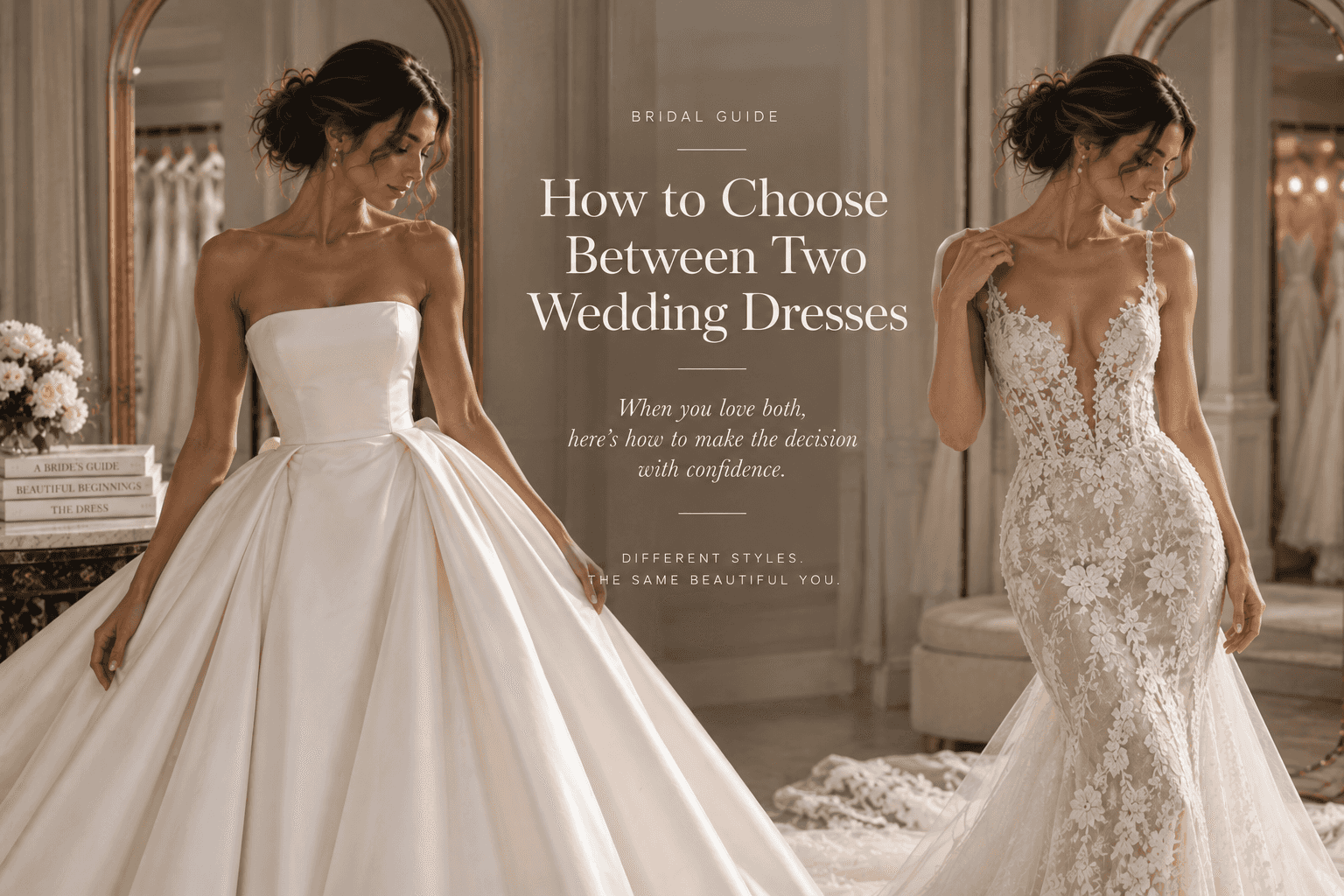
Choosing between two wedding dresses can be harder than finding one you like in the first place.
By this stage, you are usually not comparing a good dress with a bad dress. You are comparing two dresses you genuinely love, often for completely different reasons.
One may feel romantic and dramatic. The other may feel cleaner, more modern or more like your everyday style. One may photograph beautifully. The other may feel better when you move. One may impress everyone in the room while the other quietly keeps pulling your attention back.
If you are stuck between two wedding dresses, the goal is not to discover which gown is objectively better.
It is to work out which one you actually want to wear.
First, Stop Asking Which Dress Is “Better”
There may be no useful answer.
One dress can have better lace while the other has a stronger silhouette. One can be more dramatic while the other feels more effortless.
Wedding dresses are not being scored at an international technical competition.
The important question is:
Which dress would you be more disappointed to lose?
Try Both Dresses Again
If possible, put both gowns on during the same appointment.
Your memory is not always reliable when comparing dresses tried days or weeks apart.
Lighting, mood, styling, the people with you and even how tired you were can change your impression.
Seeing both dresses again under similar conditions makes the comparison much more useful.
Put Your Favourite On Second
If you already suspect one dress is winning, try the other first.
Then put your suspected favourite back on.
Notice what happens immediately.
Do you relax?
Do you smile?
Does the second dress suddenly feel more obviously right?
Or does returning to it reveal that you had exaggerated how much you loved it?
Either reaction gives you information.
Do Not Ask Everyone to Vote Immediately
The fastest way to become confused is to turn your fitting room into a referendum.
If six people immediately announce:
- “Dress one!”
- “No, definitely two!”
- “I liked the other one from Tuesday!”
you can lose track of your own reaction remarkably quickly.
Let the bride speak first.
Say what you think before asking anyone else.
Compare How You Feel, Not Just How the Dresses Look
Both gowns may look beautiful.
Ask how you feel while wearing them.
Do you feel:
- Confident?
- Comfortable?
- Attractive?
- Elegant?
- Excited?
- Like yourself?
A dress can be visually impressive while making you feel strangely disconnected from yourself.
That matters.
Which Dress Makes You Look at Yourself?
This is a useful distinction.
With one gown, you may think:
That dress is beautiful.
With the other:
I look beautiful.
The second reaction is often more important.
Imagine the Dresses Without the Boutique Experience
Bridal boutiques are designed to make dresses feel extraordinary.
There are mirrors, lighting, veils, platforms and people paying attention to every detail.
Now mentally remove all of it.
Imagine each dress in your actual venue.
Which one still feels right?
Picture the Ceremony
Imagine walking toward your partner in Dress One.
Then imagine the same moment in Dress Two.
Do not think about which photograph looks more impressive.
Think about which version feels more natural when you picture the actual moment.
Picture the Entire Wedding Day
Your dress has to exist beyond the ceremony entrance.
Imagine:
- Getting into the car
- Walking through the venue
- Taking photographs
- Sitting at dinner
- Talking to guests
- Dancing
Which gown fits more naturally into your day?
Compare the Silhouettes First
Forget lace, buttons, pearls and detachable sleeves for a moment.
Look at the overall shape.
Which silhouette do you prefer?
Maybe one dress has spectacular detailing but the other gives you the proportion you actually love.
Silhouette usually has more visual impact than individual decoration.
Then Compare the Necklines
The neckline sits close to your face and appears in a huge percentage of wedding photographs.
Ask:
- Which frames your shoulders better?
- Which feels more secure?
- Which works with your jewellery?
- Which looks better from close range?
If you strongly prefer the neckline of one gown, give that preference appropriate weight.
Compare the Waistlines
Waist placement can completely change the personality of a wedding dress.
A natural waist may feel classic.
A Basque waist may feel more elongated and dramatic.
A drop waist may create a longer, more fashion-forward silhouette.
Look at the complete proportion rather than simply asking which dress feels more “flattering.”
Compare the Fabrics
You will spend hours physically wearing this material.
Which fabric do you actually prefer?
Maybe you love:
- The crispness of Mikado
- The sheen of satin
- The softness of tulle
- The texture of lace
- The clean fall of crepe
Fabric affects not only appearance but movement, weight and how formal the gown feels.
Compare the Dresses in Natural Light
If possible, see both gowns near natural light.
Artificial boutique lighting can change:
- Ivory tones
- Nude linings
- Sheen
- Beading
- Transparency
A dress that looks subtle indoors may sparkle dramatically outside, while another may photograph more softly than expected.
Take Photographs From the Same Angles
If photography is permitted, take comparable images of both dresses.
Use:
- Front
- Back
- Side
- Close-up neckline
- Full-length movement shot
Do not compare one professionally posed photograph of Dress One with a blurry photograph of Dress Two taken while somebody was asking you to turn around.
Give the dresses a fair fight.
Look at the Photographs Later
You do not need to decide inside the boutique.
Look at the photographs later when the fitting-room energy has disappeared.
Often one dress begins to stand out very clearly once you are no longer surrounded by opinions.
But Do Not Analyse the Photographs to Death
There is a point where useful comparison becomes forensic investigation.
If you have zoomed into the same image eighteen times and are now evaluating whether your right shoulder looks 3% better in Dress Two, the process has stopped helping.
Judge the complete look.
Which Dress Do You Keep Thinking About?
After the appointment, notice which gown returns to your mind naturally.
Not which one you think you should choose.
Which one do you actually picture?
Which one do you open the photographs of first?
Which one would you most like to put on again?
Which Dress Would You Be More Upset to Lose?
This is one of the best tie-breakers.
Imagine the boutique calls tomorrow.
Dress One has been discontinued and can no longer be ordered.
What is your immediate reaction?
Now imagine the same thing happens to Dress Two.
Which loss hurts more?
That answer can be considerably more revealing than another pros-and-cons list.
The Coin-Toss Test
You do not actually have to let a coin choose your wedding dress.
Assign Dress One to heads and Dress Two to tails.
Flip the coin.
Before looking at the result, notice which side you hope it lands on.
Congratulations. The coin has completed its entire professional responsibility.
Compare What You Would Change
Write down the modifications you would want for each gown.
For example:
Dress One:
- Shorten straps
- Hem
- Add bustle
Dress Two:
- Change neckline
- Remove sleeves
- Reduce skirt volume
- Change lining
If one gown needs refinement while the other needs reconstruction, that tells you something.
Do Not Choose a Dress for Its Potential
Be careful with:
It would be perfect if…
Small alterations are normal.
But if you love an imaginary future version of the gown considerably more than the dress currently in front of you, you may simply need to find that imaginary dress somewhere else.
Ask What You Love About Each Dress
Be specific.
Do not write “beautiful.”
Instead:
- I love how the waist looks.
- I love the lace.
- I love the back.
- I love how light it feels.
- I love the drama of the skirt.
- I love how modern it looks.
Then ask which qualities matter most to you.
Ask What Bothers You About Each Dress
Do the same with the negatives.
One concern may be fixable.
Another may be fundamental.
For example:
The straps are too long is probably an alteration.
I do not like the skirt is a different category of problem.
Separate Fixable Problems From Permanent Ones
Usually fixable:
- Hem length
- Strap length
- Minor fit issues
- Bustle
- Some lining adjustments
Potentially complicated or expensive:
- Completely changing the neckline
- Reshaping the entire skirt
- Removing major structural elements
- Changing heavily embellished sections
- Rebuilding the back
Ask a qualified bridal alterations specialist before assuming a major change will be easy.
Consider Comfort Honestly
If one gown is significantly more comfortable, do not dismiss that as boring practical information.
You may be wearing the dress for ten or twelve hours.
Compare:
- Weight
- Heat
- Scratchiness
- Ability to sit
- Ability to walk
- Support
- Neckline security
The better-looking dress is not automatically the dress you should choose if you spend the entire day wishing to escape it.
Move in Both Dresses
Do not stand perfectly still while deciding.
Walk.
Sit.
Turn.
Raise your arms.
Take a large step.
If one dress immediately feels easier and more natural, factor that into the decision.
Consider the Dress Weight
A large skirt can feel manageable for ten minutes and considerably more significant after several hours.
Ask how the finished gown will compare with the sample.
Beading, multiple layers and structured fabrics can add substantial weight.
Compare the Trains
Which train do you prefer?
More importantly, which train makes sense for your wedding?
A dramatic cathedral train may be perfect for a large formal ceremony.
If your day involves stairs, pavements and several venue changes, the simpler train may make your life substantially easier.
Ask How Each Dress Bustles
A bustle changes the back of the dress.
If both gowns have trains, ask to see how they might look once bustled.
You may spend more time at the reception with the train up than down.
Think About the Venue — But Do Not Let It Choose
Your venue is useful context.
It is not your stylist.
A castle does not require a ball gown.
A beach does not require chiffon.
A city hall does not require a mini.
Ask which dress feels better within your setting, but do not reject the one you love because somebody invented an imaginary venue rule.
Consider the Season
If your wedding involves significant time outdoors, compare how the dresses will behave in the actual weather.
Think about:
- Heat
- Cold
- Humidity
- Wind
- Rain
But again, consider real conditions. A winter wedding inside a heavily heated ballroom is not technically occurring in a snow globe.
Compare the Dresses With Your Accessories
If you already own important accessories, try them with both gowns where possible.
Think about:
- Veil
- Jewellery
- Shoes
- Family heirlooms
- Headpieces
One gown may integrate naturally with something you definitely want to wear.
Do Not Let the Veil Choose the Dress
Veils are powerful.
A cathedral veil can make nearly anything feel like a Moment.
Evaluate both gowns without the veil first.
Then add it.
The veil should complete your favourite gown rather than manufacture your preference.
Think About Hair and Neckline Together
A high neckline, dramatic back or sculptural shoulder may influence how you want to wear your hair.
If one dress suddenly forces you into styling choices you dislike, consider whether that matters.
But do not design your entire wedding dress decision around a hairstyle that can be changed in approximately twelve minutes.
Compare the Price Properly
If the dresses have different prices, compare the complete cost rather than the ticket price alone.
Include:
- Dress price
- Alterations
- Custom changes
- Shipping
- Taxes or import duties
- Cleaning if buying a sample
A less expensive gown that requires extensive reconstruction may not remain the cheaper option.
If One Dress Is Much More Expensive
Ask yourself whether you actually prefer it enough to justify the difference.
Sometimes the answer is yes.
Sometimes you realise you slightly prefer one detail on a gown costing twice as much.
Price should not automatically choose the dress, but neither should it be treated as an impolite topic nobody is allowed to mention.
Do Not Choose the More Expensive Dress Because It Feels More Important
Expensive does not automatically mean:
- More flattering
- Better designed
- Better constructed
- More appropriate
- More “bridal”
Choose the gown, not the prestige of its invoice.
Do Not Choose the Cheaper Dress Simply Because It Is Sensible
The reverse is also true.
If you can comfortably afford both and clearly love one more, do not choose the other simply because saving money feels virtuous.
There is no medal ceremony afterward for selecting the dress that made you less happy at a better price point.
Consider Alteration Risk
If one gown fits much more naturally through difficult areas such as the bust, hips or heavily embellished seams, it may require fewer complicated alterations.
Ask the boutique what each dress is likely to need.
For major structural work, consult a specialist.
Think About Timing
If one gown has a long production timeline and your wedding is relatively close, confirm that ordering and alterations can be completed safely.
A theoretical favourite that cannot arrive before your wedding has unfortunately removed itself from the competition.
Do Not Let a Sales Deadline Manufacture Certainty
“You have to decide today” can create artificial urgency.
Sometimes there is a legitimate reason:
- A sample sale
- A designer discontinuation
- A production deadline
Ask exactly why the deadline exists.
If it is merely a sales tactic, you do not have to participate.
If One Dress Is a Sample Sale Gown
Inspect its condition carefully.
A sample dress may be excellent value, but factor in:
- Cleaning
- Repairs
- Missing beads
- Damaged lace
- Stretching
- Alterations
Do not allow the discount to become the most attractive feature of the dress.
Which Dress Matches Your Personal Style?
Look beyond “bridal style.”
What clothing normally makes you feel best?
Do you tend to prefer:
- Clean tailoring?
- Romantic detail?
- Strong structure?
- Minimalism?
- Drama?
- Vintage influence?
- Fashion-forward shapes?
Your wedding dress can absolutely be more elaborate than your normal clothes, but it should still make emotional sense with your taste.
Which Dress Feels Less Like a Costume?
You may admire a dress because it creates an extraordinary transformation.
But if you feel as though you are playing the role of somebody else’s bride, pay attention.
The right gown can be theatrical without making you feel disguised.
Do Not Choose Based on What You Think Your Partner Wants
Your partner may have preferences, but they are not wearing the dress.
If they once casually mentioned liking lace, you are not therefore contractually bound to select Dress Two because it contains more lace per square metre.
Choose what makes you feel best.
Do Not Choose Based on What Your Mother Wants
Your mother may have excellent taste.
She may also have excellent taste for herself.
Listen to useful observations, particularly about fit or construction.
But personal preference remains personal preference.
Do Not Choose the Dress That Gets the Biggest Reaction
A dramatic gown often produces a bigger fitting-room response than a subtle one.
People react loudly to:
- Huge skirts
- Sparkle
- Long trains
- Dramatic lace
That does not automatically mean it is the better dress.
Quiet confidence can be considerably more important than theatrical applause.
Ask Your Entourage Better Questions
Instead of asking, “Which one do you like?” try:
- Which one looks more like me?
- Did you notice me adjusting anything?
- Which one seemed easier to move in?
- Was there anything about either dress I seemed uncomfortable with?
These questions produce more useful observations than a popularity contest.
If the Group Is Split, That Is Fine
A divided entourage does not mean you have a problem.
It may simply mean both dresses are good.
The deciding vote belongs to the person whose body will be inside the dress.
Try Shopping Alone Once
If everybody else’s opinions have become too loud, return alone if the boutique allows it.
You may be surprised how obvious your preference becomes without an audience.
Sleep on It
Unless there is a genuine deadline, give yourself a night.
You do not need three months of philosophical reflection.
But separating yourself from the boutique environment can help.
Notice which gown you wake up thinking about.
Do Not Spend Weeks Oscillating Forever
More thinking does not always produce more certainty.
Once you have:
- Retried both dresses
- Checked fit
- Compared photographs
- Confirmed alterations
- Checked the budget
- Considered comfort
you may simply have to choose.
Decision-making cannot always eliminate the existence of another excellent option.
There May Not Be One Objectively Correct Choice
This is often the real problem.
Both dresses may work.
You might have a beautiful wedding in either.
That does not mean you have failed to identify some secret correct answer.
It means you have found two excellent dresses.
What If They Are Completely Different?
This is extremely common.
You may be choosing between:
- A minimalist satin column and a lace ball gown
- A fitted crepe dress and a romantic tulle A-line
- A modern mini and a traditional floor-length gown
Do not force them into the same category.
Ask which version of yourself you most want to be on the wedding day.
Do You Need to Buy Both?
No.
The existence of two dresses you love does not automatically create a two-dress wedding.
If you genuinely want a second look and the budget works, buying both may make sense.
But “I cannot decide” is not necessarily a good reason to double the spending.
Could One Become the Reception Dress?
Possibly, particularly if one gown is shorter, lighter or easier to dance in.
But ask whether you genuinely want two distinct looks.
If you would rather wear your favourite gown all evening, do that.
You are allowed to remain in your wedding dress during your wedding.
Do Not Demote Your Favourite to the Second Dress
If you clearly prefer one gown, do not make it the reception dress simply because the other looks more conventionally “ceremonial.”
The dress you love most deserves consideration for the part of the day that matters most to you.
Use a Simple Scoring System If You Need One
If your brain genuinely prefers structure, score each dress from 1 to 5 on:
- Overall silhouette
- Neckline
- Back
- Fabric
- Comfort
- Movement
- Venue practicality
- Alteration requirements
- Price
- How much you actually love it
Then look at the result.
If your heart immediately begins arguing with the winning spreadsheet, that is also useful data.
Notice Which Dress You Keep Defending
If somebody criticises Dress One and you immediately explain why they are wrong, while criticism of Dress Two makes you quietly agree, your preference may already be obvious.
Notice Which Dress You Keep Making Excuses For
There is a difference between defending something you love and rationalising something that bothers you.
If you repeatedly say:
Yes, it is uncomfortable, but…
Yes, I hate the back, but…
Yes, it is twice my budget, but…
listen to the sentence before the “but.”
Ask Yourself Which Dress You Would Choose Without Social Media
Imagine neither gown had ever appeared on Instagram, Pinterest or TikTok.
You do not know which silhouette is trending.
You do not know which designer is famous.
You do not know which one bridal editors currently prefer.
Which dress do you choose?
Ask Which Dress You Would Choose If Nobody Saw the Label
If one gown is from a prestigious designer, mentally remove the name.
Would you still prefer it?
Designer reputation may tell you something about construction or craftsmanship, but it should not create attraction that the actual gown does not.
Ask Which One You Would Choose If They Cost the Same
This is especially useful when price is distorting the decision.
Imagine both dresses cost exactly the same amount.
Which one wins?
Then reintroduce reality and decide whether the price difference changes what is financially sensible.
Ask Which One You Would Choose If Both Were Discontinued Tomorrow
You can save only one.
Which one?
At some point we may have fully transformed bridal shopping into a dramatic game show, but the question works.
You Do Not Need 100% Certainty
Many people expect the correct wedding dress decision to eliminate every trace of doubt.
That is not how every person experiences decisions.
You can be 90% certain and still make an excellent choice.
Certainty often grows after the decision rather than before it.
Once You Choose, Stop Reopening the Case
This part matters.
Once you have carefully chosen between two beautiful gowns, do not continue conducting daily retrials.
Do not repeatedly compare screenshots.
Do not search for new dresses “just to check.”
Do not ask fourteen additional people which one they would have selected.
You made the decision using the information that mattered.
Stop Shopping Once You Have Ordered
Your social media algorithms will not receive a ceremonial memo announcing that wedding dress shopping has concluded.
They will continue presenting beautiful gowns indefinitely.
Mute, unfollow or simply stop searching if necessary.
The existence of another beautiful dress does not make yours wrong.
So, How Do You Choose Between Two Wedding Dresses?
Reduce the noise.
Try both again if you can.
Compare the complete silhouettes, comfort, movement, alterations, cost and how each dress fits into your actual wedding.
Listen to other people’s useful observations without handing them the decision.
And then notice the emotional evidence you keep producing anyway:
- The dress you want to put back on
- The dress you keep looking at
- The dress you keep imagining at the ceremony
- The dress you would be genuinely upset to lose
When two wedding dresses are both beautiful, the answer usually is not hidden in another round of comparison. It is in the one you already keep hoping will win.
“`
Tips & Tricks
View All Tips & Tricks


