
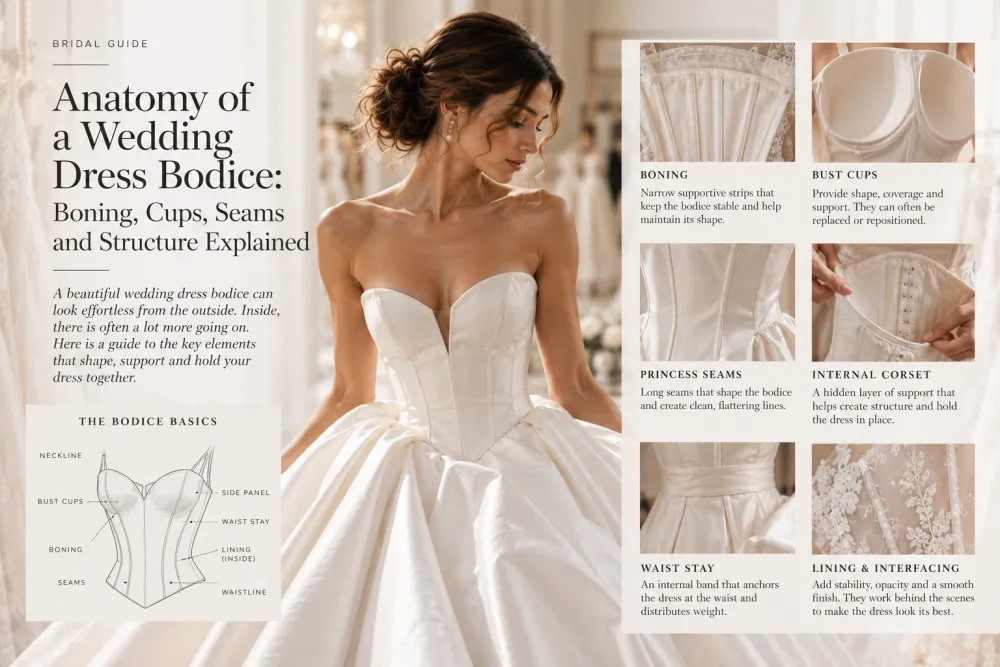
A beautiful wedding dress bodice can look almost effortless from the outside.
Inside, considerably more may be happening.
Boning creates structure. Cups shape and support the bust. Seams control the fit. Linings protect the skin and conceal construction. Waist stays help anchor the gown. Corsetry can redistribute tension across the torso.
Understanding these elements is useful when shopping because two wedding dresses that look almost identical can behave very differently once you put them on.
Here is what is actually holding your wedding dress together — and, occasionally, holding you together inside it.
What Is a Wedding Dress Bodice?
The bodice is the upper section of the wedding dress, generally extending from the neckline to the waist or hips.
Depending on the design, it may be:
- Soft and relatively unstructured
- Lightly supported
- Fully boned
- Corset-inspired
- Built around an internal corset
The amount of structure required depends on the neckline, fabric, silhouette and intended fit.
A loose chiffon bodice and a strapless satin ball gown are solving very different engineering problems.
Why Bodice Construction Matters
Good bodice construction does more than make a dress look fitted.
It can help:
- Support the bust
- Keep a strapless neckline in place
- Define the waist
- Prevent fabric from collapsing or wrinkling
- Distribute the weight of the dress
- Create a particular silhouette
This is why judging a wedding dress only by its surface decoration can be misleading.
The flowers may be beautiful. The invisible architecture underneath them is what determines whether you spend the wedding wearing the gown or repeatedly pulling it back into position.
Boning: The Framework of the Bodice
Boning consists of narrow supportive strips sewn into channels inside the bodice.
Despite the name, modern bridal boning is generally made from synthetic materials or metal rather than actual bone.
Its job is to keep the bodice stable and help maintain its intended shape.
Boning is particularly common in:
- Strapless gowns
- Corseted bodices
- Basque-waist dresses
- Structured ball gowns
- Fitted dresses requiring strong torso support
More Boning Does Not Automatically Mean Better
The quality, position and flexibility of the boning matter more than simply counting how many pieces are inside the dress.
Good boning should follow the body and support the garment.
It should not feel as though several pieces of plastic have independently decided to attack your ribs.
Bust Cups: Shape, Coverage and Support
Many wedding dresses contain sewn-in bust cups.
These can provide:
- Shape
- Coverage
- A smooth bust line
- Some support
But sewn-in cups are not automatically equivalent to a supportive bra.
Real support usually comes from the interaction between the cups and the rest of the bodice structure.
A cup floating inside a loose bodice cannot perform miracles simply because somebody stitched it there.
The Cup Needs to Fit Your Bust
If the cup is too small, the bust may spill above or around it.
If it is too large, you may see empty space or an unnatural shape.
During alterations, cups can often be repositioned or replaced with a more appropriate size.
If something looks strange around the bust during a fitting, do not automatically assume your body is the problem.
Princess Seams
Princess seams are long vertical seams that shape the bodice without relying on a horizontal waist dart.
They often run from the neckline or armhole down through the bust toward the waist.
They are extremely useful in bridalwear because they allow the fabric to follow the curves of the body while creating long, clean visual lines.
They can also provide convenient locations for internal boning.
Darts
A dart removes excess fabric to create three-dimensional shape.
Darts are commonly used around the bust and waist.
They may be visible as deliberate construction lines or incorporated subtly into the design.
A well-positioned dart helps fabric follow the body smoothly rather than hanging like a flat piece of cloth attempting to negotiate with anatomy.
Panel Construction
Many structured wedding dress bodices are made from multiple shaped panels.
Instead of forcing one large piece of fabric around the torso, the designer joins several carefully shaped sections.
This allows much greater control over:
- Bust shape
- Waist definition
- Torso length
- Curvature
When boning follows these seams, the panels can create a strongly sculpted effect.
What Is an Internal Corset?
Some wedding dresses contain a separate supportive structure hidden beneath the visible outer bodice.
This may include:
- Boning
- Firm lining
- Hooks and eyes
- Lacing
- Elastic support
- A waist stay
The outer fabric can then remain visually clean while the internal layer performs most of the structural work.
This is one reason a seemingly simple satin gown can contain considerably more construction than an obviously decorated dress.
Visible Corsetry
In other gowns, the construction becomes part of the design.
Visible boning channels, sheer panels and corset seams deliberately reveal the structure of the bodice.
This has become an important part of contemporary bridal design.
But visible corsetry and functional corsetry are not always the same thing.
Some visible boning is primarily decorative, while some completely invisible bodices provide substantial support.
The Waist Stay: A Small Detail That Does a Big Job
A waist stay is an internal ribbon or band fitted securely around the waist.
It helps anchor the dress to the body and can reduce the amount of weight being carried by the neckline or shoulders.
This can be particularly useful in:
- Strapless dresses
- Heavy ball gowns
- Structured corseted gowns
You may never see it once the dress is fastened.
You may, however, appreciate its contribution enormously by hour seven.
Why a Strapless Wedding Dress Should Not Hang From Your Bust
A properly constructed strapless gown should usually be supported through the torso and waist.
The neckline should not survive exclusively through friction and optimism.
If you constantly need to pull the dress upward, possible causes include:
- The bodice is too large
- The waist is not fitted correctly
- The bust cups are wrong
- The internal support is inadequate
- The torso length is incorrect
Correct fit matters as much as the original construction.
What Is Interfacing?
Interfacing is an additional material applied between layers of fabric to provide stability and body.
It can help a neckline maintain its shape, strengthen areas around closures and give delicate outer fabrics additional support.
You generally will not see it.
That is rather the point.
Underlining vs Lining
These terms describe different layers.
Underlining is attached to the fashion fabric and behaves almost as part of it. It can add opacity, stability or body.
Lining forms the interior finish of the garment and sits against the body.
A wedding dress may contain both.
And between the beautiful satin you see and the lining you touch, there may be several additional layers quietly doing administrative work.
Why Some Bodices Have Mesh
Sheer mesh or illusion tulle can provide support while creating the appearance of an open neckline or back.
You commonly see it in:
- Deep V-necklines
- Plunging sides
- Illusion backs
- Sheer corset bodices
Good illusion mesh should work with the design rather than immediately announcing itself from across the room.
What Holds a Plunging Neckline Together?
A very deep neckline often relies on more construction than it appears to.
Depending on the gown, support may come from:
- Illusion mesh
- Boning
- Structured cups
- Reinforced seams
- Strategically placed internal support
The apparent absence of fabric does not necessarily mean the absence of engineering.
How a Basque-Waist Bodice Is Different
A Basque-waist bodice extends below the natural waist, often ending in a V or curved point.
Because the bodice is longer, its construction has to work not only around the bust and waist but also toward the upper hips.
Boning placement and torso length become particularly important.
If the bodice is too long, the lower edge may dig into the body or buckle when you sit.
How a Drop-Waist Bodice Is Different
A drop-waist bodice also extends below the natural waist, but generally lowers the entire transition between bodice and skirt rather than creating the distinctive central point of a Basque waist.
Again, fit through the hips becomes increasingly important as the bodice gets longer.
Why Torso Length Matters
Two brides can have the same bust, waist and hip measurements while requiring different bodice proportions.
One may have a longer torso.
If the bodice length is wrong:
- The waist seam may sit incorrectly
- The cups may be too high or low
- The neckline may gape
- Boning may dig into the body
- A Basque point may extend too far
This is why bridal fit involves more than ordering according to the waist measurement on a size chart.
What Should a Structured Bodice Feel Like?
Secure.
Not immovable.
Not painful.
Not respiratory.
You should generally be able to:
- Breathe normally
- Sit
- Walk
- Raise your arms reasonably
- Remain in the dress for several hours
Structure and suffering are not synonyms.
Wrinkles Can Tell You Something About Fit
Some wrinkles are simply a normal consequence of fabric moving over a body.
Others indicate tension.
For example, horizontal pulling across the bodice may suggest that an area is too tight, while gaping can indicate excess room or incorrect shaping.
The direction of the wrinkle can help an experienced alterations specialist identify the source.
Why the Sample Bodice May Look Wrong
Bridal samples rarely fit every person who tries them.
A stylist may need to clip excess fabric or leave a back partially open.
This can distort:
- Cup position
- Waist placement
- Neckline shape
- Back height
- Overall tension
Ask how the bodice should sit in your correct size before rejecting or ordering a gown based entirely on the sample fit.
Can the Cups Be Changed?
Often, yes.
Changing cups is a common bridal alteration.
A different cup size, shape or position may improve the appearance of the bust significantly.
However, changing cups cannot necessarily compensate for a bodice whose overall construction is wrong for your proportions.
Can Boning Be Added?
Sometimes.
An alterations specialist may be able to add additional support or replace inadequate boning.
Whether this makes sense depends on the existing seams, fabric and construction.
Can Boning Be Shortened?
Yes, in some situations.
This may be necessary when adjusting torso length or preventing boning from digging into the body.
But altering structural elements should be done carefully so the bodice does not lose the support it was designed to provide.
What About a Corset Back?
A lace-up corset back can provide some adjustability and create strong tension through the bodice.
But the presence of lacing does not automatically mean the dress can accommodate unlimited size variation.
The front, cups, side seams and skirt still need to fit correctly.
Zipper Backs Can Be Just as Structured
A gown does not need visible lacing to contain corsetry.
A concealed zipper may close over a fully structured internal bodice.
Do not judge support solely from the closure you can see.
How to Examine Bodice Construction While Shopping
You do not need to dismantle the boutique sample like a suspicious customs officer.
Simply look inside.
Check for:
- Boning
- Built-in cups
- Waist stays
- Internal closures
- Clean seam finishing
- Comfortable lining
Then ask the stylist how the dress is designed to provide support.
Move Before You Decide
Standing perfectly still in front of a mirror tells you only part of the story.
In a structured bodice:
- Sit down
- Walk
- Turn
- Raise your arms
- Take a deep breath
Your wedding contains all of these advanced athletic activities.
Pay Attention to the Lower Edge
If the bodice extends below the natural waist, check what happens when you sit.
Does it dig into your hips?
Does the boning bend?
Does the bodice ride upward?
A beautiful elongated corset that works only while standing is a slightly limited piece of clothing.
Ask About Alterations Before Ordering
If the sample reveals a significant fit issue, ask whether it can realistically be corrected.
Particularly important questions include:
- Can the cup size be changed?
- Can the bodice be shortened?
- Can the neckline be adjusted?
- Can additional support be added?
- Can the waist position be changed?
Some adjustments are routine. Others require substantial reconstruction.
Good Construction Is Not the Same as Maximum Structure
A wedding dress does not need a corset, twelve bones and an internal pulley system to be well made.
A bias-cut silk dress may deliberately contain very little internal structure.
A soft tulle bodice may be designed to move with the body.
Quality means the construction is appropriate for the design.
The Outside Tells Only Half the Story
When trying wedding dresses, it is easy to focus entirely on what you see:
The lace. The satin. The pearls. The neckline.
But how a bodice feels and behaves depends heavily on the construction you cannot see.
Boning creates stability. Cups help shape the bust. Seams turn flat fabric into a three-dimensional garment. Linings, interfacing and internal supports allow the visible dress to look effortless.
You do not need to become a corsetiere before buying a wedding dress.
But understanding the basic anatomy of the bodice makes it considerably easier to recognise when a dress is genuinely supporting you — and when you are doing most of the work yourself.
Tips & Tricks
View All Tips & Tricks


