
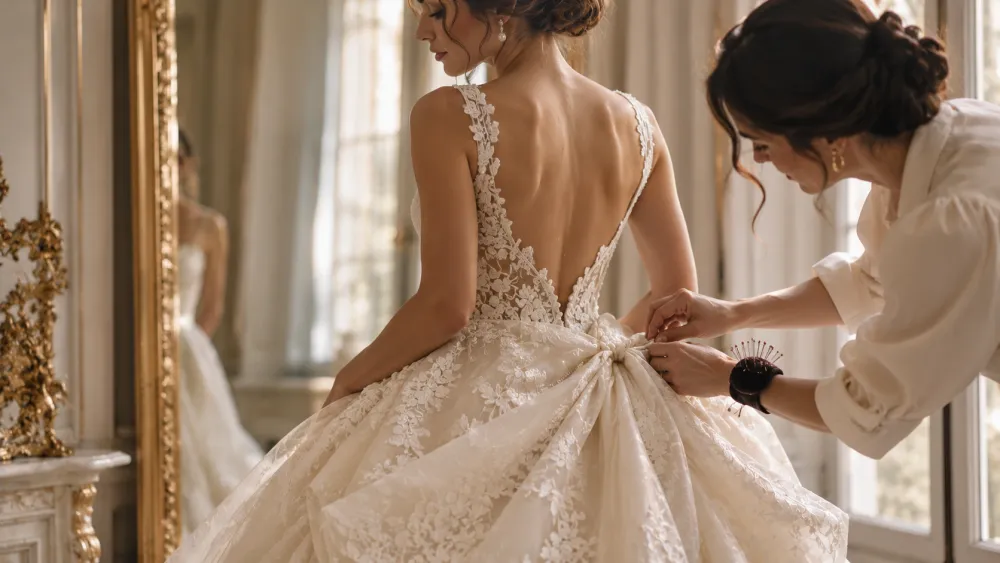
What Happens to Your Train After the Ceremony?
You’ve made your grand entrance. You’ve walked down the aisle. Now you need to dance without dragging several metres of beautiful fabric behind you.
A wedding dress train can be one of the most spectacular features of a bridal gown. But once the ceremony is over, that beautiful length of fabric can become surprisingly inconvenient.
That’s where a wedding dress bustle comes in.
A bustle is a system of discreet buttons, hooks, loops or ribbons that lifts and secures the train, allowing you to move more comfortably during the reception.
The bustle makes the dancing possible.
What Is a Wedding Dress Bustle?
Unlike a train, which is part of the gown’s original silhouette, a bustle is usually created or adjusted during alterations.
Its purpose is simple: lift the train off the floor without compromising the appearance of the dress.
Depending on the fabric, construction and length of the train, your seamstress may recommend one attachment point or several.
1. American Bustle (Over-Bustle)
The American bustle lifts the train and secures it to the outside of the skirt, usually with buttons or hooks.
This creates visible folds or draping across the back of the gown.
Best for: Wedding dresses with structured skirts, decorative trains or fabrics that hold their shape beautifully.
2. French Bustle (Under-Bustle)
A French bustle gathers the train underneath the skirt, often using ribbons or ties secured inside the gown.
The result creates soft folds and additional volume at the back.
Best for: Brides who prefer a romantic, gathered effect or want the bustle attachments concealed beneath the dress.
3. Ballroom Bustle
The ballroom bustle is designed to make the train appear as though it has disappeared into the skirt.
Multiple attachment points distribute the fabric so the gown maintains a relatively even hemline.
Best for: Brides who want a cleaner reception silhouette, particularly with fuller skirts.
4. Austrian Bustle
An Austrian bustle uses a system of ribbons or drawstrings to gather the train vertically, creating a ruched effect.
Its appearance can be especially decorative, although suitability depends heavily on the gown’s construction.
Best for: Certain soft, flowing fabrics and dresses where decorative gathering complements the original design.
5. Wrist Loop
A wrist loop allows you to lift part of the train by holding a small loop attached to the fabric.
Technically, it isn’t the same as a secured bustle because you must continue holding the train.
However, it can be useful for photographs, short walks or gowns with relatively lightweight trains.
Best for: Brides who want a simple temporary lifting option rather than a permanently secured reception arrangement.
Your Bustle Needs a Rehearsal.
Don’t wait until the reception to discover that nobody knows which ribbon goes where.
Ask your seamstress to demonstrate the bustle during your final fitting, and have someone photograph or record the process.
Which Wedding Dress Bustle Is Best?
There isn’t one bustle that works for every wedding dress.
The right choice depends on the train length, fabric weight, skirt construction, embellishments and the appearance you want once the train is lifted.
Creates visible draping on the outside of the skirt.
Gathers fabric underneath for a softer, more romantic effect.
Distributes the train to create a more even reception hemline.
Allows temporary lifting but requires you to hold the train.
How Much Does a Wedding Dress Bustle Cost?
Bustle pricing varies considerably depending on the gown and the alterations specialist.
A simple, lightweight train may require only a few attachment points. A cathedral-length train with heavy embroidery, multiple layers or delicate lace may need a more elaborate system.
Ask for an individual quote rather than assuming bustle alterations are included in the purchase price of your dress.
Can Every Wedding Dress Have a Bustle?
Most wedding dresses with trains can be adapted, but not every bustle style is suitable for every gown.
Extremely delicate fabrics, unusual construction or heavily embellished trains may require a custom solution.
In some cases, a detachable train or overskirt may be more practical than a traditional bustle.
When Should You Have Your Bustle Added?
Discuss the bustle during your alterations appointments, ideally before the final fitting.
Your seamstress needs to evaluate the finished hem length, fabric weight and how the gown sits on your body.
Bring your wedding shoes, as the final height of the skirt can affect how the train is lifted.
Five Questions to Ask Your Seamstress
1. Which bustle style works best with my dress?
Ask to see how the train will look when secured.
2. How many attachment points will I need?
Longer or heavier trains may require additional support.
3. Will the bustle affect the original silhouette?
Some styles create visible folds, while others aim for a cleaner finish.
4. Can I sit and dance comfortably?
Test the bustle while moving rather than standing still.
5. Who will help me fasten it?
Have a trusted person learn the process before the wedding.
The Final Word
Your wedding dress should be spectacular during the ceremony and practical enough to enjoy throughout the reception.
A carefully designed bustle allows you to keep the beauty of your gown while making it easier to walk, dance and celebrate.
Because the train deserves its moment. But so do you.
Tips & Tricks
View All Tips & Tricks


The Fashion Brides is an independent editorial publication. Third-party images remain the property of their respective rights holders. For image credits, copyright concerns or removal requests, please see our Editorial & Copyright Policy .
