
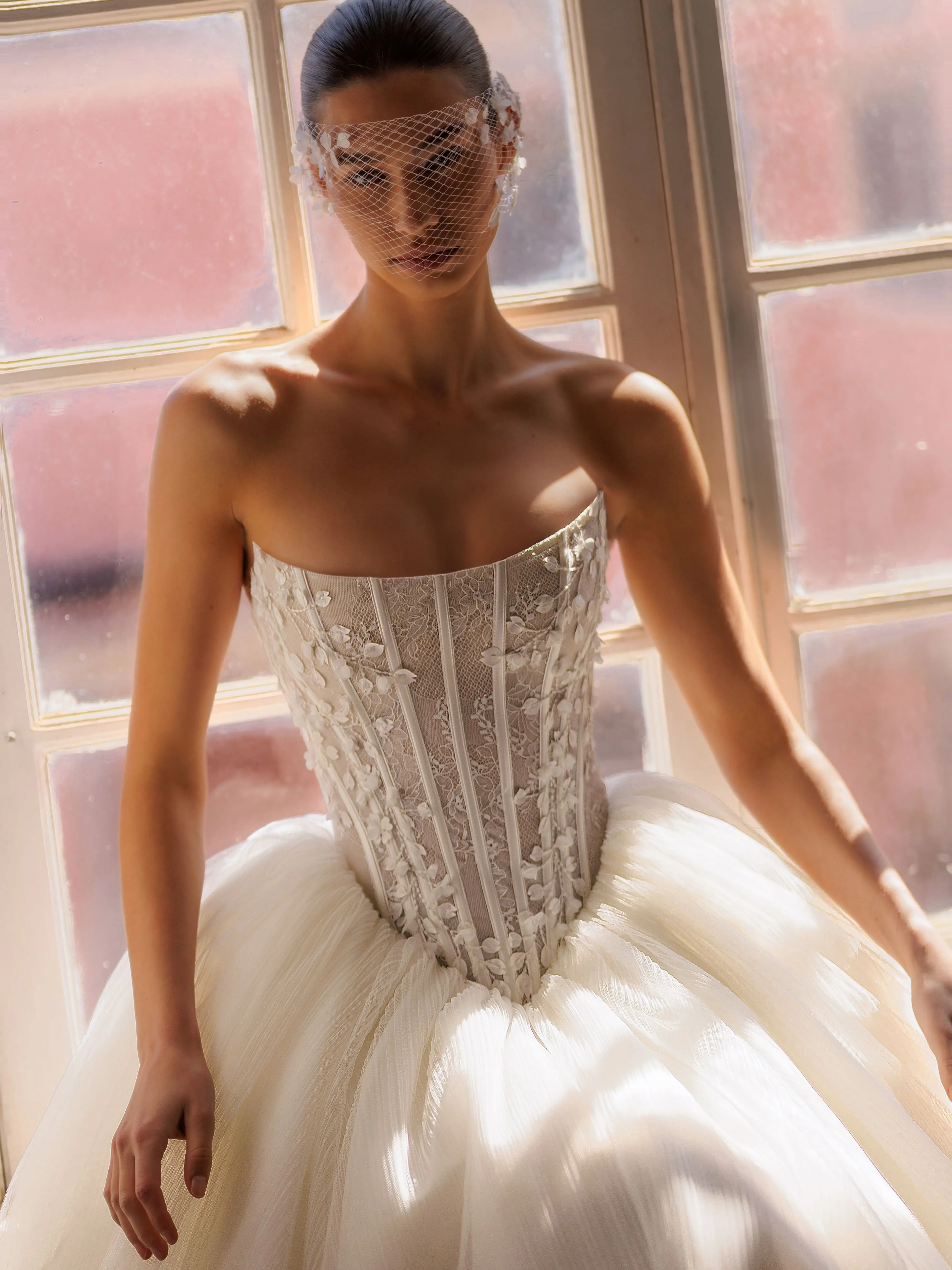
Corset and bustier wedding dresses can look remarkably similar from the outside. Both may feature visible boning, sculpted seams and a strapless neckline, but they are not necessarily constructed to perform the same job. A corset primarily shapes and supports the torso, while a bustier is usually designed to lift and define the bust with lighter shaping through the waist.
The short answer
A corset wedding dress generally uses stronger internal structure, more extensive boning and sometimes adjustable lacing to shape the waist and torso. A bustier wedding dress usually relies on fitted cups, underwire, seaming and lighter boning to support the bust and create a smooth, close-fitting bodice.
Why Are Corset and Bustier Wedding Dresses Confused?
Modern bridal terminology is not always precise. Designers, salons and retailers may use the words corset, corset-inspired, bustier and structured bodice almost interchangeably. A gown may be described as corseted simply because it has visible boning or a lace-up back. Another may be called a bustier dress because it is strapless and has defined cups, even though its internal construction extends well below the waist. The name is therefore only a starting point. To understand how a wedding dress will fit and feel, examine what is happening inside the bodice: the boning, cups, closures, lining, waist support and alteration possibilities.What Is a Corset Wedding Dress?
A corset wedding dress contains a structured bodice designed to support and shape a substantial portion of the torso. Traditional corsetry uses multiple vertical bones and adjustable lacing to hold the garment firmly against the body. In contemporary bridalwear, the corset is often built directly into the dress rather than worn as a separate undergarment. Some versions provide significant waist definition, while others borrow the visual language of corsetry without creating strong compression.- More extensive internal boning
- Support distributed through the torso
- Often extends to or below the natural waist
- May include adjustable back lacing
- Can create stronger waist definition
- May feature a basque or elongated waistline
What Is a Bustier Wedding Dress?
A bustier wedding dress has a close-fitting bodice designed primarily to support, lift and define the bust. It commonly includes shaped cups, underwire, fitted seams and light or moderate boning. The construction is generally lighter than a true corset and usually creates definition without deliberately reducing the waist. Bustier bodices are frequently strapless, although thin straps, off-the-shoulder details and detachable sleeves may be added.- Defined or underwired cups
- Support concentrated around the bust
- Light to moderate boning
- Usually a fixed rather than adjustable fit
- Often fastened with a zipper or hooks
- Creates lift and smoothing rather than compression
Corset vs Bustier Wedding Dresses: The Main Differences
| Feature | Corset wedding dress | Bustier wedding dress |
|---|---|---|
| Primary purpose | Supports and shapes the torso and waist | Lifts and defines the bust |
| Boning | Usually more extensive and structural | Usually lighter and concentrated around the bodice |
| Cups | May have shaped cups, but not always | Usually has clearly defined cups or underwire |
| Closure | Often lacing, sometimes combined with a zipper | Usually zipper, hook-and-eye or another fixed closure |
| Adjustability | Lacing may allow some adjustment | Fit is usually determined by the garment size and alterations |
| Waist effect | Can create stronger definition or compression | Generally smooths without significant compression |
| Overall feeling | Architectural, sculpted and secure | Lifted, fitted and comparatively lightweight |
How Does a Corset Wedding Dress Work?
Boning creates the structure
Boning consists of narrow rigid or flexible supports inserted into channels inside the bodice. It prevents the fabric from collapsing, distributes tension and helps the dress maintain its intended shape.Lacing can adjust the fit
A traditional lace-up corset can be tightened or loosened within a limited range. This does not mean that one dress will fit every size. The bust, waist, hip position and torso length must still correspond properly to the wearer.The torso carries part of the gown’s weight
In a well-constructed corset gown, support is distributed around the body instead of relying entirely on the neckline or straps. This can be particularly valuable for strapless ball gowns and heavily embellished wedding dresses.How Does a Bustier Wedding Dress Work?
The cups provide lift and definition
Bustier bodices commonly use shaped cups, underwire or carefully engineered seams. The cup must match the bride’s bust correctly; otherwise, it may gape, compress, spill or sit in the wrong position.Lighter boning keeps the bodice upright
Boning in a bustier helps maintain the shape of the neckline and prevents the bodice from folding. It does not automatically mean that the garment is intended to reshape the entire waist.The fit is usually more fixed
Because many bustier gowns close with a zipper or hooks, the bodice must be fitted accurately through alterations. Unlike adjustable lacing, a fixed closure offers less flexibility if the size changes close to the wedding.Does Visible Boning Mean a Dress Has a Corset?
No. Visible boning may be structural, decorative or a combination of both. Some gowns display boning channels through transparent tulle while using only light internal support. Others conceal substantial corsetry beneath an opaque satin or lace exterior. Similarly, a lace-up back does not prove that the gown contains a traditional corset. The lacing may provide adjustment, decoration or simply a particular bridal look.
Do not judge the construction from the photographs alone. Ask to see the inside of the gown. A beautifully photographed “corset dress” may be a lightly boned fashion bodice, while a minimal satin gown may contain an exceptionally supportive internal structure.
Which Style Offers More Bust Support?
Neither term guarantees better support. A bustier with correctly fitted underwired cups may provide excellent lift, while a poorly fitted corset can flatten or displace the bust. Conversely, a carefully constructed overbust corset can provide strong support without separate bra-style cups. The decisive factors are cup shape, boning placement, torso length, fabric strength and alterations. Brides with a fuller bust should pay particular attention to whether the cups are available in appropriate proportions rather than simply increasing the overall dress size.Which Style Creates More Waist Definition?
A genuine corset construction generally offers stronger waist definition because it is designed to shape a larger portion of the torso. An elongated corset or basque-waist corset can create an especially sculpted silhouette. A bustier may visually define the waist through seaming and contrast between the fitted bodice and skirt, but it is not usually intended to produce the same degree of compression.
A wedding dress should never cause pain, numbness, dizziness or restricted breathing. “Corseted” does not mean suffering ceremonially for twelve hours. Correct structure should feel secure and supportive—not medically alarming.
Should You Choose a Corset or Bustier Wedding Dress?
Consider a corset wedding dress if…
You want stronger torso support, an architectural silhouette, adjustable lacing or visibly defined shaping through the waist.Consider a bustier wedding dress if…
You want defined cups, bust-focused support, a lighter bodice or a clean strapless look without substantial waist compression.Comfort and Movement
A structured wedding dress will feel different from everyday clothing, but you should still be able to breathe normally, sit, walk and raise your arms sufficiently for the events of the day. During your bridal appointment, test more than the mirror pose. Sit in a chair, bend slightly, turn at the waist and simulate hugging someone. Check whether the boning digs into the ribs or hips and whether the cups remain correctly positioned when you move. If the gown feels uncomfortable, do not assume that every corset or bustier will feel the same. The problem may be the torso length, cup size, boning position or sample size rather than the entire category.Questions to Ask at Your Bridal Appointment
- Is this a true corset construction or a corset-inspired bodice?
- What type of boning is used inside the dress?
- Does the bodice include underwire or built-in cups?
- Can the cup size be changed independently from the dress size?
- Is the back lacing functional or primarily decorative?
- How much size adjustment does the lacing realistically allow?
- Can the bodice be altered for a shorter or longer torso?
- Will I need to wear a separate bra or additional support?
- Does the bodice support the weight of the skirt?
- Can I sit and breathe comfortably after alterations?
Frequently Asked Questions
Is a corset wedding dress always lace-up?
No. Many modern wedding dresses contain internal corsetry while closing with a zipper, buttons or hooks. Lacing is common, but it is not the only sign of corset construction.Is a bustier always strapless?
No. Bustier bodices are frequently strapless, but they may also include thin straps, off-the-shoulder sleeves or detachable elements.Can a corset wedding dress replace a bra?
A properly constructed and fitted corset bodice may provide sufficient support without a separate bra. This depends on the design, bust proportions and internal construction of the gown.Are corset wedding dresses uncomfortable?
They should feel firm and structured, but they should not be painful or prevent normal breathing. Discomfort often indicates incorrect sizing, unsuitable torso length or poorly positioned boning.Are corset dresses flattering for every body type?
Corset construction can provide support and definition across many figures, but no single cut is universally flattering. The placement of the waist, cups and boning must suit the bride’s individual proportions.Can a bustier wedding dress support a fuller bust?
Yes, provided that the cups, underwire, seams and bodice circumference are correctly fitted. Choosing the correct cup proportions is more important than the word “bustier” in the dress description.The Final Difference
The difference between corset and bustier wedding dresses is primarily one of construction and emphasis. A corset shapes and supports the torso, often creating stronger waist definition. A bustier concentrates more closely on lifting the bust and holding a fitted neckline in place. Because bridal labels are used loosely, look beyond the product name. Examine the inside of the gown, ask how the structure works and choose the dress that remains secure when you walk, sit, breathe and celebrate.
Keep The Fashion Brides in your Google results
Add us as a Preferred Source to see more bridal collections, designers and guides from The Fashion Brides.
Tips & Tricks
View All Tips & Tricks


