
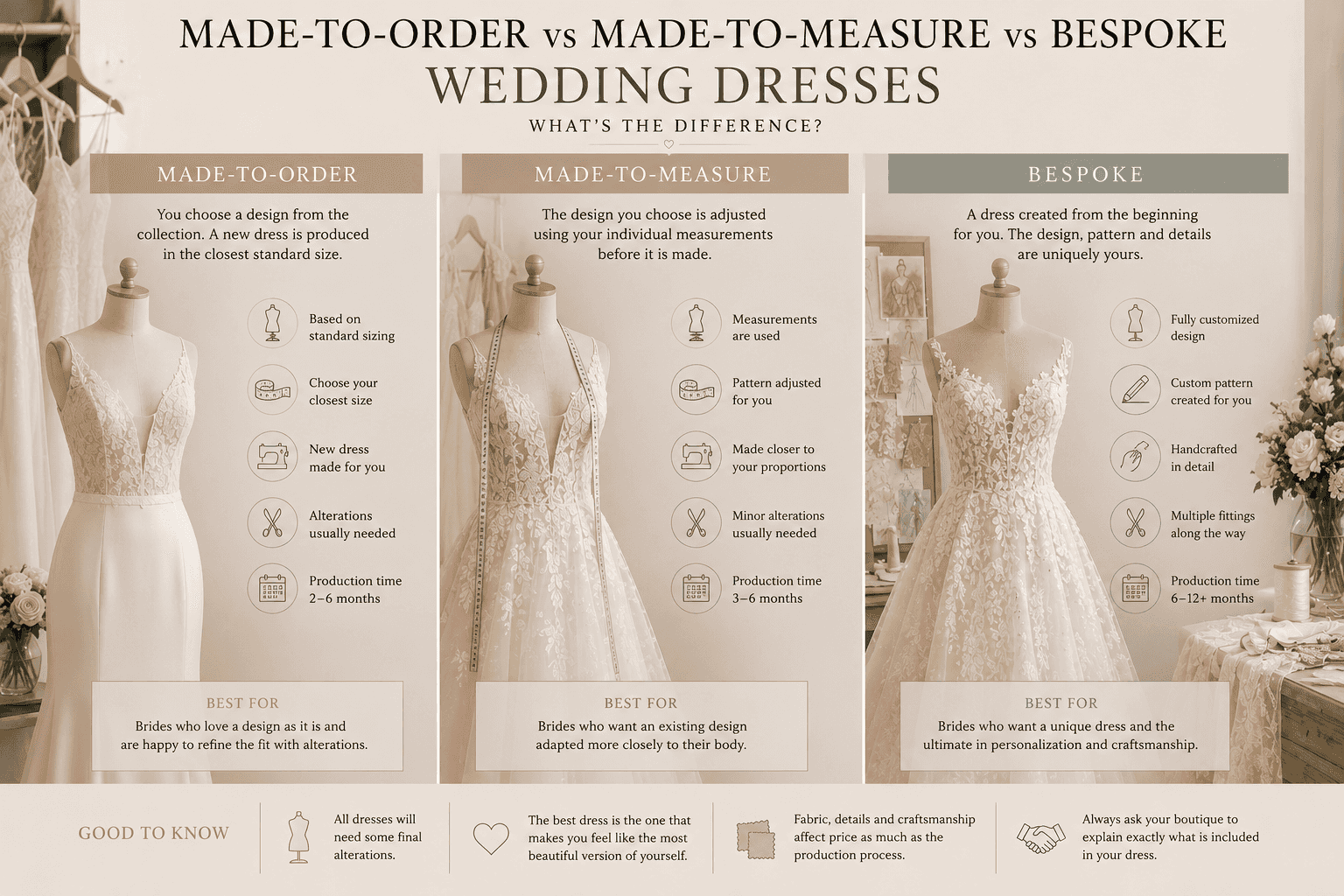
You visit a bridal boutique, fall in love with a wedding dress and place an order. Several months later, a gown arrives for you.
Was it made-to-order? Made-to-measure? Bespoke?
Those terms are often used interchangeably in bridal fashion, but they do not necessarily describe the same process.
The main difference is how much of the wedding dress is created specifically for your body — and how much of the original design can be changed.
Understanding that distinction before you buy can help you know exactly what you are paying for and what to expect when your gown arrives.
What Is a Made-to-Order Wedding Dress?
Made-to-order is one of the most common ways designer wedding dresses are purchased through bridal boutiques.
You try on a sample gown, choose the design you want and have your measurements taken. The boutique then compares those measurements with the designer’s standard size chart and orders the most appropriate size.
A new gown is produced for your order rather than you purchasing the sample you tried in store.
However, the pattern itself is generally based on a standard size rather than being created specifically from your individual measurements.
Does Made-to-Order Mean the Dress Will Fit Perfectly?
No.
This is one of the most common misunderstandings about ordering a wedding dress.
A made-to-order gown is new and ordered for you, but it is usually still produced according to the designer’s standardized sizing.
You might measure as one size at the bust, another at the waist and another at the hips. The boutique will determine which standard size provides the best starting point for that particular gown.
Once the dress arrives, alterations refine the fit to your body.
Will a Made-to-Order Wedding Dress Need Alterations?
Usually, yes.
Standard sizing cannot account for every variation in height, torso length, bust shape, shoulder width or body proportion.
Common alterations include:
- Adjusting the bust or waist
- Taking in the bodice
- Adjusting straps or sleeves
- Refining the hips of a fitted gown
- Shortening the hem
- Adding a bustle to the train
This is entirely normal and does not mean the dress was ordered incorrectly.
Can You Customize a Made-to-Order Wedding Dress?
Sometimes.
Many bridal designers offer predetermined customization options for certain gowns.
You might be able to change the lining colour, alter a neckline, add sleeves, remove a train, order additional length or combine approved elements from two designs.
These options depend entirely on the designer and gown.
A dress offering several customization choices is still not necessarily bespoke. The designer is modifying an existing design rather than creating an entirely new one for you.
What Is a Made-to-Measure Wedding Dress?
A made-to-measure wedding dress begins with an existing design or pattern but is adjusted more extensively according to your individual measurements.
Instead of simply selecting the closest standard size and relying on alterations later, measurements are incorporated into the production process.
The exact level of customization varies between designers.
Some may adjust only key measurements, while others can modify several areas of the pattern before the gown is constructed.
This is why it is important to ask exactly what a boutique or designer means when using the term made-to-measure.
Does Made-to-Measure Mean No Alterations?
Not necessarily.
Even a gown produced using individual measurements may require final adjustments once it is physically on your body.
Fabric behaves differently depending on construction, weight and movement. Small changes in posture or the shoes you wear can also affect the final fit.
A final fitting is therefore still an important part of the process.
The difference is that a made-to-measure gown should generally begin much closer to your individual proportions than a standard-size made-to-order dress.
What Is a Bespoke Wedding Dress?
A genuinely bespoke wedding dress is created specifically for an individual bride.
Rather than beginning with a finished gown from an existing collection, the process typically begins with an idea.
You work with a designer or couture atelier to develop the silhouette, fabric, neckline, construction, embellishment and details of the dress.
A pattern may then be created specifically for your measurements and proportions.
In its traditional sense, bespoke means the dress itself is being created for you — not simply produced for you.
What Happens During the Bespoke Process?
The process differs between designers and ateliers, but it may involve several stages.
These can include:
- An initial design consultation
- Sketches and design development
- Fabric and embellishment selection
- Detailed measurements
- A custom pattern
- A toile or mock-up of the gown
- Multiple fittings
- Construction of the final dress
- Hand finishing and final adjustments
The bride becomes part of the design process rather than simply choosing a finished style from a collection.
What Is a Toile?
In couture and bespoke dressmaking, a toile is a test version of a garment created before the final fabric is cut.
It may be made from inexpensive cotton or another suitable fabric and allows the designer to assess proportions, construction and fit.
Changes can then be made to the pattern before work begins on expensive silk, lace or embellishment.
Not every custom bridal process includes a toile, but it is a traditional and extremely useful part of bespoke garment construction.
Is Couture the Same as Bespoke?
Not automatically.
Couture is one of the most frequently used — and loosely used — words in bridal fashion.
In everyday marketing, it may simply suggest luxurious construction, extensive handwork or a premium collection.
In French fashion, Haute Couture has a much more specific meaning and is a legally protected designation governed by strict criteria.
A bridal designer describing a gown as “couture” therefore does not automatically mean the dress is bespoke or that the fashion house is officially recognized as Haute Couture.
Ask about the actual production process rather than relying on the terminology alone.
Made-to-Order vs Made-to-Measure
The simplest distinction is this:
Made-to-order: you choose an existing design and a new gown is produced, usually according to a standard size.
Made-to-measure: you choose an existing design, but its pattern or construction is adjusted more extensively using your individual measurements.
Both begin with an existing wedding dress design.
The difference is how closely the gown is adapted to your body during production.
Made-to-Measure vs Bespoke
The distinction here is primarily about design as well as fit.
With made-to-measure, you generally begin with an existing design.
With bespoke, the design itself can be created specifically for you.
A made-to-measure bride might say, “I want this gown, adapted to fit my proportions.”
A bespoke bride might say, “I want to create a gown with this silhouette, this neckline and this type of embroidery.”
What About Custom Wedding Dresses?
The word custom can describe many different things.
A boutique might call a made-to-order gown with modified sleeves a custom dress. Another designer may use the same word for a completely original gown created from scratch.
Neither usage tells you enough on its own.
If a dress is described as custom, ask what is actually customizable.
Can you change existing elements? Are your measurements incorporated into the pattern? Is the designer creating a new pattern? Are you developing an original design?
The answers matter more than the label.
Which Option Gives You the Most Design Freedom?
Bespoke generally provides the greatest creative freedom.
You may be able to choose everything from the silhouette and fabric to embroidery placement, sleeve construction and train length.
Made-to-measure offers less design freedom because it usually begins with an existing gown, although some designers allow significant modifications.
Made-to-order normally offers the least customization, but this varies widely between bridal houses.
Which Option Is Most Expensive?
There is no universal price hierarchy because designer, fabric, construction and embellishment all affect cost.
However, bespoke gowns are generally more expensive because they require significantly more individual design work, pattern development, fittings and hand labour.
Made-to-measure can also command a premium over standard made-to-order bridal.
A highly embellished made-to-order designer gown, however, could still cost more than a relatively simple bespoke dress from another atelier.
Always compare the actual services and craftsmanship included rather than the terminology alone.
Which Takes the Longest?
Bespoke wedding dresses typically require the longest and most involved process because the gown must be designed and developed before final construction.
Made-to-measure also requires sufficient production time to accommodate individual adjustments.
Made-to-order wedding dresses can take several months as well, particularly when produced internationally or during busy bridal seasons.
If your wedding date is approaching, tell the boutique immediately. Rush production may be available for certain designers, while others may recommend an off-the-rack gown instead.
Questions to Ask Before Ordering Your Wedding Dress
Whatever terminology a boutique uses, ask practical questions:
- Is my dress being produced in a standard size?
- Are my individual measurements incorporated into the pattern?
- Which design elements can be changed?
- Are customization fees additional?
- Will I see the gown before it is completed?
- How many fittings are included?
- Are final alterations included in the price?
- How long will production take?
- Who actually makes the gown?
A reputable boutique or designer should be able to explain the process clearly.
Which Type of Wedding Dress Should You Choose?
Choose made-to-order if you have found an existing designer gown you love and are happy to have the final fit refined through alterations.
Consider made-to-measure if you love an existing design but want it produced more closely to your individual proportions.
Choose bespoke if the experience of creating a unique dress is important to you or if you have a specific design in mind that you cannot find in an existing collection.
There is no hierarchy of how special your wedding dress is.
A made-to-order gown can be exquisitely constructed. A bespoke gown can be beautifully simple. An off-the-rack dress may fit you almost perfectly the moment you put it on.
Know What You Are Actually Buying
The terminology surrounding luxury bridal fashion can sound impressive, but the production process is what matters.
Do not assume that “made for you” means made to your measurements, that “custom” means an original design or that “couture” automatically means bespoke.
Ask how the gown will actually be created.
Once you understand the difference between made-to-order, made-to-measure and bespoke, you can choose the experience — and the dress — that is genuinely worth paying for.
Tips & Tricks
View All Tips & Tricks


