
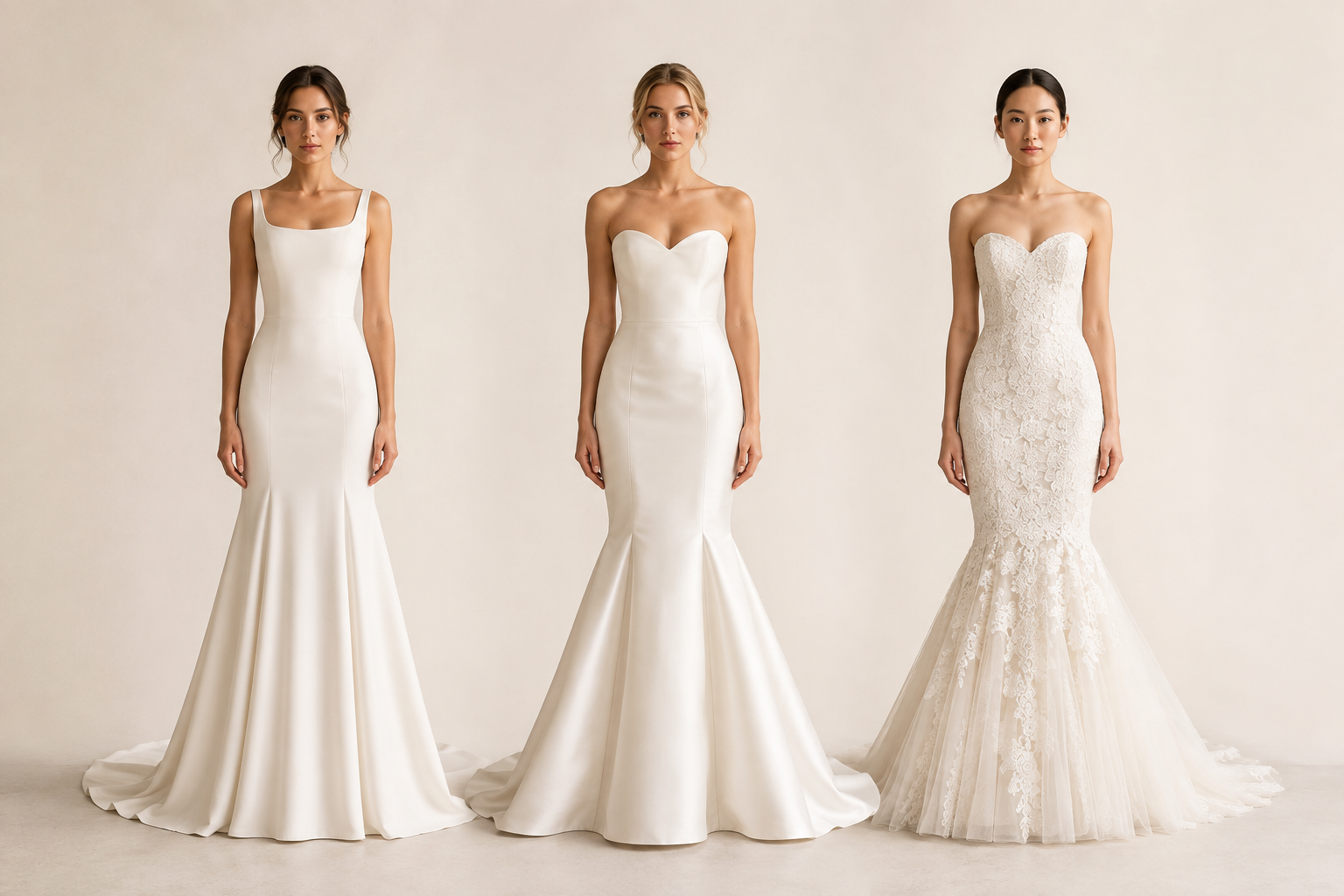
Mermaid, trumpet and fit-and-flare wedding dresses all follow the body before widening into a fuller skirt. Because the three silhouettes share the same basic idea, their names are frequently used interchangeably—even by bridal designers and retailers.
The principal difference is where the skirt begins to flare and how dramatically it expands. A fit-and-flare gown loosens gradually below the hips, a trumpet dress begins to flare around the mid-thigh, and a mermaid dress remains fitted to the knees or lower before opening dramatically.
This guide explains the difference between mermaid, trumpet and fit-and-flare wedding dresses, including their construction, movement, fabrics and alteration requirements.
Mermaid vs Trumpet vs Fit-and-Flare at a Glance
| Silhouette | Where the Flare Begins | Shape | Movement |
|---|---|---|---|
| Fit-and-flare | Below the hips or upper thighs | Soft and gradual | Usually the least restrictive |
| Trumpet | Around the mid-thigh | Defined but balanced | Moderate freedom around the knees |
| Mermaid | At the knees or below | Dramatic and highly sculpted | Usually the most restrictive |
What Is a Fit-and-Flare Wedding Dress?
A fit-and-flare wedding dress follows the body through the bodice, waist and hips before widening gradually through the skirt. Of the three related silhouettes, it has the earliest and softest transition from fitted bodice to fuller skirt.
The flare usually begins below the hips or around the upper thighs. It does not create the sharp, dramatic break associated with a mermaid gown. Instead, the fabric slowly moves away from the body, producing a balanced combination of definition and movement.
Fit-and-flare is also the broadest category. Some retailers use it as an umbrella term for any dress fitted through the hips, including trumpet and mermaid gowns. When the three silhouettes are treated separately, however, fit-and-flare refers to the least restrictive and most gradually widening version.
Characteristics of a Fit-and-Flare Wedding Dress
- Fitted through the bodice, waist and hips
- Begins widening below the hips or around the upper thighs
- Creates a gradual rather than abrupt flare
- Usually allows more movement around the thighs and knees
- Can appear soft, minimalist, romantic or structured
- Works with both fluid and more substantial fabrics
Fit-and-flare gowns may be made from crepe, lace, satin, Mikado, stretch fabrics or layered tulle. A lightweight crepe version will produce a softer outline, while structured satin can create a more architectural silhouette.
What Is a Trumpet Wedding Dress?
A trumpet wedding dress is fitted through the bodice, waist, hips and upper thighs before beginning to flare around the middle of the thigh. Its outline resembles the widening bell of a trumpet, which gives the silhouette its name.
The transition is more noticeable than that of a general fit-and-flare gown but begins higher than the flare of a mermaid dress. This creates a clearly sculpted silhouette without enclosing the knees as tightly as many mermaid designs.
A trumpet gown often represents the middle ground between fit-and-flare and mermaid: more dramatic than the former, but generally easier to move in than the latter.
Characteristics of a Trumpet Wedding Dress
- Closely fitted through the hips and upper thighs
- Begins to flare around the mid-thigh
- Creates a visible but not extremely abrupt transition
- Provides more leg movement than a traditional mermaid gown
- Emphasizes the contrast between the fitted torso and expanding skirt
- Often supports a train without requiring excessive skirt volume
Trumpet dresses are frequently constructed from lace, crepe, satin and Mikado. Fabrics with some body help preserve the characteristic trumpet shape, while softer materials create a more fluid transition.
What Is a Mermaid Wedding Dress?
A mermaid wedding dress follows the body closely through the bodice, waist, hips and thighs before flaring at the knees or below. It creates the most dramatic contrast of the three silhouettes.
The lower skirt may expand smoothly or be constructed from tulle, ruffles, godets, pleats, feathers or contrasting fabric. Some designs create a distinct division between the fitted upper section and the skirt, while others form a continuous sculptural curve.
Because the fitted portion extends farther down the legs, mermaid gowns can restrict the wearer’s stride. The degree of restriction depends on the placement of the flare, the stretch of the fabric, the lining and the cut of the skirt.
Characteristics of a Mermaid Wedding Dress
- Closely fitted through the thighs
- Begins to flare at the knees or below
- Creates a pronounced contrast between the upper and lower dress
- Produces a dramatic, body-defined silhouette
- May limit stride length and knee movement
- Often features a substantial train or sculptural lower skirt
What Is a Fishtail Wedding Dress?
Fishtail wedding dress is commonly used as another name for a mermaid gown, particularly in British and European bridal terminology. Both terms usually describe a dress fitted through the thighs before widening near the knees or lower legs.
Some designers use “fishtail” for a softer silhouette or for a gown with additional fullness concentrated at the back. However, there is no universally accepted technical difference between mermaid and fishtail wedding dresses.
The Main Difference: Where the Dress Begins to Flare
The easiest way to distinguish the three wedding dress silhouettes is to look at the point where the skirt stops following the body and begins moving outward.
- Fit-and-flare: the skirt begins widening below the hips or around the upper thighs.
- Trumpet: the skirt begins widening around the middle of the thighs.
- Mermaid: the skirt remains fitted until the knees or below.
The names describe a spectrum rather than three categories separated by perfectly fixed measurements. A dress that begins to loosen slightly above the knees may be labelled trumpet by one designer and mermaid by another.
For this reason, examining the actual cut is more useful than relying exclusively on the retailer’s description.
Fit-and-Flare vs Trumpet Wedding Dress
Both silhouettes follow the upper body and hips, but a fit-and-flare gown begins opening higher and more gradually. A trumpet dress remains fitted farther down the thighs before producing a more visible flare.
The difference can sometimes appear subtle from the front. It is often easier to identify from the side and back, where the relationship between the hips, thighs and skirt becomes clearer.
Choose a Fit-and-Flare Effect If You Prefer:
- A softer transition from bodice to skirt
- More space around the upper thighs
- A less sharply sculpted silhouette
- Greater flexibility while sitting and walking
- A dress that combines definition with a relaxed skirt
Choose a Trumpet Effect If You Prefer:
- A more defined line through the thighs
- A recognizable flare without enclosing the knees
- A balance between movement and drama
- A more sculpted alternative to a general fit-and-flare gown
Trumpet vs Mermaid Wedding Dress
A trumpet wedding dress begins to flare around the mid-thigh, while a mermaid gown remains closely fitted until the knee or below.
This difference changes both the visual effect and the way the dress moves. A trumpet gown creates a longer, gradual curve through the body and leaves more room around the knees. A mermaid gown produces a sharper transition and a more dramatic lower skirt.
If the flare begins well above the knees, the dress is more accurately described as trumpet. If the fabric stays narrow through the knees and then expands, it is a mermaid silhouette.
Fit-and-Flare vs Mermaid Wedding Dress
Fit-and-flare and mermaid represent the two ends of this fitted-silhouette spectrum.
A fit-and-flare wedding dress begins to loosen shortly below the hips, providing more room through the thighs and knees. A mermaid wedding dress remains fitted much farther down, creating a stronger contrast between the body and the flared skirt.
A bride who likes the defined waist and hips of a mermaid gown but dislikes restricted movement may prefer a fit-and-flare or trumpet interpretation.
Is a Mermaid Wedding Dress the Same as a Fit-and-Flare?
Not technically. A mermaid gown can be considered part of the broader fit-and-flare family because it is fitted before it flares. However, when bridal silhouettes are categorized individually, mermaid describes a more specific construction in which the dress remains fitted to the knees or below.
This explains why a retailer may place mermaid dresses inside a general “fit-and-flare” category while still describing individual gowns as mermaid silhouettes.
Which Silhouette Is Easiest to Walk In?
A fit-and-flare wedding dress generally provides the greatest freedom of movement because the skirt begins opening higher on the legs. Trumpet gowns usually allow moderate movement, while mermaid dresses are most likely to restrict the stride.
However, the category alone does not determine comfort. A stretch-crepe mermaid dress may allow more movement than a heavily boned trumpet gown with a rigid lining.
Several construction details influence mobility:
- The exact height of the flare
- The width of the skirt around the knees
- Whether the fabric stretches
- The structure and number of lining layers
- The placement of seams and godets
- The weight and length of the train
- Whether the dress includes a slit
During a fitting, walk normally rather than taking the short steps encouraged by a narrow bridal platform. Sit, climb several steps, turn and bend slightly. A dress should be assessed through movement, not exclusively while standing still.
Can You Sit in a Mermaid Wedding Dress?
Yes, but the dress must provide enough room through the hips, thighs and knees for the wearer to bend comfortably. A mermaid gown that fits correctly while standing may still feel too tight when sitting.
When trying the dress, use a normal chair rather than a wide showroom sofa. Check whether the fabric pulls sharply across the thighs, whether the bodice shifts upward and whether the skirt permits the knees to bend naturally.
Do not assume that discomfort is simply part of wearing a fitted wedding dress. The gown may require adjustments to the seams, lining or flare placement.
Which Fabrics Work Best for Each Silhouette?
Fabric affects how sharply the dress follows the body and how the lower skirt holds its shape.
Fabrics for Fit-and-Flare Wedding Dresses
- Crepe: creates a smooth, streamlined silhouette with a softer flare.
- Lace: follows the body while adding texture and disguising some seam lines.
- Stretch satin: combines sheen, structure and flexibility.
- Chiffon overlays: soften the fitted base and create additional movement.
- Mikado: produces a more sculptural and architectural shape.
Fabrics for Trumpet Wedding Dresses
- Lace over structured lining: preserves the fitted shape while allowing visual softness.
- Satin: creates a smooth and clearly defined flare.
- Crepe: offers a modern, restrained interpretation.
- Mikado: emphasizes the trumpet construction and supports a substantial train.
- Organza: can add lightweight volume to the lower skirt.
Fabrics for Mermaid Wedding Dresses
- Stretch crepe: allows a close fit with greater mobility.
- Lace: adapts well to body-contouring seams and dramatic skirts.
- Structured satin: creates a smooth, sculptural outline.
- Tulle: builds volume below the knees without excessive visual weight.
- Organza: supports dramatic ruffles, layers and flared panels.
How the Train Changes the Silhouette
A train extends the line of the skirt and can make the flare appear more dramatic. Mermaid gowns often feature trains that continue directly from the lower skirt, reinforcing the fishtail effect.
Trumpet and fit-and-flare dresses may also have chapel, cathedral or detachable trains. When comparing gowns, view the silhouette before the train is arranged by a stylist. A carefully spread train can make almost any fitted dress appear fuller than it will while walking.
Ask to see the dress with the train released, moving and bustled. These are the versions that will exist through most of the wedding day.
Can These Wedding Dress Silhouettes Have Sleeves?
Mermaid, trumpet and fit-and-flare gowns can all be paired with sleeves. The silhouette describes the shape of the dress through the torso and skirt, not the neckline or arm coverage.
Common combinations include:
- Long lace sleeves with a fitted mermaid skirt
- Off-the-shoulder sleeves with a trumpet silhouette
- Detachable tulle sleeves with a corseted fit-and-flare gown
- Minimal straps with a clean crepe dress
- A high neckline with a sculptural satin skirt
Sleeves may affect movement through the shoulders and upper body, so they should be tested with the same care as the fitted skirt.
Do Mermaid, Trumpet and Fit-and-Flare Dresses Need Shapewear?
Shapewear is optional, not an automatic requirement for a fitted wedding dress. Many gowns include cups, boning, lining and internal corsetry that provide their own support and shaping.
If shapewear is worn, its edges should not interrupt the surface of the dress. This is particularly important beneath smooth crepe and satin, which can reveal seams, waistbands and changes in texture.
Bring the intended undergarments to the fitting before the gown is altered. Different shapewear can change the position of the waist, hips and bust, affecting how the dress is pinned.
Alterations for Fitted Wedding Dress Silhouettes
Mermaid, trumpet and fit-and-flare dresses require precise alterations because small changes can affect both fit and movement.
Common alterations include:
- Adjusting the bust, waist or hip seams
- Refining the fit through the thighs
- Reshaping or stabilizing the neckline
- Shortening the hem without disturbing the flare
- Adjusting the lining separately from the outer fabric
- Adding or modifying a bustle
- Repositioning lace appliqués after seam alterations
- Adding discreet support or cups inside the bodice
A fitted dress should follow the body without producing strong horizontal pulling, twisted seams or a skirt that rises when walking. Taking a gown in too aggressively can change a trumpet into an unintentionally restrictive mermaid or prevent the dress from sitting correctly.
How to Identify the Silhouette in Photographs
When shopping online, ignore the styled train temporarily and examine the outline of the dress around the hips, thighs and knees.
- Find the point where the skirt stops following the legs.
- Compare that point with the hips, mid-thigh and knees.
- Look at both front and side images.
- Check photographs in which the model is walking.
- Notice whether skirt fullness exists around the entire dress or mainly at the back.
A dramatic train can make a relatively narrow fit-and-flare gown look like a mermaid dress from behind. The front and side views usually reveal the actual construction more clearly.
Which Wedding Dress Silhouette Should You Choose?
The choice is not about finding the silhouette that supposedly “corrects” your body. It is about deciding how much definition, drama and freedom of movement you want.
Consider Fit-and-Flare If:
- You want a fitted bodice and defined hips with a softer skirt.
- You prefer greater freedom through the thighs and knees.
- You want a silhouette between A-line and mermaid.
- You expect to walk and dance without changing dresses.
Consider Trumpet If:
- You want more definition than a general fit-and-flare gown.
- You like a visible flare but do not want it to begin at the knees.
- You want a sculpted silhouette with moderate mobility.
- You prefer balanced proportions rather than an extremely dramatic lower skirt.
Consider Mermaid If:
- You want the dress to remain closely fitted through the thighs.
- You prefer a pronounced, dramatic flare.
- You like a highly sculpted bridal silhouette.
- You are comfortable testing movement carefully and altering the fit precisely.
Frequently Asked Questions
What is the main difference between mermaid, trumpet and fit-and-flare wedding dresses?
The main difference is where the skirt begins to widen. Fit-and-flare dresses loosen below the hips or around the upper thighs, trumpet dresses flare around the mid-thigh, and mermaid gowns remain fitted until the knees or below.
Is trumpet the same as fit-and-flare?
A trumpet gown belongs to the broader fit-and-flare family, but it is more specifically fitted through the upper thighs before producing a defined flare around mid-thigh.
Is fishtail the same as mermaid?
In most bridal terminology, fishtail and mermaid refer to the same silhouette. Individual designers may use the terms slightly differently, but there is no standardized distinction.
Which is more comfortable: mermaid or trumpet?
Trumpet gowns generally provide more room around the knees because the flare begins higher. Fabric, lining and construction can nevertheless make an individual mermaid gown more comfortable than a particularly rigid trumpet dress.
Which silhouette is closest to an A-line wedding dress?
Fit-and-flare is the closest of the three, although it remains fitted through the hips while an A-line skirt usually begins widening from the waist.
Can a mermaid wedding dress be altered into a trumpet?
Sometimes, but the change may require releasing the seams or reconstructing sections of the skirt so that the flare begins higher. Whether this is possible depends on the seam allowances, fabric, lace placement and original pattern.
Can a trumpet dress have a cathedral train?
Yes. Trumpet, mermaid and fit-and-flare dresses can all support long trains. The train length does not determine the silhouette.
Are all fitted wedding dresses mermaid dresses?
No. Sheath, column, slip, fit-and-flare and trumpet gowns can all follow the body without having the knee-level flare required for a true mermaid silhouette.
Understanding the Difference
Mermaid, trumpet and fit-and-flare wedding dresses exist along the same silhouette spectrum. Each begins with a fitted upper body, but the placement and intensity of the flare create a different proportion.
A fit-and-flare gown offers the softest transition and generally the greatest movement. A trumpet dress remains fitted farther down before opening around the mid-thigh. A mermaid gown continues closely to the knees or below, producing the most dramatic contrast.
Because bridal terminology is not perfectly standardized, use the label as a starting point rather than a guarantee. Examine where the individual gown begins to widen, how it behaves while walking and whether its construction provides the combination of shape and movement you want.
Tips & Tricks
View All Tips & Tricks


