
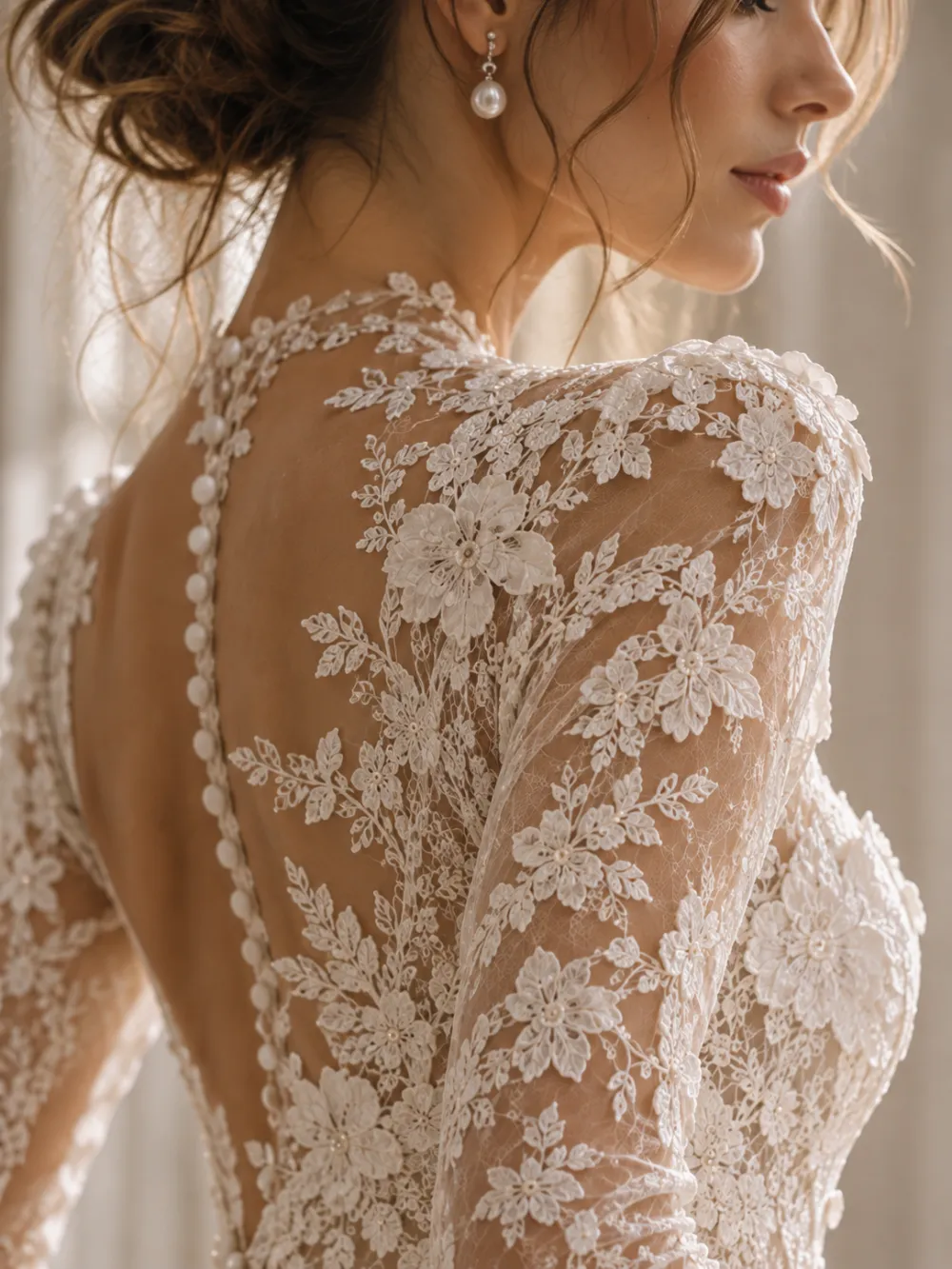
The Art of Bridal Lace
Delicate Chantilly. Sculptural Guipure. Intricate Alençon. Behind every beautiful lace wedding dress is a textile with its own character, construction and history.
Not all lace is created equal. Some varieties are so delicate they seem almost weightless. Others are bold, architectural and substantial enough to define an entire wedding dress.
And while bridal boutiques frequently describe gowns simply as “lace wedding dresses,” that description tells us remarkably little about the actual fabric.
Understanding different types of bridal lace helps explain why certain wedding dresses look romantic and ethereal, while others feel structured, dramatic or distinctly contemporary.
Sometimes, it’s the entire design.
What Is Bridal Lace?
Lace is an openwork textile created through arrangements of threads that form decorative patterns and spaces.
Traditional lace can be made by hand using needles or bobbins, while contemporary bridal lace is frequently produced using specialised machinery.
Different techniques create different textures, levels of transparency, pattern definitions and structural characteristics.
Some laces are produced as continuous fabrics. Others are created as decorative motifs, borders or appliqués that can be positioned individually on a wedding dress.
1. Chantilly Lace
Chantilly lace is celebrated for its fine net ground, delicate floral patterns and soft, almost weightless appearance.
Historically associated with French lacemaking, it often features intricate floral motifs outlined with slightly heavier threads.
In bridal fashion, Chantilly lace is particularly beautiful when layered over tulle, used for sheer sleeves or incorporated into softly flowing gowns.
Its delicate character makes it well suited to romantic designs where transparency and movement are important.
Signature look: Fine, delicate floral patterns with a soft, airy appearance.
2. Alençon Lace
Alençon lace is traditionally associated with the French town of Alençon and the elaborate needle-lace techniques developed there.
Historic handmade Alençon lace is exceptionally labour-intensive and prized for its craftsmanship.
In modern bridal retail, the term is also frequently used for machine-made lace with corded floral motifs that resemble traditional Alençon designs.
This distinction matters because a wedding dress described as featuring Alençon lace does not necessarily contain handmade French needle lace.
Signature look: Defined floral motifs, often with raised or corded outlines.
3. Guipure Lace
Guipure lace is distinguished by its bold patterns and the absence of a conventional net background.
Instead, decorative motifs are connected by bars or bridges, creating a more substantial openwork textile.
In bridal design, Guipure can feel particularly contemporary when used for geometric patterns, oversized flowers or architectural details.
Its stronger visual presence makes it an interesting alternative to delicate floral lace.
Signature look: Bold connected motifs with pronounced texture and open spaces.
4. Corded Lace
Corded lace features decorative patterns outlined or enhanced with thicker threads or cords.
The additional definition creates dimension and helps motifs stand out against the underlying fabric.
Corded lace is frequently used in bridal bodices, sleeves and trains where the designer wants the pattern to remain visible from a distance.
Signature look: Raised outlines that emphasise floral or decorative motifs.
5. Embroidered Tulle Lace
Many contemporary wedding dresses feature embroidery applied to a fine tulle or mesh base.
Although often described broadly as lace, embroidered tulle is technically distinct from several traditional lacemaking methods.
It allows designers to create intricate patterns, three-dimensional flowers, delicate vines and decorative motifs on a transparent foundation.
Embroidery can also incorporate beads, sequins, crystals or additional fabric elements.
Signature look: Decorative embroidery floating over a sheer, lightweight base.
Not Every Floral Fabric Is Lace.
Embroidery, appliqué, lace and three-dimensional fabric flowers can create similar visual effects, but they aren’t necessarily produced using the same techniques.
Understanding the difference makes bridal craftsmanship much easier to appreciate.
6. Venetian Lace
Venetian lace is associated with the rich history of Italian lacemaking, particularly the elaborate needle-lace traditions developed in Venice.
Historic Venetian needle lace often featured bold, raised motifs and intricate decorative construction.
In contemporary bridal fashion, the term may be used more loosely for substantial, richly patterned lace inspired by those historic styles.
Signature look: Ornate motifs, pronounced texture and a decorative, sometimes sculptural appearance.
7. Crochet Lace
Crochet lace is created using a hook to form interconnected loops and decorative patterns.
Its appearance can range from delicate openwork to more substantial geometric or floral designs.
In bridal fashion, crochet-inspired textiles are often associated with relaxed, bohemian aesthetics, although sophisticated contemporary interpretations are equally possible.
Signature look: Visible looped construction and distinctive openwork patterns.
8. Schiffli Lace
Schiffli lace is produced using specialised embroidery machinery that creates decorative patterns on a fabric foundation.
In some production methods, the underlying base is removed or dissolved, leaving an openwork embroidered design.
This technique allows for elaborate motifs and repeated patterns suitable for commercial textile production.
Schiffli embroidery and lace are widely used in fashion, including bridalwear.
Signature look: Precise embroidered motifs, sometimes forming an openwork fabric.
How Different Types of Bridal Lace Compare
Fine, airy and delicate. Particularly suited to sheer layers and romantic silhouettes.
Intricate floral patterns, often with raised outlines and a more defined appearance.
Bold, substantial motifs connected without a conventional net background.
Decorative motifs worked onto sheer mesh, allowing intricate and dimensional effects.
Why Does Some Bridal Lace Look More Expensive?
The visual quality of lace depends on several factors, including thread fineness, pattern complexity, manufacturing technique and finishing.
Fine lace can require sophisticated machinery or extensive handwork, while elaborate embroidery may involve multiple production stages.
However, delicacy alone doesn’t determine quality.
A beautifully executed bold Guipure lace can be just as impressive as an exceptionally fine Chantilly design.
The relationship between the textile and the wedding dress is equally important.
Even extraordinary lace can lose its impact when poorly positioned, stretched or interrupted by careless seams.
How Designers Use Lace Appliqués
Instead of constructing an entire wedding dress from continuous lace fabric, designers may cut individual motifs and apply them to a separate foundation.
This technique allows flowers, leaves and decorative patterns to follow the contours of the body.
Appliqués can soften transitions between sheer and opaque sections, decorate necklines or create the illusion of embroidery growing across the gown.
Careful placement is particularly important around corset seams, waistlines and curved sections.
What Is Three-Dimensional Bridal Lace?
Three-dimensional lace incorporates raised elements that extend beyond the surface of the fabric.
These may include layered petals, sculpted flowers, textured embroidery or separately attached decorative motifs.
The result creates depth and movement, particularly when combined with sheer fabrics.
Three-dimensional lace can transform a relatively simple silhouette into an elaborate design without relying on traditional beading.
Does Lace Affect the Structure of a Wedding Dress?
Yes, although the effect depends on the type of lace and how it is used.
Fine Chantilly lace generally contributes little structural support on its own, while heavier openwork fabrics may influence how the garment hangs and moves.
Most fitted lace wedding dresses rely on underlying fabrics, lining, corsetry or other construction elements to maintain their silhouette.
The lace provides visual character, while the foundation controls fit and support.
Look Closely at the Seams.
In beautifully constructed lace gowns, decorative motifs may be carefully repositioned or joined to disguise seam lines.
It’s one of those details that can make an extraordinary difference without immediately attracting attention.
How to Recognise Beautifully Constructed Lace
Motifs follow the silhouette rather than appearing randomly interrupted.
Decorative patterns are joined carefully, with minimal unnecessary disruption.
Threads, embroidery and openwork details appear consistent and appropriately finished.
The lace works with the underlying fabric without excessive pulling or distortion.
Which Type of Lace Is Best for a Wedding Dress?
There isn’t a universally superior bridal lace.
Chantilly offers delicacy and softness. Guipure creates a stronger visual statement. Corded lace adds definition, while embroidered tulle allows designers to explore intricate decorative effects.
The most successful choice depends on the silhouette, the intended aesthetic and the relationship between the lace and the gown’s construction.
A minimalist wedding dress may need only a beautifully positioned lace detail. An elaborate couture gown might combine several different techniques.
It’s the one that belongs to the dress.
The Final Word
Bridal lace is far more varied than the familiar image of delicate white flowers.
From centuries-old needle-lace traditions to contemporary embroidered textiles, each technique offers different possibilities for texture, transparency and design.
Understanding those differences reveals something important about wedding dress craftsmanship.
Sometimes the most extraordinary part of a bridal gown isn’t its silhouette or embellishment. It’s the fabric itself.
Tips & Tricks
View All Tips & Tricks


The Fashion Brides is an independent editorial publication. Third-party images remain the property of their respective rights holders. For image credits, copyright concerns or removal requests, please see our Editorial & Copyright Policy .
More from alencon
Discover more bridal collections from alencon.

