
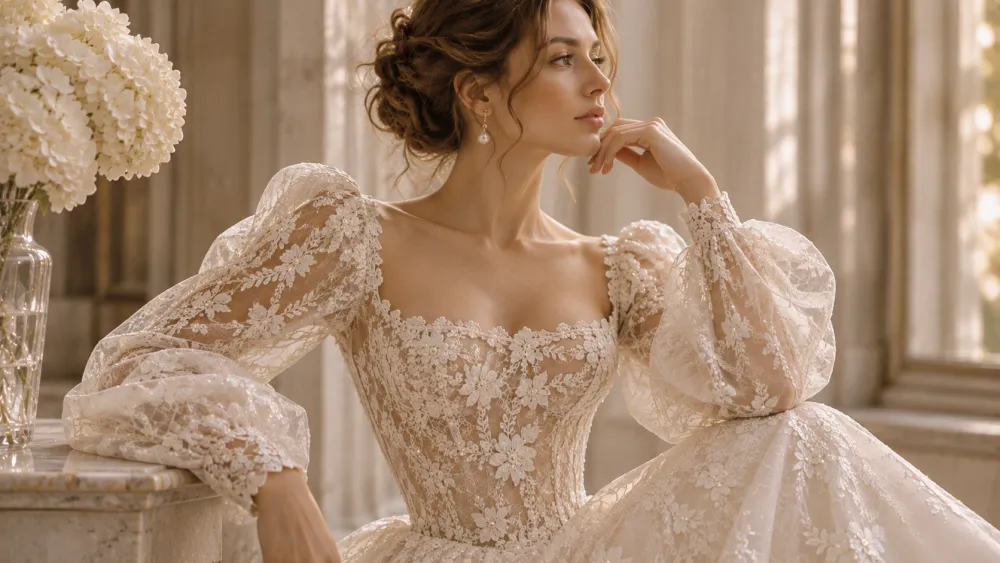
The Art of Bridal Sleeves
From delicate lace sleeves to dramatic sculptural shapes, sleeves can change the proportions, character and entire visual identity of a wedding dress.
Consider two identical wedding dresses. Both feature the same fitted bodice, the same beautifully constructed skirt and the same luxurious fabric.
Now add long lace sleeves to one and oversized sculptural sleeves to the other.
Suddenly, they become two entirely different designs.
Wedding dress sleeves are far more than an additional piece of fabric. They influence proportion, movement, structure and the overall aesthetic of a bridal gown.
Or completely redefine it.
1. Long Sleeve Wedding Dresses
Long sleeves are among the most recognisable features of traditional bridal fashion, although contemporary interpretations can feel remarkably modern.
They may be constructed from lace, embroidered tulle, crepe, satin or other fabrics, each producing a different visual effect.
Fitted long sleeves create a continuous line from the shoulder to the wrist, while looser versions introduce softness and movement.
The relationship between the sleeve and the bodice is particularly important. A beautifully fitted sleeve should follow the arm without pulling the neckline or restricting movement.
Signature look: Elegant coverage, elongated lines and a refined bridal silhouette.
2. Off-the-Shoulder Wedding Dress Sleeves
Off-the-shoulder sleeves sit below the natural shoulder line, leaving the shoulders and collarbones exposed.
They can be softly draped, fitted, gathered or constructed into more dramatic shapes.
In traditional ball gowns, off-the-shoulder sleeves often create a romantic, portrait-like neckline.
Contemporary designers also use them to introduce architectural folds, oversized fabric details and unexpected proportions.
Because these sleeves sit below the shoulder, their construction may limit how freely the arms can be raised.
Signature look: An open neckline with soft, romantic or sculptural framing.
3. Puff Sleeve Wedding Dresses
Puff sleeves create volume through gathering, pleating or carefully shaped fabric.
The fullness may be concentrated around the shoulder, distributed throughout the sleeve or gathered near the cuff.
Depending on the proportions, puff sleeves can reference historical fashion, romantic dressmaking or contemporary couture.
Small puff sleeves introduce a delicate decorative detail. Exaggerated versions can become the dominant feature of the gown.
Signature look: Rounded volume, romantic proportions and a distinctive shoulder silhouette.
4. Bell Sleeve Wedding Dresses
Bell sleeves are relatively fitted near the upper arm before widening towards the wrist.
The flare may be subtle or dramatically exaggerated.
Soft fabrics such as chiffon and lightweight lace create fluid movement, while more structured textiles produce a stronger architectural effect.
Bell sleeves can introduce beautiful movement into otherwise simple wedding dresses.
Signature look: A widening sleeve silhouette with graceful movement.
5. Cap Sleeve Wedding Dresses
Cap sleeves extend slightly beyond the shoulder without covering much of the upper arm.
They can be integrated into the bodice or constructed as separate sleeve pieces.
In lace wedding dresses, cap sleeves often provide a delicate transition between the neckline and the shoulder.
Structured cap sleeves can also create a sharper, more tailored appearance.
Signature look: Minimal shoulder coverage with a clean, understated finish.
Proportion Is Everything.
A dramatic sleeve changes the visual balance of the entire gown.
The wider the shoulder detail, the more important the relationship between the bodice, waist and skirt becomes.
6. Bishop Sleeve Wedding Dresses
Bishop sleeves are typically fuller through the arm and gathered into a fitted cuff at the wrist.
They create volume without necessarily adding substantial width at the shoulder.
Sheer tulle, chiffon and lightweight embroidered fabrics are particularly effective because they allow the sleeve to move softly.
The result can feel romantic, historical or contemporary depending on the fabric and accompanying silhouette.
Signature look: Soft fullness gathered into a defined wrist cuff.
7. Illusion Sleeve Wedding Dresses
Illusion sleeves use transparent or semi-transparent fabrics to create the appearance of decoration resting directly against the skin.
Fine tulle or mesh often provides the foundation for lace appliqués, embroidery, beads or delicate floral motifs.
The visual effect depends on the transparency of the base fabric and how carefully decorative elements are positioned.
Well-executed illusion sleeves can appear remarkably delicate despite containing considerable technical construction.
Signature look: Sheer coverage with floating lace or embroidery.
8. Detachable Wedding Dress Sleeves
Detachable sleeves allow a bridal gown to change its appearance without requiring an entirely separate dress.
They may attach to the bodice using concealed fastenings or be designed as independent pieces worn around the arms.
Some create the appearance of a traditional long-sleeved gown. Others function as decorative accessories with dramatic volume.
The attachment method is important because detachable sleeves must remain secure without pulling or distorting the neckline.
Signature look: A transformable bridal design with multiple styling possibilities.
9. Juliet Sleeve Wedding Dresses
Juliet sleeves combine fullness near the shoulder with a more fitted section extending down the arm.
The style takes inspiration from historical and theatrical costume traditions, particularly romantic interpretations of Renaissance fashion.
In bridal design, Juliet sleeves can introduce a distinctive period-inspired character without requiring an entirely historical silhouette.
Delicate fabrics and restrained proportions can make the effect surprisingly contemporary.
Signature look: A rounded upper sleeve transitioning into a fitted lower section.
10. Flutter Sleeve Wedding Dresses
Flutter sleeves are short, loose sleeves designed to move softly around the upper arm.
They are often constructed from lightweight materials such as chiffon, tulle or delicate lace.
Unlike structured cap sleeves, flutter sleeves emphasise movement rather than definition.
They can soften a fitted bodice or complement a romantic A-line silhouette.
Signature look: Light, flowing fabric with delicate movement.
Wedding Dress Sleeve Styles Compared
Creates a continuous, elegant line with a more defined silhouette.
Adds volume around the shoulders and changes the gown’s proportions.
Introduces fluid movement and decorative fullness through the arms.
Combines delicate coverage with embroidery, transparency and texture.
How Sleeve Fabric Changes the Design
The same sleeve pattern can produce dramatically different results depending on the material.
Organza can create crisp, lightweight volume. Chiffon produces fluid movement. Lace introduces texture and decorative detail.
Structured satin or mikado can support dramatic sculptural shapes, while fine tulle allows the sleeve to appear almost weightless.
The fabric must also work with the intended construction. A design that looks effortless in lightweight chiffon may behave very differently when recreated in a heavier textile.
In bridal design, the sleeve’s shape and fabric are inseparable decisions.
Beautiful Sleeves Need Beautiful Construction.
The most elaborate sleeve in the world loses its appeal if it pulls the bodice out of position.
Armholes, shoulder placement, lining and fabric weight all contribute to how successfully a sleeve works with the gown.
Can Sleeves Be Added to a Strapless Wedding Dress?
Often, although the possibilities depend on the gown’s construction.
Decorative off-the-shoulder sleeves may be relatively straightforward to introduce when the bodice can support the attachment.
Adding fully fitted sleeves is more complicated because the gown may need a redesigned shoulder area, additional support or substantial alterations to the neckline.
A strapless bodice is not automatically constructed to accommodate the movement and tension created by attached sleeves.
For some designs, detachable sleeves provide a more practical alternative.
Can Wedding Dress Sleeves Be Removed?
In many cases, yes.
However, removing sleeves may expose unfinished armholes, alter the neckline or affect the bodice’s support.
Some sleeves are purely decorative, while others contribute to the structure of the dress.
An experienced bridal alterations specialist should evaluate the construction before recommending changes.
Why Sleeve Placement Matters
The position where a sleeve joins the bodice influences the appearance of the shoulders, neckline and upper body.
A slightly extended shoulder line can create a broader, more architectural silhouette.
A narrow, carefully positioned sleeve can produce a softer and more delicate effect.
Off-the-shoulder designs introduce an entirely different visual relationship between the arms and neckline.
These differences may appear subtle on a hanger but become immediately noticeable when the gown is worn.
What Makes a Wedding Dress Sleeve Well Constructed?
The sleeve follows the intended shoulder and armhole position without distorting the bodice.
Gathering, pleating and structural elements create the intended shape consistently.
The sleeve allows appropriate movement without excessive pulling or restriction.
Seams, cuffs, lace edges and attachment points are carefully executed.
Which Wedding Dress Sleeve Style Is Best?
There is no universally superior sleeve style.
Long fitted sleeves offer a refined, continuous silhouette. Puff sleeves create dramatic proportions. Bell and bishop sleeves introduce movement, while illusion sleeves allow designers to explore transparency and intricate decoration.
Detachable sleeves offer an additional possibility: changing the visual character of the gown without replacing it.
The strongest designs consider the sleeves as part of the complete silhouette rather than an accessory added at the end.
It changes the way we see it.
The Final Word
Wedding dress sleeves reveal how much design can be concentrated into a relatively small part of a garment.
A change in length, fabric, volume or shoulder placement can transform a familiar silhouette into something entirely different.
From delicate illusion lace to extravagant sculptural shapes, bridal sleeves offer designers extraordinary creative possibilities.
And when beautifully constructed, they become much more than a detail. They become part of the dress’s identity.
Tips & Tricks
View All Tips & Tricks


The Fashion Brides is an independent editorial publication. Third-party images remain the property of their respective rights holders. For image credits, copyright concerns or removal requests, please see our Editorial & Copyright Policy .
