
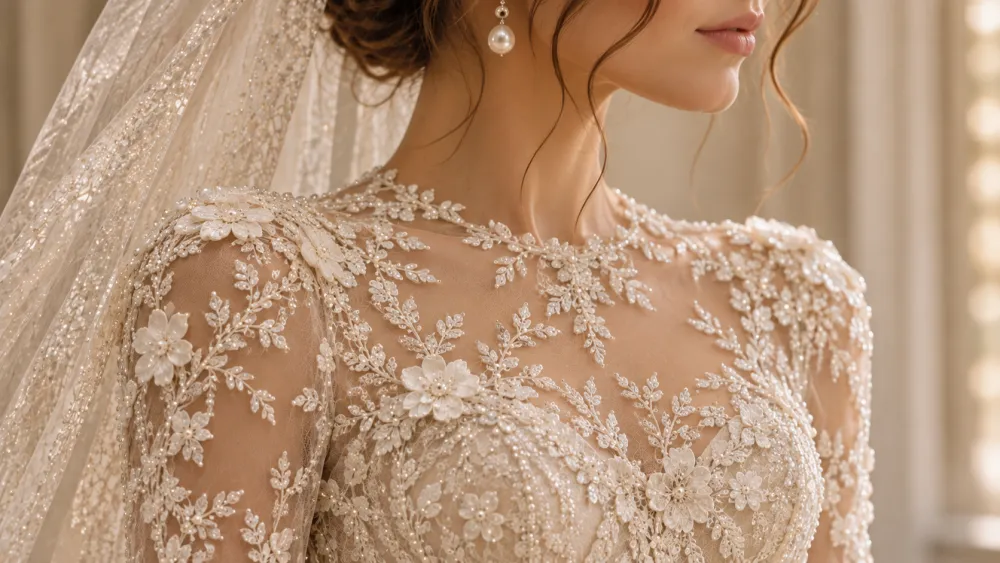
The Details That Make a Wedding Dress Extraordinary
Thousands of tiny beads. Delicately embroidered pearls. Crystals that catch the light with every movement. Discover the craftsmanship behind bridal embellishments.
Some wedding dresses make an impression through their silhouette. Others rely on extraordinary fabrics, intricate construction or beautifully controlled proportions.
And then there are gowns where the smallest details become the main attraction.
A scattering of pearls across a corset. Thousands of beads arranged into elaborate patterns. Crystals carefully positioned to catch the light without overwhelming the design.
Bridal embellishment is an art of precision, texture and placement.
What Are Wedding Dress Embellishments?
Wedding dress embellishments are decorative elements added to a gown’s fabric or construction to create texture, dimension, pattern or light reflection.
They can be applied by hand, machine or through a combination of techniques.
Common bridal embellishments include beads, sequins, pearls, crystals, embroidery, appliqués and three-dimensional fabric flowers.
While some are purely decorative, others help define the visual structure of a gown by emphasising seams, waistlines, necklines or particular areas of the silhouette.
1. Beaded Wedding Dresses
Beading is one of the most versatile decorative techniques in bridal fashion.
Small beads can be arranged into delicate floral patterns, geometric designs, intricate borders or dense decorative surfaces.
Depending on their size, shape and finish, beads can create anything from subtle texture to dramatic sparkle.
Seed beads are particularly useful for fine decorative work, while larger beads can introduce stronger visual definition.
Signature effect: Texture, intricate pattern and controlled light reflection.
2. Pearl-Embellished Wedding Dresses
Pearls bring a distinctive softness to bridal embellishment.
Unlike highly reflective crystals, pearl-like beads usually create a more diffused, luminous effect.
Designers may scatter them across sheer tulle, arrange them into decorative borders or use them to emphasise floral embroidery.
They are especially effective on minimalist gowns, where a restrained arrangement can introduce texture without disrupting the silhouette.
Many pearl-embellished wedding dresses use imitation pearls rather than natural or cultured pearls.
Signature effect: Soft luminosity, dimensional texture and understated elegance.
3. Crystal Wedding Dresses
Crystals are selected primarily for their ability to reflect and refract light.
Faceted crystal embellishments can create intense sparkle, particularly under directional lighting.
They may be sewn individually, incorporated into embroidered motifs or applied as part of larger decorative arrangements.
The visual effect depends on the crystal’s cut, size, colour, placement and surrounding fabric.
A few carefully positioned crystals can create a subtle shimmer. Dense crystal embellishment can transform a gown into a dramatic statement piece.
Signature effect: Brilliant sparkle and strong light reflection.
4. Sequin Wedding Dresses
Sequins are thin decorative discs that reflect light from their surfaces.
They can be sewn individually or incorporated into embroidered fabrics and decorative patterns.
In bridal design, sequins are frequently combined with beads or embroidery to create layered textures.
Clear, ivory and translucent sequins can produce a delicate shimmer, while metallic finishes create a more pronounced effect.
Signature effect: Surface shimmer, movement and reflective texture.
5. Embroidered Wedding Dresses
Embroidery uses threads to create decorative patterns on a fabric foundation.
It can be executed by hand or machine, with techniques ranging from fine linear details to dense, raised motifs.
Bridal embroidery frequently incorporates flowers, leaves, geometric patterns and decorative borders.
Some embroidery is entirely thread-based, while other designs combine stitching with beads, sequins or crystals.
Signature effect: Pattern, texture and intricate decorative detail.
More Embellishment Doesn’t Always Mean Better Design.
Thousands of crystals cannot rescue poor proportions or careless construction.
The most successful embellishment works with the silhouette, fabric and structure of the gown rather than competing against them.
6. Three-Dimensional Floral Embellishments
Three-dimensional flowers are created using layers of fabric, embroidery, lace or other decorative materials.
Unlike flat embroidery, these elements extend beyond the surface of the gown.
They can be used sparingly to highlight a neckline or arranged densely across a skirt to create an elaborate botanical effect.
Materials such as organza, tulle and silk can produce delicate petals with different levels of transparency and structure.
Signature effect: Sculptural texture, depth and romantic movement.
7. Bridal Appliqués
Appliqué involves attaching decorative fabric shapes or motifs to a separate foundation.
In bridal fashion, lace appliqués are particularly common.
Designers may position individual flowers or decorative patterns across a corset, sleeves or skirt to create a continuous visual composition.
Carefully placed appliqués can also soften seam lines and create the illusion that decorative motifs are growing naturally across the gown.
Signature effect: Layered decoration and precise pattern placement.
8. Metallic Thread Embroidery
Metallic threads introduce reflective detail without relying entirely on crystals or sequins.
Gold, silver and other metallic finishes can be incorporated into embroidered patterns, borders or decorative motifs.
The result may range from subtle highlights to elaborate, richly textured designs.
Metallic embroidery can be particularly striking when combined with ivory or champagne fabrics.
Signature effect: Refined metallic highlights and decorative richness.
How Bridal Embellishments Compare
Soft luminosity and dimensional texture with relatively gentle light reflection.
Brilliant sparkle, particularly under direct or directional lighting.
Surface shimmer that changes as the fabric moves.
Decorative patterns created through threadwork, with or without additional embellishment.
Hand-Beaded vs Machine-Embellished Wedding Dresses
Hand embellishment allows artisans to position individual decorative elements with considerable control.
This can be particularly valuable when working around curved seams, complex motifs or delicate fabrics.
Machine embroidery and embellishment techniques, however, can also produce sophisticated and highly detailed results.
The distinction isn’t simply between good and bad craftsmanship.
Quality depends on the design, materials, execution and finishing rather than whether every decorative element was attached by hand.
Handwork can increase labour requirements, but machine production isn’t automatically inferior.
Why Are Heavily Embellished Wedding Dresses Expensive?
Elaborate embellishment can involve substantial material and labour costs.
Complex designs may require extensive pattern development, careful motif placement and many hours of decorative work.
Additional construction may also be necessary to support the weight of heavy embellishments.
However, price depends on more than the number of beads or crystals.
Material quality, production methods, designer positioning and the complexity of the overall gown all influence the final cost.
Does Embellishment Make a Wedding Dress Heavier?
It can.
Dense beading, crystals and layered decorative elements add weight to the underlying fabric.
On a fitted bodice, this may require additional structural support. On a skirt, heavy embellishment can change how the fabric hangs and moves.
Designers must balance decorative ambition with the practical behaviour of the garment.
A beautifully embellished dress should remain wearable, not simply impressive on a mannequin.
Decoration Should Have a Purpose.
A pearl can soften a neckline. A crystal can draw attention to a particular detail. Embroidery can follow the natural lines of a silhouette.
The finest embellishment doesn’t simply cover a wedding dress. It becomes part of its design.
How to Recognise Quality Bridal Embellishment
Beads, crystals and decorative elements are properly secured to the fabric.
Decorative patterns appear deliberate, with minimal loose threads or irregular attachment.
Embellishments complement the silhouette and follow the intended design lines.
The underlying material supports the decoration without excessive pulling or distortion.
How to Care for an Embellished Wedding Dress
Heavily embellished gowns require careful handling.
Beads and crystals can catch on delicate fabrics, while raised embroidery and three-dimensional flowers may be vulnerable to crushing or snagging.
Follow the designer’s care instructions and consult a specialist cleaner experienced with bridal garments.
Avoid assuming that a gown can be safely steamed, pressed or cleaned using methods suitable for ordinary clothing.
Storage should also account for the weight of the dress. Heavy gowns may need additional support to prevent stretching or distortion.
Which Wedding Dress Embellishments Are Best?
There isn’t one universally superior decorative technique.
Pearls offer softness. Crystals create brilliance. Embroidery introduces intricate pattern, while three-dimensional flowers add sculptural texture.
The most successful choice depends on the silhouette, fabric and overall design.
A minimalist gown may need only a delicate scattering of pearls. An elaborate couture creation might combine several techniques into a richly detailed composition.
They reward it.
The Final Word
Bridal embellishment is much more than adding sparkle to a wedding dress.
It involves understanding texture, light, proportion, construction and the relationship between decoration and fabric.
From delicate pearl embroidery to elaborate crystal arrangements, each technique offers a different way to transform a gown.
And sometimes, the smallest details reveal the greatest amount of craftsmanship.
Tips & Tricks
View All Tips & Tricks


The Fashion Brides is an independent editorial publication. Third-party images remain the property of their respective rights holders. For image credits, copyright concerns or removal requests, please see our Editorial & Copyright Policy .
