
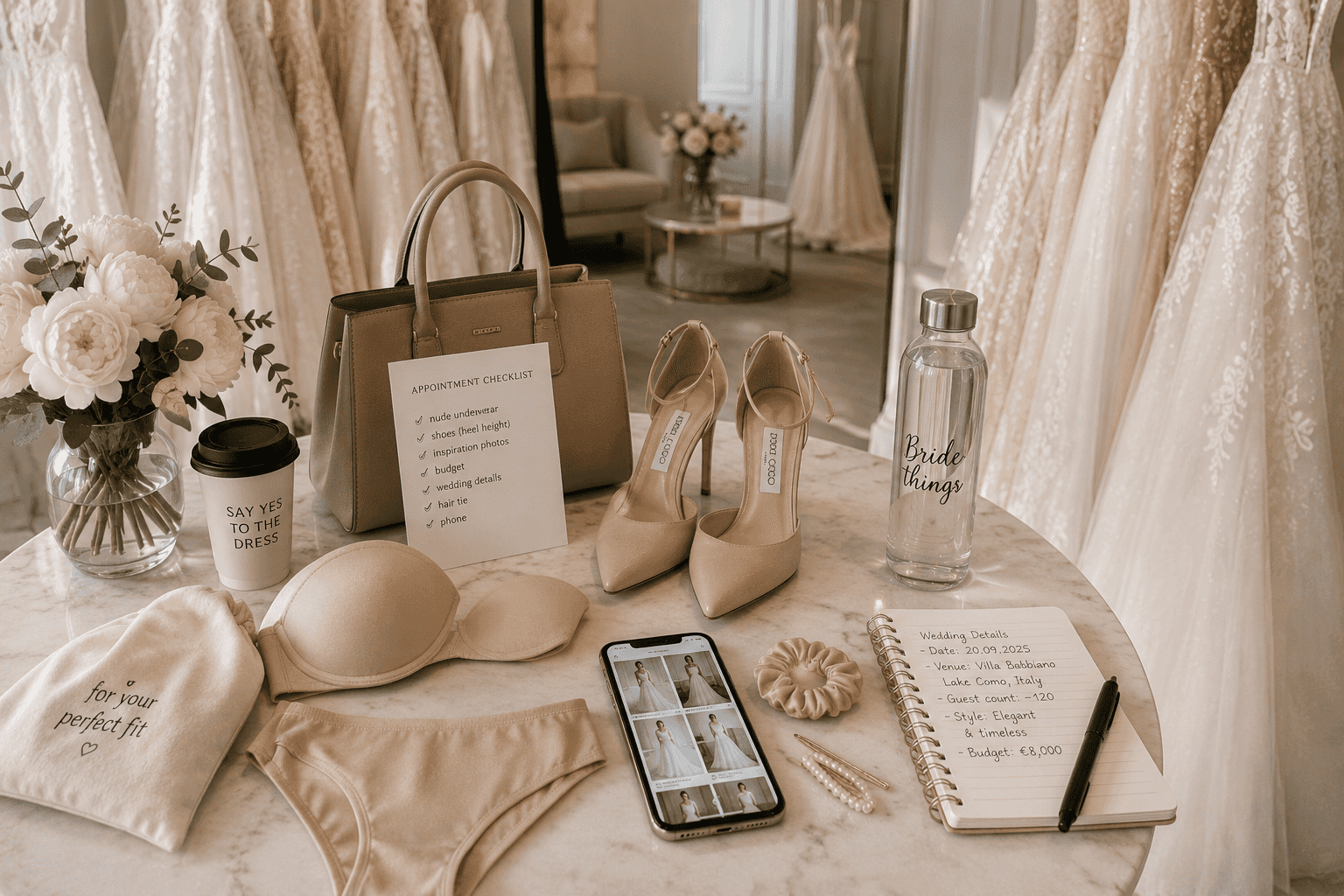
Your first wedding dress appointment is booked. You have saved approximately 400 dresses to your phone, investigated every designer you can find and possibly developed very strong opinions about necklines you had never thought about before getting engaged.
Now, what do you actually need to bring?
The good news is: not very much.
A bridal boutique will provide the wedding dresses, fitting assistance and usually most of what you need to understand how a gown will look. But bringing a few carefully chosen things can make the appointment considerably easier — and help you judge each dress more accurately.
Wear Nude, Seamless Underwear
You do not need to arrive wearing elaborate bridal lingerie.
Simple, comfortable, seamless underwear in a shade close to your skin tone is usually the most practical option.
Wedding dresses can be made from surprisingly unforgiving fabrics, particularly crepe, silk and lightweight satin. Bright colours, heavy seams and textured underwear may show through some gowns and distract from the actual fit.
A thong is not mandatory. Shapewear is not mandatory. Wear whatever allows you to feel comfortable while changing repeatedly in a fitting room.
Do You Need to Bring a Bra?
Probably not.
Many wedding dresses have built-in cups, corsetry, boning or enough internal structure that they are designed to be worn without a traditional bra.
A regular bra can actually make it more difficult to see how certain gowns are supposed to sit, particularly with strapless, backless, illusion or plunging necklines.
If you know you want additional support, however, bring the type of undergarment you are considering and discuss it with your stylist.
The important thing is not to purchase expensive bridal lingerie before choosing your dress. The gown determines the underwear — not the other way around.
Bring Shoes With a Similar Heel Height
You do not need to have your wedding shoes before your first bridal appointment.
But if you already know approximately how high your heels will be, bringing shoes with a similar heel height can help you understand the proportions of the dress.
This is particularly useful when considering fitted silhouettes, dramatic trains or gowns where the waist and skirt proportions change noticeably with height.
If you normally wear flats and plan to wear flats on your wedding day, there is no reason to spend the appointment standing in stilettos.
Bring something representative of what you are actually likely to wear.
Bring Your Wedding Shoes If You Already Have Them
If you have already bought your wedding shoes, bring them.
You may not need them for every dress you try, but they can be useful when you begin seriously considering a particular gown.
Your exact shoes become especially important later during alterations, when the hem of the dress will be adjusted to the correct length.
Bring Inspiration Photos — But Edit Them First
Showing your stylist a few wedding dresses you genuinely love can be extremely helpful.
Showing them 247 screenshots is less useful.
Before your appointment, choose approximately five to ten images that best represent what attracts you.
They do not all need to look identical.
Perhaps one has the neckline you love, another has the perfect skirt and a third captures the overall mood you want. Your stylist can use those images to identify recurring elements in your preferences.
It is also helpful to explain why you saved each dress.
“I love the neckline” gives considerably more information than simply handing over your phone.
Know Your Wedding Details
You do not need to have planned every flower arrangement before shopping for your dress.
However, a few basic details can help your stylist recommend appropriate gowns.
- Your wedding date
- The season
- The venue or general type of venue
- Whether the ceremony is indoors or outdoors
- Your approximate level of formality
- Any religious or cultural dress requirements
A September city wedding and a July ceremony on a Mediterranean beach may lead to very different practical considerations, even if the bride’s personal style remains exactly the same.
Know Your Wedding Dress Budget
You should have an approximate budget before your appointment.
More importantly, tell the boutique what it is.
A good stylist needs that information to show you gowns you can realistically purchase.
Trying on a dress far beyond your budget may seem harmless, but falling in love with a gown you cannot comfortably afford can make everything else feel like a compromise.
Also ask what the quoted dress price includes.
Alterations, veils, accessories, customization and rush fees may all be separate expenses.
Bring the Right People
Your entourage technically counts as something you bring to the appointment — and it may influence the experience more than anything in your handbag.
Choose people whose opinions you trust and who understand your taste.
Wedding dress shopping becomes difficult very quickly when five people are trying to dress five different imaginary brides.
Your mother may envision a romantic lace ball gown. Your best friend may prefer minimalist silk. Your sister may suddenly develop a passionate objection to sleeves.
None of them are wearing the dress.
A small group of supportive people is usually more useful than a large audience.
Bring Hair Ties or Clips
This is a tiny thing that can make a surprising difference.
If you are considering high necklines, detailed backs, statement shoulders or veils, being able to quickly put your hair up can help you see the dress properly.
You do not need to recreate your wedding hairstyle.
A simple clip or hair tie is enough to change the overall proportions and reveal details that would otherwise be hidden.
Consider Your Hair and Makeup
You do not need professional hair and makeup for a bridal appointment.
But arriving in a way that makes you feel reasonably polished can sometimes make it easier to imagine the complete look.
If you normally wear makeup, wear your normal makeup. If you rarely wear it, there is no need to create an entirely different face for wedding dress shopping.
Be careful with heavy foundation, lipstick or body makeup that could transfer onto delicate samples.
Bring Any Important Accessories You Already Own
If you already know you will wear a particular family veil, piece of jewellery or meaningful accessory, bring it if practical.
This is especially useful if the item will influence your dress choice.
An heirloom veil with elaborate lace, for example, may look very different with a heavily embellished gown than with a simple satin dress.
You do not need to bring every possible accessory to your first appointment. Only bring pieces that are already part of the plan.
Bring Shapewear Only If You Actually Want to Wear It
You do not need shapewear to try on wedding dresses.
And you certainly do not need to decide that you will wear it simply because you are shopping for a wedding dress.
If shapewear is something you regularly wear and feel comfortable in, bring it.
If you are considering it for a particular fitted gown, you can experiment later once you understand the construction of the dress.
Many structured wedding gowns already provide considerable shaping through corsetry and internal support.
Should You Bring a Veil?
Unless you already own a specific veil you intend to wear, no.
Bridal boutiques generally have veils available to help you visualize the complete look.
Once you have narrowed down your dress choices, trying a veil can be surprisingly useful. It changes the overall proportions and can make a gown feel very different.
But there is no need to purchase a veil before finding the dress it needs to accompany.
Bring Your Phone
This sounds obvious, but your phone can be one of the most useful tools during the appointment.
Use it for your inspiration images, notes and — if the boutique allows photography — pictures or short videos of your favourite dresses.
A short video of yourself walking in a gown can sometimes tell you more than a static photograph.
You can see how the skirt moves, how the train behaves and whether you naturally move comfortably in the dress.
Always ask whether photography is permitted before taking pictures.
Bring an Open Mind
This is perhaps the only wedding dress shopping cliché worth keeping.
You should absolutely arrive with preferences. Knowing your taste makes the appointment more efficient.
But bridal gowns can behave very differently on the body than they do in photographs.
If your stylist suggests one dress outside your original plan and can explain why, try it.
You are allowed to hate it.
You are also allowed to discover that the dress you said you would never wear is suddenly the most interesting gown in the room.
What You Do Not Need to Bring
Wedding dress appointments already involve enough decisions. There is no reason to arrive carrying half your wedding wardrobe.
You generally do not need:
- Your final wedding shoes if you have not chosen them yet
- A special bridal bra
- Expensive new shapewear
- Your wedding jewellery
- A veil you purchased simply for the appointment
- Your entire bridal party
- A perfectly finalized wedding aesthetic
Most of these decisions become easier after you have chosen the dress.
The Simplest Wedding Dress Appointment Checklist
If you want the short version, bring:
- Nude, comfortable underwear
- Shoes in approximately your planned heel height
- A small selection of inspiration images
- Your approximate budget
- Your basic wedding details
- A hair tie or clip
- Your phone
- One or two people whose opinions you genuinely trust
Everything else is optional.
You are going to a wedding dress appointment to discover what you want — you do not need to arrive already dressed like a bride.
Tips & Tricks
View All Tips & Tricks


